
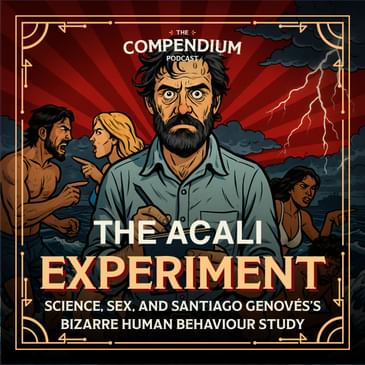
In this episode of the Compendium, we explore the Acali Experiment—a 1973 voyage where anthropologist Santiago Genovés set sail with ten strangers to study human behavior. Dubbed the "Sex Raft" by the media, his 101-day Atlantic crossing aimed to investigate the roots of violence and sexuality. Despite Genovés's attempts to incite conflict, the crew's resilience challenged his expectations. This journey not only questioned scientific ethics but also inspired discussions on human nature and peace.
We give you just the Compendium, but if you want more, here are our resources:
- "Mutiny on the Sex Raft” - The Guardian
- "The Raft Tells Of Sex, Chaos And Mutiny In A Crazy 1973 Social Experiment" - Forbes
- "The Raft Chronicles an Extreme Experiment with Human Nature" - The New Yorker
- "The Seville Statement on Violence" - Wikipedia
- "Acali" - Wikipedia
-
“The Raft (2018)" - Documentary by Marcus Lindeen
- Hosts: Kyle Risi & Adam Cox
- About: Kyle and Adam are more than just your hosts, they’re your close friends sharing intriguing stories from tales from the darker corners of true crime, the annals of your forgotten history books, and the who's who of incredible people.
- Intro Music: Alice in dark Wonderland by Aleksey Chistilin
- ⭐ Review & follow on: Spotify & Apple Podcasts
- 📸 Follow us on Instagram: @theCompendiumPodcast
- 🌐 Visit us at: TheCompendiumPodcast.com
- ❤️ Early access episodes: Patreon
[00:00:01] - [Speaker 0]
For the documentary, they build a wooden replica of the original craft, and so all the survivors can come along and they can walk around it. They reminisce about kind of their experience. They're pointing out where their sleeping bags were positioned and, of course, how they would poop over the edge of the raft.
[00:00:16] - [Speaker 1]
And the fact that they did it there and there and there and there and there.
[00:00:20] - [Speaker 0]
This is where doctor Edna goes, how many people did you sleep with? And she's like, many. Many. Many. Everybody.
[00:00:26] - [Speaker 1]
Including the fish.
[00:00:53] - [Speaker 0]
Welcome to the Compendium, an assembly of fascinating things, a weekly variety podcast that gives you just enough information to stand your ground at any social gathering.
[00:01:03] - [Speaker 1]
We explore stories from the darker corners of true crime, the hidden gems of history, and the jaw dropping deeds of extraordinary people.
[00:01:10] - [Speaker 0]
I am Kyle Reese, your ringmaster for this week's episode.
[00:01:13] - [Speaker 1]
And I'm Adam Cox, the in house coroner for this week's episode.
[00:01:17] - [Speaker 0]
My god. We need an in house coroner. That doesn't look good for our glass door reviews. People keep dying.
[00:01:25] - [Speaker 1]
Well, yeah, that and the animals. It's it's a lot a lot of death in the circus.
[00:01:29] - [Speaker 0]
The busiest person is the coroner. Yep. Before we dive in, a quick heads up to all of our lovely freaks out there. Remember that signing up to our Patreon as a free member will get you early access to next week's episode and the entire seven days before anyone else.
[00:01:43] - [Speaker 1]
And if you want even more, then consider becoming a certified freak for a small monthly subscription. It will unlock all of our unreleased episodes up to six weeks earlier, plus brand new, never heard before, and straight off the press.
[00:01:55] - [Speaker 0]
We are expanding our Patreon benefits even further because now you can have access to all of our vintage compendium episodes from season one. These are the episodes from back in the day when we're first getting started. Now they're exclusively available to all of our Patreon members.
[00:02:09] - [Speaker 1]
Yep. There's just so much content for you to get stuck into, and we'll be adding even more exclusive episodes for Patreon members as the weeks go on. So signing up for as little as $3 is literally the best way that you can support the show.
[00:02:20] - [Speaker 0]
And, of course, depending on the tier that you choose, we've got some exclusive merch to send your way. We are sending out all of our certified members an exclusive compendium key chain so we can always be with you wherever you are. As Adam always likes to say
[00:02:33] - [Speaker 1]
Always near your crotch.
[00:02:34] - [Speaker 0]
Always near your crotch. This is a brand new benefit for all of our certified freak team members as a special thank you for supporting us over all these months. If you are an existing member, just send us a DM with your address, and we'll ship one out to you. And I promise you, no matter where you are in the world, even if there are tariffs involved, we will cover the costs.
[00:02:52] - [Speaker 1]
We'll get to you. And while you're at it, don't forget to follow us on your favorite podcast app and leave us a review. Your support helps us reach even more people who, like you, love a good tale of the unexpected.
[00:03:03] - [Speaker 0]
Alright, freaks. Enough of the housekeeping. Let's buckle up and get today's show started because, Adam, today on the Compendium, we are diving into an assembly of ocean bound strangers, sexual tension, and a scientific meltdown.
[00:03:19] - [Speaker 1]
Yeah. I've got nothing. What what is this about?
[00:03:22] - [Speaker 0]
Today's episode has actually been one of the most requested episodes by our listeners to the point that I just couldn't ignore it anymore. And, honestly, it has made me question whether or not our certified freaks are in fact perverts.
[00:03:37] - [Speaker 1]
I'm sure a few of them are.
[00:03:38] - [Speaker 0]
But the thing is I have to admit, this realization, I didn't quite grasp it until I actually sat down and finished the research for this episode. So I've caved. I have delivered. And so today, I am serving you the wild story of the 1973 Akali experiment.
[00:03:56] - [Speaker 1]
Ah, yes. I have seen this requested a few times. Although, to be honest, I don't really know too much about this.
[00:04:02] - [Speaker 0]
Did you know there was a sexual element to this?
[00:04:04] - [Speaker 1]
No. So do we need to tell our parents to stop listening?
[00:04:06] - [Speaker 0]
Yeah. If you have any kids, then you can stop listening. No. I'm joking. We're not gonna get into anything graphic.
[00:04:11] - [Speaker 0]
Okay. Because it's not as people think. That's the key about the story. But, anyway, basically, the Ikali was a social study led by Mexican anthropologist Santiago Genovej. We're just gonna call him Santiago.
[00:04:23] - [Speaker 0]
You know how terrible I am with names. But Santiago's initial hypothesis was that human violence was an inherent trait influenced by sexual competition, which he drew from kind of observations of primates, where he basically noticed that their conflicts often arose around access to ovulating females.
[00:04:42] - [Speaker 1]
So what you're saying is men will often fight in order to woo a woman.
[00:04:47] - [Speaker 0]
Exactly. So it's a very primal hypothesis. We are animals after all. Right? Mhmm.
[00:04:51] - [Speaker 0]
Santiago's thinking was that since human beings are primates too, a similar dynamic might exist in humans. So And he wanted to see if he could observe this, but to do that, he needed to confine a group of very attractive and diverse people together in an isolated environment with no distractions, thereby providing an insight into the roots of human conflict.
[00:05:14] - [Speaker 1]
Okay. So it's a bit like a social experiment that he's doing.
[00:05:16] - [Speaker 0]
Exactly. And the best way that he thought that he could isolate and confine these very, very attractive people for a long enough period of time to strip everything back to their raw psychology was to set them off on a raft in the middle of the Atlantic Ocean on a one hundred and one day voyage, and the raft was called the Akali. And what
[00:05:38] - [Speaker 1]
kind of a raft is this? Is this like a nice enough boat? Because this feels just a little bit dangerous.
[00:05:43] - [Speaker 0]
That was the point of the experiment. By adding this elements of danger, that would help strip back to their kind of their primal psychology. Uh-huh. But here's what's really interesting. As it starts to become apparent that humans, when given the choice, will actually just cooperate with one another with a very little fuss, Santiago starts to get desperate.
[00:06:01] - [Speaker 0]
He wants to really prove his hypothesis so badly that it begins to provoke conflict. And, basically, he manipulates situations amongst the crew, And spoiler alert, this does not work out very well for him, and so he ends up crumbling. It sounds like
[00:06:17] - [Speaker 1]
big brother at sea.
[00:06:18] - [Speaker 0]
It is unbelievable that they haven't actually made this. Even worse so, Santiago becomes so completely fixated on the sexual aspects of his theory that when the news of this bizarre voyage starts making headlines while the crew are still out in the middle of the Atlantic Ocean, unbeknownst to them, the Ecclesi experiment becomes branded by the media as sex raft.
[00:06:39] - [Speaker 1]
Oh, that sounds delightful. It it sounds actually really hot. But on a dinghy, though.
[00:06:45] - [Speaker 0]
It's not a dinghy. It's a raft.
[00:06:46] - [Speaker 1]
I feel like I need to see it. Is there any pictures?
[00:06:48] - [Speaker 0]
Yeah. Sure.
[00:06:50] - [Speaker 1]
Okay. Yeah. It looks sturdy enough. It kinda reminds me, you know, when you go on, like, a holiday around the islands?
[00:06:56] - [Speaker 0]
It's the booze cruise. Yes.
[00:06:59] - [Speaker 1]
Like some of those catamarans, which are just filled with people. Yeah. And you're like, that looks awful.
[00:07:03] - [Speaker 0]
And so the press were reporting us as this kind of orgy fueled voyage, where they just apparently just believed that the only science that was taking place on board was love.
[00:07:14] - [Speaker 1]
It's not like a doctor on board. I just wondered if people needed, I don't know, contraception, the morning after pill, or anything like this.
[00:07:20] - [Speaker 0]
I'll tell you what they did need. What? A lot of constipation.
[00:07:23] - [Speaker 1]
Oh god. It sounds horrendous.
[00:07:25] - [Speaker 0]
And the thing is though, it's not too far from the truth. They did have a lot of sex. Mhmm. But the story's a lot more interesting than just that. Yeah.
[00:07:34] - [Speaker 0]
There's poo involved. There is poo involved. So, Adam, today on the comedian, I'm gonna be telling you about the 1973 Akali experiment, a story that wasn't just a floating free for all of sex orgies, but also a daring social study of violence, isolation, and human cooperation, an aspect that in itself is genuinely fascinating. But sadly, one that the world quickly forgot because they just became transfixed on this idea that they were just having sex all the time. This is a story about how when given the choice, human beings would rather choose cooperation and peace over violence and war.
[00:08:06] - [Speaker 0]
But there are some other fascinating twists in a story. There's loads of irony. There's a savage shark butchery event. There's a mutiny plot and even a close shave with death. And at the heart of it, it's a story of how our assumptions about inherent human behavior can really surprise us.
[00:08:23] - [Speaker 0]
So there's so many layers to today's story. I'm really sorry for all of our pervert certified freaks out there who believe that this is just gonna be a sex story.
[00:08:33] - [Speaker 1]
So how did this all start then? Why did this guy wanna put together this experiment? How did he even recruit these people? Yeah. How did it happen?
[00:08:40] - [Speaker 0]
So, actually, it's a it's a great starting point because the scientist behind the Akali experiment was a guy called Santiago Genovei. He was born in Spain in 1923, but grew up mostly in Mexico where he eventually worked as an anthropologist at the National Autonomous University of Mexico. Here's a little bit of a backstory on Santiago and how he became the puppet master of the Akali. So in the nineteen seventies, Santiago actually teamed up with a very well known Norwegian adventurer named Thor Heyerdahl.
[00:09:10] - [Speaker 1]
What a great name.
[00:09:11] - [Speaker 0]
An amazing name, by the way. So Thor was already famous for his Kintiki experiment back in 1947 where he and his team set off from Peru crossing the Pacific Ocean to the Polynesian Islands with nothing but a wooden raft. Basically, he wanted to prove that an ancient group of sun worshiping blonde and redheaded Caucasians known as the Tiki people could have reached and colonized the Polynesian Islands in pre Columbian times. His full hypothesis was that the white race had reached Polynesia before the Polynesian people did, which is an interesting kind of hypothesis in itself.
[00:09:43] - [Speaker 1]
And did he prove this fact then?
[00:09:45] - [Speaker 0]
No. I mean, he did. He proved that as possible, but not that that was the case, that they'd colonized Polynesia. Right?
[00:09:52] - [Speaker 1]
Right. With you.
[00:09:53] - [Speaker 0]
Because overwhelmingly, this is completely rejected by researchers long before the expedition even began. And yet in spite of that, he still decided to go and try and prove it anyway. And the reason was rejected is pretty simple. If it was true, there'd be ancestral DNA evidence to back all this up. But the reality is there's no genetic link between the so called Tiki people and the Polynesian Islanders.
[00:10:12] - [Speaker 0]
Was he just, like, wanted a jolly and therefore was like, do
[00:10:14] - [Speaker 1]
you know what? Why don't we build this raft? We'll go sailing, and when it's all in the name of science?
[00:10:19] - [Speaker 0]
I wouldn't call that a jolly. Like, on a raft crossing the Pacific Ocean, one of the biggest oceans on the planet, I'd be terrified.
[00:10:26] - [Speaker 1]
Yeah. But this was, like, the forties, just after the war. True. Maybe this was a jolly.
[00:10:30] - [Speaker 0]
Maybe. In the end, they end up drifting for a hundred and one days, and they do actually eventually make it to the islands. After the expedition, Thor goes on to write a bestselling book, which later leads to an Academy Award winning documentary about the entire adventure. So he's a pretty big deal. But then in 1969, Thor, along with Santiago, decides that this time they wanted to prove that ancient Egyptians could have traveled across the Atlantic to the Caribbean Islands thousands of miles away on nothing but a boat made of papyrus.
[00:11:01] - [Speaker 1]
Isn't papyrus, like, reeds or paper or something like that?
[00:11:04] - [Speaker 0]
When I hear papyrus, I think paper.
[00:11:06] - [Speaker 1]
Yeah. Papyrus paper was made out of reeds.
[00:11:08] - [Speaker 0]
I did not know that. So it wasn't just a case of folding up some newspaper and putting it into the ocean.
[00:11:13] - [Speaker 1]
Yeah. I don't think that would ever work.
[00:11:15] - [Speaker 0]
No. But in my mind, when you hear papyrus, you think paper. So was there any
[00:11:19] - [Speaker 1]
DNA results or anything like that studies that made them think that that's what had happened?
[00:11:24] - [Speaker 0]
No. Not necessarily. Do you remember you watched that documentary that these ancient mariners from, like, Atlantis or something, it drifted off into different corners of the world and colonized these different areas, hence why there's pyramids on pretty much every single continent.
[00:11:38] - [Speaker 1]
Yeah. The ancient apocalypse. Yeah. And they would build these structures that would look at the stars, like the North Pole or whatever. And didn't they have, like, the same stories that they these people from all over the world which would pass down about these great floods and stuff like that.
[00:11:51] - [Speaker 1]
Correct.
[00:11:51] - [Speaker 0]
Yes. Now I'm not saying that this is anything connected, but it sounds very much like that because it's like this idea that ancient Egyptians or these mariners from the West had managed to get through to kind of South America or Mhmm. Whatever. So this boat, essentially, that they made out of kind of papyrus reeds is 40 feet long with a single v shaped mast and a square sail. So it could steer since it obviously had, like, an oar on the port side as well.
[00:12:14] - [Speaker 0]
So they build this boat. They call it the Ra after the Egyptian sun god. And when they finish, they set off from Morocco across the Atlantic with a small crew of seven. Only two of them have any sailing experience at all, which makes me question, like, why bring the other five? I don't get it.
[00:12:29] - [Speaker 0]
Are they just there for the jolly? Maybe your mate. Yeah. Entertainer. They've got a juggler on board.
[00:12:34] - [Speaker 0]
So after several weeks, they're almost at the end of their journey when the raft starts taking on water and the crew quickly discover that they had actually forgotten to install a tensioner, which is a very crucial element in these types of kind of straw boats, which prevents the hole from sagging and then eventually flooding.
[00:12:50] - [Speaker 1]
Rookie mistake. Always pack the tensioner.
[00:12:53] - [Speaker 0]
You need at least three of them on board. So, yeah, it's not great, especially when you're, like, hundreds of miles from land in the middle of the Atlantic. Luckily, they managed to radio through to Barbados. They get rescued by a passing yacht, and then the mission is sort of kinda successful. They make it, like, 98% of the way there.
[00:13:10] - [Speaker 1]
Yeah. But 98% is not completing the mission.
[00:13:12] - [Speaker 0]
Exactly. So it wasn't a slam dunk. So that's why the next year, Thor goes and tries again, this time with the Ra two, and this time he remembers to include the tensioner. They set off sail again from Morocco heading west across the Atlantic, and apart from a small minor mishap where they get lost triggering a massive United Nations search operation, they do actually make it all the way to Barbados. In the end, Thor proves that ancient Egyptian mariners could have crossed the Atlantic sailing along the Canary Current in a papyrus reed boat, essentially.
[00:13:43] - [Speaker 0]
That's not to say that they did, but that they could've.
[00:13:46] - [Speaker 1]
So I'm guessing he made this papyrus boat based on what they thought was possible for the Egyptians to have made at the time.
[00:13:53] - [Speaker 0]
It was based on actual historic ancient drawings of these types of boats that the Egyptians would've used. So following all of this, in 1972, Santiago is actually returning from a conference on violence in humans, which, of course, as we know, is his main area of study. On his way back to Mexico, his plane is hijacked by a gang of terrorists. And while the other passengers are all freaking out, Santiago himself is loving this. What person loves being hijacked?
[00:14:18] - [Speaker 0]
This is what he studies for a living. Right?
[00:14:20] - [Speaker 1]
Oh, so he just gets out his note, paper, and pen, go, this is great. This is great research.
[00:14:23] - [Speaker 0]
Checking down loads of notes. Later, he says this was too good to be true. He's getting hijacked and literally has a front row seat observing all this violence in real time. Eventually, though, the plane is heading to Cuba. I'm not sure whether or not there were any casualties, but Santiago himself, he's completely fine.
[00:14:38] - [Speaker 0]
And this is where he decides that he actually wants to recreate similar conditions in a controlled scientific environment where he could safely observe without the fear of being killed. He wants to understand what causes human violence and how do these behaviors manifest themselves.
[00:14:53] - [Speaker 1]
So this was his inspiration. Wow. This guy, I I don't know if I trust him.
[00:14:58] - [Speaker 0]
I think that's a running theme throughout this. He does become a bit of a dirtbag, but it's only through desperation. And we're gonna see why in a minute.
[00:15:05] - [Speaker 1]
Okay.
[00:15:06] - [Speaker 0]
And you've gotta remember, this was all happening at the time of the Vietnam War when that was in full swing. So you can sort of understand the backdrop in which this interest probably materialized within. So the plan was that he was gonna build a small boat, fill it with people from all around the world. He figures a boat would give the isolation and the stressful conditions that he needs, but most importantly, an environment that was completely inescapable with the potential of danger always being a factor.
[00:15:31] - [Speaker 1]
Yeah. That's a bit twisted. He's gonna be putting people's lives at risk.
[00:15:35] - [Speaker 0]
He is, but he needs to create a very specific set of circumstances or a situation. He believes that this kind of setting will strip people back to their raw authentic behaviors beyond the social roles and masks that we wear in everyday life, essentially.
[00:15:49] - [Speaker 1]
Couldn't he just, like, drop them in a jungle or something?
[00:15:52] - [Speaker 0]
He could have done, but he himself says that even in a remote desert, you can easily escape each other because you can just walk away. But on the Akali drifting in the middle of the Atlantic, test subjects will just not be able to escape each other. Basically, if he could pull this off, he believed he could finally answer the question, is violence something built into our genes, or is this something that we learn from the societies and cultures that we live in? So he starts to build this boat. It is basically a big steel raft, and he names it the Akali, which comes from the indigenous language of the Aztecs and other small groups of people living in Southern Mexico and Central America at the time.
[00:16:27] - [Speaker 0]
Basically, the word means house on the water. Okay. And by design, the raft is not big at all. It's about 40 feet long and about 12 feet wide. It's got a single tiny cabin about the size of one small bedroom, and so there is just no privacy on board.
[00:16:42] - [Speaker 0]
There is no motor on board, which means maneuvering in choppy conditions is almost impossible. The only propulsion that they have will be a single sail, making them completely reliant on the wind and the current. The plan was to set off from the Canary Islands off the coast of Northwest Africa and sail all the way to Mexico, which is about 4,000 miles in total, which is estimated to take them around three months.
[00:17:04] - [Speaker 1]
And so they have no beds. Am I right in saying that? Or they do they have, like, mattress on the floor or something? Sleeping bags. Sleeping bags.
[00:17:10] - [Speaker 1]
Okay. And they don't have running water, I'm guessing, or, a shower. So they're gonna stink. I don't care if they start out
[00:17:16] - [Speaker 0]
hot. Mhmm.
[00:17:17] - [Speaker 1]
Two months in, then they're not gonna be hot.
[00:17:19] - [Speaker 0]
If anything, it makes it even more attractive.
[00:17:21] - [Speaker 1]
Gross.
[00:17:21] - [Speaker 0]
And the thing is, while three months doesn't sound like a long time, sociologists say that given the confined space and the lack of privacy along with the lack of control and not being able to maneuver the boat at will, those three months would feel like the emotional equivalent of fifteen years on land.
[00:17:35] - [Speaker 1]
That sounds horrendous. It
[00:17:37] - [Speaker 0]
sounds awful. So the experiment was designed to condense what should feel like a lifetime of human interaction into a very short kind of window of time. And I don't know about you, but that is not something that I'm willing to sign up for, especially knowing that there's just no way off that boat.
[00:17:54] - [Speaker 1]
Are they getting paid for this as well? Mm-mm. No. No. No.
[00:17:57] - [Speaker 1]
No. So they are just doing it for the experience?
[00:17:59] - [Speaker 0]
That's right. So, basically, he really wants shit to kick off on this raft. He's literally designing the experiment so that conflict feels inevitable.
[00:18:09] - [Speaker 1]
Interesting. This is like Big Brother. Although that's a bit different, isn't it? Because they'd be like, oh, you know, there's 12 housemates, they would put 11 chairs out and then let them argue over it.
[00:18:18] - [Speaker 0]
I mean, he will do stuff like that. Uh-huh. But it is exactly like Big Brother. If he was a producer for Big Brother, he would instantly get the
[00:18:25] - [Speaker 1]
Interesting.
[00:18:25] - [Speaker 0]
But, also, the thing is that he's also supposed to be a real serious scientist. Right? So this doesn't really sound like how scientists are supposed to do science, does it? Everything feels very much orchestrated. In that, he's setting up to deliver a very specific outcome.
[00:18:38] - [Speaker 0]
He's looking to spark violence in people when the experiment is like, well, what causes violence to erupt? He is making it erupt.
[00:18:46] - [Speaker 1]
Yeah. Because you said something a little while ago about that he was trying to work out if violence is something we learn or we're born with it. But for me, there's an instant flaw with that because, one, these are adults that would probably have been exposed to violence already, so they would have already learned about violence. And two, he's putting them in a condition which is gonna cause anger and tension and everything like that. So therefore, I don't know, if you put them on, a floating five star resort that was going out to sea, maybe it'd be a bit different.
[00:19:14] - [Speaker 0]
Yeah. It doesn't really reflect the real world situation that we typically live in. It's very much manufactured. And I don't know if that's how they normally do science. I just I don't know, but it just feels off to me.
[00:19:25] - [Speaker 1]
But I'm still excited for this to kick off.
[00:19:27] - [Speaker 0]
I know. Right? So he needs a crew or test subjects. He launches a worldwide search to find 10 participants of all varying ethnic backgrounds, different religions, and social classes. The aim was to create a floating microcosm of people that he believed represented the entire world.
[00:19:42] - [Speaker 0]
Again, it's not really realistic. And while he doesn't overtly say this to potential applicants, one of the most important things that he is looking for is that they're all smoking hot. He figures that if he packs a raft full of attractive people from all over the world, you're going to ramp up the sexual tension amongst them. So he's literally thinking like a reality TV producer.
[00:20:02] - [Speaker 1]
Yeah. Is he so he's trying to create these relationships to happen, basically, these sparks. Mhmm. And then is he also trying to get people to perhaps get jealous of each other by doing this as well? 100%.
[00:20:13] - [Speaker 0]
Yeah. So he places several newspaper ads around the world which read exhibition leader looking for volunteers to sail on a raft across the Atlantic. Duration, three months. Males and females, preferably married, but participants without a spouse will be allowed. Ages 25 to 40, write a letter along with your CV.
[00:20:32] - [Speaker 0]
Applications will be kept confidential. So he wants them
[00:20:36] - [Speaker 1]
to be married but not travel with their partner. Mhmm. He wants them to be tempted in order to have an affair. Right?
[00:20:42] - [Speaker 0]
No. Basically, he believes that it will make it more difficult for them to be away from home, therefore fueling emotions and frustrations within those people. He thinks that if you miss your kids, you're more likely to rip off another boy's face.
[00:20:56] - [Speaker 1]
Okay.
[00:20:57] - [Speaker 0]
But this is hilarious to me because he's floating the idea that unmarried people couldn't possibly have anyone that they might miss.
[00:21:04] - [Speaker 1]
No. No. They So
[00:21:05] - [Speaker 0]
he's clearly never met Keith.
[00:21:07] - [Speaker 1]
They are just not important.
[00:21:08] - [Speaker 0]
They're not important. And also, this does not have all the hallmarks of a good experiment. Isn't it better for the test subjects to be completely random? He's the only one making the selection based on what he thinks is a representation of normal society, which I think is very flawed because it's completely subjective to what he thinks rather than an actual representation.
[00:21:27] - [Speaker 1]
Yeah. He's going off what I'm guessing is what these people look typically or stereotypically attractive or who he finds attractive. Exactly. I mean, this whole experiment is flawed, but it's it's kinda wild.
[00:21:37] - [Speaker 0]
It is what it is. So in spite of the Verily Fey kind of ad, he gets hundreds of applications from all over the world, which he personally then goes off and hand selects 10 crew members. And, honestly, because this screams reality TV, a big brother vibes, or even Love Island open water edition, I'm actually gonna introduce his test subjects like reality TV contestants.
[00:21:58] - [Speaker 1]
Great.
[00:21:58] - [Speaker 0]
Because why not? Let's do it. So onboard, we've got Santiago himself, the mastermind. So imagine, like, a big screen appearing, and it just says the mastermind, and Santiago's face instantly appears. It's got all these lights around it, and his bio then appears.
[00:22:13] - [Speaker 0]
And he goes, I'm Santiago, 49, Mexican anthropologist. I've studied human behavior across continents, and now I'm putting my theories to the ultimate test. On this raft, I'm not just observing. I am orchestrating. Let's see what happens when the world is confined to 12 by seven meters of steel.
[00:22:33] - [Speaker 1]
Did he actually say that or you No.
[00:22:35] - [Speaker 0]
Oh, I made all
[00:22:36] - [Speaker 1]
that up. Just double checking.
[00:22:38] - [Speaker 0]
It could be plausible.
[00:22:39] - [Speaker 1]
It could. Yeah.
[00:22:39] - [Speaker 0]
So, obviously, he is the main scientist on board. He is the oldest on board, obviously making sure to surround himself by a bunch of very hot, attractive young Love Islanders pulling all the strings and manipulating situations for his own game. He is big brother, essentially. Mhmm. Next up, we have Maria Bornstam, the captain.
[00:22:59] - [Speaker 0]
Her bio reads, I'm Maria, 30, from Sweden, proud to be the first woman to earn a marine time command certificate leading this diverse crew across the Atlantic. Challenge accepted. Let's navigate these uncharted waters together. God. So, yeah, Maria's gonna be the captain on board.
[00:23:17] - [Speaker 0]
And, again, this is deliberate in that Santiago wanted to challenge the traditional patriarchal roles and to potentially provoke conflict and frustration amongst the men to see if having a woman in authority would increase or decrease violent tensions within the group.
[00:23:32] - [Speaker 1]
Okay.
[00:23:33] - [Speaker 0]
So Maria is a big deal on board, but she's also already a big deal outside of the experiments as well because she is the first woman in the world with a professional sea captain's degree.
[00:23:42] - [Speaker 1]
And how dare a woman command this ship?
[00:23:44] - [Speaker 0]
Exactly. Next, we have Jose Maria Montereau Perez. He's the scholar, and his bio goes, hola. I'm Jose Maria, 34 Uruguayan anthropologist and former student of Santiago. With my flowing hair and my gorgeous beard, I bring both brains and charm to the raft.
[00:24:04] - [Speaker 0]
Let's see how intellect and allure mixes on the high seas. Jose is basically the raft stud with his hair and his beard. In the questionnaires that Santiago has him fill out on board, Jose is routinely voted the hottest guy on the raft. Everyone wants to suck and fuck him.
[00:24:21] - [Speaker 1]
Oh god. Let's see. Come on. Show me a picture. I mean, he's alright.
[00:24:27] - [Speaker 0]
If you are on a raft in the middle of the Atlantic
[00:24:29] - [Speaker 1]
You can't be too picky.
[00:24:30] - [Speaker 0]
You can't be too picky. And, again, this was important because that sexual tension unchecked Santiago is hoping will cause things to escalate. All of these people are professionals in their regular life to some degree. Right? Mhmm.
[00:24:42] - [Speaker 0]
So it must have been
[00:24:42] - [Speaker 1]
a blow for some of them
[00:24:43] - [Speaker 0]
to learn that aside from their skills in whatever, it turns out that the real reason they're there is because of, like, their rock hard abs and their flowing hair. Like, oh, okay. But what about my skills?
[00:24:53] - [Speaker 1]
I'd be fine with it.
[00:24:56] - [Speaker 0]
I think men would be. I think women would have more of a problem with that.
[00:24:59] - [Speaker 1]
You're here just to look pretty. Okay.
[00:25:02] - [Speaker 0]
The next crewmate is Savannah Zanotti, the diver. She goes, bonjour. I'm Savannah, 32, from France. As a scuba diver and pollution researcher, the ocean is my office. This journey is a deep dive into human nature.
[00:25:17] - [Speaker 1]
So I feel like she wants to be there. Out of all the people so far, I'm actually perhaps the captain. It kinda makes sense that they're on this.
[00:25:24] - [Speaker 0]
Yeah. No. It's good to have these people there. Do actually need actual professionals on here. But the thing is, though, aside from her breasts, the reason why she's brought in is because, of course, she is an experienced diver and will be responsible for conducting a study on pollution on board.
[00:25:37] - [Speaker 0]
So, like, other than just being test subjects in this experiment, they will actually be doing science y stuff.
[00:25:41] - [Speaker 1]
So they've got jobs to do?
[00:25:42] - [Speaker 0]
They have jobs to do. Okay. Next, we have Charles Antoni, the voice. He goes, hey there. I'm Charles, 37, a Greek Cypriot radio operator.
[00:25:52] - [Speaker 0]
By day, I run a Greek restaurant in Cambridge. Now I'm turning into the frequencies of human interaction on the raft.
[00:25:58] - [Speaker 1]
So he's just gonna, what, provide radio?
[00:26:01] - [Speaker 0]
Yeah. He's a radio operator. There's two of them.
[00:26:03] - [Speaker 1]
And so does he just, what, entertain people?
[00:26:05] - [Speaker 0]
No. Radio operator. Get the weather. Get the coordinates.
[00:26:09] - [Speaker 1]
I thought but he said he had a good voice. I thought he's there to, like, I don't know, wake them up in the morning. Voice
[00:26:14] - [Speaker 0]
is also needed if you're the radio operator on a very serious science experiment in the middle of the ocean. Right? Sure.
[00:26:19] - [Speaker 1]
You could also do maybe late night love, what to send them to sleep at night.
[00:26:22] - [Speaker 0]
Yeah. And I didn't really quite crack the Greek accent there. No. But he is from The UK, so I thought I could get away with that.
[00:26:27] - [Speaker 1]
And you cracked the French lady's accent? Yeah. Okay. Cool.
[00:26:30] - [Speaker 0]
100%. I that was my best work. So, yeah, he's a Greek Cypriot living in The UK where he runs a restaurant, and he's leaving behind a fiance back at home. It's not clear if he knows that he's been accepted based on his attractiveness. If he does and he knows that the others will be smoking hot too, then it makes you question whether or not he's excited to be leaving his fiance.
[00:26:50] - [Speaker 1]
Yep. Probably some of them are thinking this is gonna be great. Yeah. Three months at sea. Sucking and fucking.
[00:26:55] - [Speaker 1]
Ew.
[00:26:55] - [Speaker 0]
Next up is Rashida Mazzaini, Earth Advocate. She goes, Salaam. I'm Rashida, 23, from Algeria. As an environmental researcher, I study the planet's health. On the raft, I'm observing the ecosystem of human interaction.
[00:27:12] - [Speaker 1]
Okay.
[00:27:12] - [Speaker 0]
So, basically, Rashida is an Algerian living in Paris. She's going to be responsible for the pollution study on board. She's also the youngest at just 23. And in the questionnaire, Rashida is voted the most popular amongst all of the men.
[00:27:26] - [Speaker 1]
I bet. So why what's pollution is she gonna be studying?
[00:27:30] - [Speaker 0]
I guess they're gonna be taking samples and checking if there's any plastic in there.
[00:27:33] - [Speaker 1]
Oh, in the water? Yes. Oh, okay.
[00:27:35] - [Speaker 0]
Gotcha. Right. So next up, we have Mary Gidley, the navigator. She goes, hi there. I'm Mary, 36 from Alaska, leaving behind a troubled past.
[00:27:44] - [Speaker 0]
I'm steering towards a new horizon on this raft. I'm charting a course not just across the ocean, but towards healing.
[00:27:52] - [Speaker 1]
God. She sounds like she's gonna be unbearable.
[00:27:54] - [Speaker 0]
So they did have someone more experienced, but because they were no Mary Gidley in the breast department, she was disqualified. And before boarding, Mary was working as a waitress but felt like she wasn't really going anywhere in life, and so she saw this experiment as an opportunity to reset and figure out what she wanted to do next. But, also, she saw this as a perfect escape from her abusive husband, so she was really glad to get away.
[00:28:18] - [Speaker 1]
So just to clarify, she wasn't the best skilled for the job, but because she was ample bosomed, she got the role.
[00:28:25] - [Speaker 0]
Okay. So some of that might have been fabricated from my opinions.
[00:28:28] - [Speaker 1]
Oh god.
[00:28:29] - [Speaker 0]
I imagine there is always going to be someone more qualified, but there's always gonna be someone more attractive. And you have to make the decision on what you do. Right? And because a really important aspect of the test subjects was attractiveness, I'm assuming he probably went with the most attractive one.
[00:28:43] - [Speaker 1]
I see. Okay. So that's an assumption not verified.
[00:28:46] - [Speaker 0]
Hey. It's safe to make that assumption. I'm just going based on what I would do. Then we have another American. She's Faye Evangelina Seymour, the communicator.
[00:28:58] - [Speaker 0]
She goes, hi. I'm Faye, 23, an American radio operator. Communication is key, especially when you're isolated at sea. I'm here to keep the signals and spirits strong.
[00:29:09] - [Speaker 1]
Okay. So she's gonna be radioing back to land to say, yep. Still at sea.
[00:29:13] - [Speaker 0]
Exactly. So she is the other radio operator along with the Greek Cypriot. And they can do it
[00:29:17] - [Speaker 1]
like a the breakfast show together. Yes.
[00:29:20] - [Speaker 0]
Great. She's basically on a par with Rashida in terms of obviously being the youngest. She is married. She's got two kids at this point, and she describes herself as intellectually hungry and really into science. She's
[00:29:31] - [Speaker 1]
here. Cool. She sounds like she'll fit right in.
[00:29:33] - [Speaker 0]
Exactly. Then we have Edna Jones, the healer. She goes, hi. I'm Edna, 32, originally from The Czech Republic, now living in Israel. As an anesthetist and the raft's doctor, I'm here to ensure we all stay afloat inside and out.
[00:29:49] - [Speaker 1]
So there's a lot of women I've noticed.
[00:29:52] - [Speaker 0]
I think there's kind of an equal mix.
[00:29:53] - [Speaker 1]
Okay.
[00:29:54] - [Speaker 0]
I think they might just be slightly skewed for more women rather than the men.
[00:29:57] - [Speaker 1]
Is that because of Jose?
[00:29:58] - [Speaker 0]
Possibly. Right. So Edna was previously working as an anesthetist in the Israeli army. She is, of course, the RAFT doctor and will be in charge of all the medical supplies on board, but she's also there because she is looking forward to testing her own boundaries.
[00:30:16] - [Speaker 1]
She has none.
[00:30:18] - [Speaker 0]
God. Anyhow's the goal? So then we have Izuki Yamaki. He is the observer. And he goes, Konichiwa, I am Iziku 29 from Japan.
[00:30:30] - [Speaker 0]
As the onboard photographer, I'm here to capture every moment of this unique journey, but perhaps I'm also part of the story.
[00:30:37] - [Speaker 1]
Oh, so he's gonna be filming them do it.
[00:30:39] - [Speaker 0]
Having sex. So, basically, he's recruited to document the entire experiment, which is where a lot of the actual documentary footage comes from. What's really funny is that he honestly didn't think that he was part of the experiment. He just thought that he was there to capture the footage. But he's got rock hard abs.
[00:30:55] - [Speaker 0]
Pecks are really bumpy as hell. So it's not long before he realizes that he's actually been observed too.
[00:31:00] - [Speaker 1]
Did he think he was gonna have, like, separate, like, living quarters? Like, well, you see you guys later. I'm just gonna go rest. And he was like, oh, I've got a sleeping bag. Oh.
[00:31:09] - [Speaker 0]
Yeah. I'm I'm the onboard photographer. Finally, we have Bernardo Bongo, the soul. Peace be with you. I am Bernardo, 29, an Angolan Catholic priest.
[00:31:21] - [Speaker 0]
Faith guides me, and on this journey, I seek to understand the divine in human connection.
[00:31:27] - [Speaker 1]
Okay. So what's he here to do?
[00:31:29] - [Speaker 0]
So just when you think this couldn't get any more like an episode of Big Brother, Bernardo Bongo is brought in, and, yes, he is a priest. The reason why he's been picked is to amplify tensions between the other hot crewmates. The intention is for them to all, like, kind of have sex all while feeling very judged by Bernardo Bongo. But what he doesn't know is that Bernardo is probably gonna be doing most of the fucking.
[00:31:50] - [Speaker 1]
Oh my god. He's like, well, not in church now. I
[00:31:56] - [Speaker 0]
can't verify that, and we don't know too much about his participation in kind of the experiments. I think he's now, like, dead now anyway, so there's not really much to go on there, but they've got a priest on board.
[00:32:07] - [Speaker 1]
Did they have to say, Bonanno, could you just face the wall for the next hour and put these, I don't know, this piece of sponge in your ears?
[00:32:12] - [Speaker 0]
Because he is Jesus' eyes. Right? So whatever he sees, Jesus sees. So if you get him to shut his eyes and look away, Jesus doesn't know that you're, doing it in the pooper. The study isn't just about sex, Adam.
[00:32:25] - [Speaker 1]
Okay. I mean
[00:32:26] - [Speaker 0]
But we're going with that angle.
[00:32:27] - [Speaker 1]
Right.
[00:32:28] - [Speaker 0]
Because sex sells. So that's all of our crewmates.
[00:32:30] - [Speaker 1]
Okay. So they're all signed up based on this advertisement. It didn't really advertise that it's all about, like, violence and humans though. Do they know what they're being studied for at this point?
[00:32:39] - [Speaker 0]
I think at this point that they do once they've been selected. But, honestly, I'd be freaking out because each one of them is probably thinking, hang on. I've been picked, and I'm not a violent person. Right? Am I the one that all the violence is going to be towards?
[00:32:52] - [Speaker 0]
Do you know what I mean? Am I stuck in a boat with smoking hot violent criminals?
[00:32:56] - [Speaker 1]
Yeah. And if you're looking around, go, everyone seems really nice. And if you can't spot the violent one there, it's probably you. Yeah.
[00:33:01] - [Speaker 0]
Yeah. Sure. So there's no way I'll ever agree to this in a million years. This sounds completely insane. Completely, utterly insane.
[00:33:08] - [Speaker 0]
In Santiago's journal, he writes, scientific studies of monkeys show that there is a link between violence and sexuality where most conflicts among male monkeys are often over access to ovulating females. I want to verify if this is the same in humans. I have selected participants based on their sexual attractiveness, and because sexuality is linked to guilt and shame, I have placed among them, Bernardo Bongo, a Catholic priest from Angola, just to see what happens. He is inside.
[00:33:41] - [Speaker 1]
I wanna know what Bernardo's report was at the end of this.
[00:33:43] - [Speaker 0]
Oh, we don't know. He's dead. Yeah. He didn't come back to the reunion, unfortunately. It's really sad thing about this because when Santiago goes off and he writes his book and his memoirs about this, he changes everyone's names.
[00:33:54] - [Speaker 0]
So it's not until a film producer comes together with a bunch of people to kinda really research who these people were. So most of them were lost to history, and they've since died. But Bernardo's story would have been the one that I would want to know about.
[00:34:06] - [Speaker 1]
Yeah. Because I feel like he wouldn't have held back, or perhaps he's repenting for his sins Mhmm. And actually didn't wanna be found.
[00:34:12] - [Speaker 0]
Gotcha. The things I've seen. He's probably gout out his eyes. So this really is like a selection process for Big Brother, but on a whole other level. It's a dangerous game that Santiago is playing.
[00:34:22] - [Speaker 0]
Because at least in Big Brother, there's security on hand. Right?
[00:34:24] - [Speaker 1]
Mhmm.
[00:34:25] - [Speaker 0]
These people are about to sail into the Atlantic Ocean where the main purpose of the study is to observe violence in humans. Like, it's the main aim of this experiment. But because there's also, like, this very apparent element of sexual behavior, of course, the press, they pick up on this bit very, very quickly and becomes their main focus. So straight away, they start dubbing the Yukali as the sex raft, the raft of love, and also the raft of passion. And some of the actual headlines read love, laugh, and orgies.
[00:34:54] - [Speaker 0]
That's a good one to put on the back of the bow, I think. In the bathroom on, a wooden plaque. Yep. Another one was the secret of the love raft. And it's this sex angle and this idea of, like, nonstop romance and orgies amongst the crew that completely overshadows the actual intended study entirely in the media.
[00:35:11] - [Speaker 0]
About 80% of the media coverage is just focused on this kind of sex and orgie kind of, like, aspects of it. And don't get me wrong. Like, humans and violence is a really interesting subject in itself. But as we know, sex just sells better in the media. Right?
[00:35:23] - [Speaker 1]
Yeah.
[00:35:23] - [Speaker 0]
Yeah. So the media have an absolute field day with this. They even nicknamed Santiago the sex professor. Also, all of this reporting is completely unbeknownst to the actual crew members themselves because most of the reporting doesn't actually kick start until after they've actually left. So imagine some of their family members missing their wives and their husbands at home, and all of a sudden, all these stories start emerging that they're actually on a sex binge draft.
[00:35:48] - [Speaker 1]
I imagine they'll be like, hang on. They told me it was a science experiment. Yeah. And now they're just going on a jolly with all these other men and women.
[00:35:55] - [Speaker 0]
I feel so bad for these people's families. So the crew are all left genuinely believing that they're going off onto this noble scientific voyage across the Atlantic, whereas in the media, they're all going they're off to go have orgies.
[00:36:08] - [Speaker 1]
So Santiago didn't reveal all the details, obviously, about what this was intending.
[00:36:12] - [Speaker 0]
To a degree, I mean, he just told them what they needed to know. Mhmm. Right? They probably don't need to know the ins and outs of why he selected some of them. But when the media reads some of kind of the notes that he's got on the studies that he's putting out in his hypothesis, they start going, oh, this is a bit of an aspects of this.
[00:36:27] - [Speaker 0]
And he selected just odd people. I wonder why. And then they put two and two together, and then they come up with a good story.
[00:36:32] - [Speaker 1]
Yeah. I guess when you see all of them on the boat as they're about to chip off sort of thing, which I think this photo I'm looking at is, yeah, They all look like young and attractive, and I guess, like, the reporters there are probably thinking, this is a bit odd.
[00:36:42] - [Speaker 0]
So, Adam, let's take a quick break. And when we get back, the Akali experiments is going to set sail across the Atlantic where Santiago is about to get very, very stressed and realize that maybe he is out of his depth.
[00:36:55] - [Speaker 1]
Can't wait.
[00:36:56] - [Speaker 0]
Looking for a podcast that combines hilarious stories, sharp wit, and some surprising deep dives into some unexpected topics? Well, you're in luck because Well I Laughed is here. Join Grant and Maya each week as they teach the other something new. From the Unabomber to Mary Shelley, from the talking mongoose to secret government cheese caves. Deeply earnest and surprisingly You never know what you might learn while laughing caves.
[00:37:22] - [Speaker 0]
Along the way because, well, I laughed. And we hope you do too. New episodes every Wednesday, wherever you get your podcasts. Looking for a podcast that that surprise. Looking for a surprising podcast?
[00:37:36] - [Speaker 0]
We are too. Drop the wrecks in the chat. So, Adam, we're back. Are you ready to hear about how the adventures onboard the Akali or as a media are dubbing it, sex raft?
[00:37:51] - [Speaker 1]
Yeah. I'm just wondering how fun it starts off. Because I imagine it's, like, it's new. It's exciting. You're getting to know each other.
[00:37:57] - [Speaker 1]
Maybe the first couple of days are quite fun, but I imagine it gets boring pretty quick.
[00:38:02] - [Speaker 0]
Not just boring, but also, like, he is deliberately designing this for tensions to flare. That's his purpose. Yeah. Let's see how the crew actually respond to that.
[00:38:10] - [Speaker 1]
Does he start it off with, like, fun and everyone get to know each other and then slowly starts, like, I don't know, saying things behind people's back, manipulating the situation, not sharing food?
[00:38:20] - [Speaker 0]
There's a little bit of all of
[00:38:21] - [Speaker 1]
that. Interesting.
[00:38:22] - [Speaker 0]
So the Akali set sail on 05/11/1973. The crew and Santiago, they all meet in the Canary Islands all for the first time, and they're like, oh, everyone's smoking hot. Once they're all briefed and they've loaded the raft with all the essentials, they essentially set off the very next day. And that's when the misrepresentation really kicks off almost immediately. As they're heading out, Maria, her boyfriend, he starts desperately trying to tail the raft, and when he gets close, he's demanding to talk to Maria.
[00:38:48] - [Speaker 0]
He's basically heard all the media reports that are coming out about the story of their blood. And he's fucking furious. He's saying, like, none of you have actually read your fucking contracts. And he's like, you've all essentially given up your bodies and your minds to Santiago. And Maria's like, I read the contract, but I didn't sign it for that very reason.
[00:39:09] - [Speaker 0]
And so Santiago actually failed to check whether or not she signed it. He just assumed that she did. So now she's on board. So she's smart. They have this massive back and forth over the radio.
[00:39:19] - [Speaker 0]
He's demanding that she quit. She's like, no. You can't leave my crew high and dry. We're literally heading out into the Atlantic Ocean. So he ends up giving her this ultimatum, like, it's either me or the raft, and she chooses the raft.
[00:39:32] - [Speaker 1]
Interesting. So she could have been that happy with him in the first place to to kind of, like, go put her relationship at risk.
[00:39:37] - [Speaker 0]
But she's also a captain, and this is a big experiment. Right? She probably would like this on her CV, essentially. It's a big opportunity. Right?
[00:39:43] - [Speaker 0]
You're the first woman in the world to have a captain's kind of license. You probably are under a lot more scrutiny than anyone else.
[00:39:50] - [Speaker 1]
That's true. Because if she did quit. I'd be like, oh, first woman
[00:39:53] - [Speaker 0]
captain quits. Yeah. Exactly. The media would just spin that into something kinda ridiculous.
[00:39:58] - [Speaker 1]
True. Okay.
[00:39:59] - [Speaker 0]
So that's some last minute drama. Eventually, the tugboat, they dispatched them into kind of the open Atlantic, and now, essentially, they are on their own. Almost immediately, the ocean is way choppier than they expected, so within five minutes, they're all totally seasick. Let me just tell you what it was like on board because every single living condition was meticulously planned in order to create tension. So first off, they are not allowed any distractions.
[00:40:24] - [Speaker 0]
Obviously, this is the nineteen seventies, so there's no phones, but they also were not allowed any books, no games, no puzzles. The only entertainment that they had was a fucking guitar, which if you're looking to evoke a violent rage, then a surefire way is to have some play that very badly for nine hours a day.
[00:40:40] - [Speaker 1]
Yeah. That I mean, I would have bashed that over someone's head.
[00:40:43] - [Speaker 0]
So to pass the time, all they do is they just sing songs and they tell stories. And because Santiago wanted to break down every single inhibition that they had, everything is done in the open, including going to the toilet. What? Mhmm. Basically, they fashioned a seat that just hung over the edge of the raft, so you'd have to do your business straight into the sea.
[00:41:01] - [Speaker 0]
So the photographer, he said that because the waves are so big, the water would often lick your bottom.
[00:41:07] - [Speaker 1]
Oh, like a Japanese loo.
[00:41:08] - [Speaker 0]
Yes. And he says it was glorious during the day, but at night, the anticipation of the icy cold water touching your ass was just pure torture.
[00:41:16] - [Speaker 1]
Oh my god. And so there's like no screen, nothing. You're sitting there staring in someone's eyes.
[00:41:23] - [Speaker 0]
Exactly. Every minute of the day, there's always someone there. So you're chatting, and meanwhile, Bernardo Bongo, the priest, couple feet away, he's just going, for the grace of God and the love of Jesus Christ. And he's just, like, shitting into the sea.
[00:41:36] - [Speaker 1]
I can't imagine he's constipated. I reckon it's the opposite when you're on that boat.
[00:41:39] - [Speaker 0]
No. Adam, they are so constipated.
[00:41:41] - [Speaker 1]
Oh, really?
[00:41:42] - [Speaker 0]
Yeah. Doctor Edna has to use up all of their constipation medicine in the first few weeks because nobody wants to poop in front of each other.
[00:41:49] - [Speaker 1]
Well, yeah, I can imagine. I guess once you've got got on over that hurdle, it's okay, but that's gonna take a while.
[00:41:54] - [Speaker 0]
That's it. You have to get over the hurdle. Right? I would have died. I would have died.
[00:41:58] - [Speaker 0]
If I'm someone new, I won't poo. I just won't do it. And remember remember when we were in Australia and I hadn't gone for eleven fucking days?
[00:42:06] - [Speaker 1]
Oh, yeah. I do.
[00:42:07] - [Speaker 0]
Yeah. I thought I was gonna die.
[00:42:08] - [Speaker 1]
Yeah. You're like, is this normal? Am I gonna just explode or implode?
[00:42:11] - [Speaker 0]
And someone suggested that you do the moo to poo technique.
[00:42:14] - [Speaker 1]
Oh god.
[00:42:15] - [Speaker 0]
And it's exactly as it sounds. Basically, you sit on the loo, you lean forward slightly, you rest your hands on your thighs, your spine straight, you lift your chest up, you take a few deep breaths into your belly, relax your abdominal muscles. And then when you're ready, basically, you exhale, and then you say, basically, this widens your waist muscles, and then you build up abdominal pressure. And then as you draw out the, you transition into an, moo, which makes kinda your lower belly kinda bulge forward, and that just kinda relaxes your pelvic floor muscles. If you just do that a bunch of times, I'm telling you, it will work.
[00:42:53] - [Speaker 0]
I felt like a brand new man. I was just so relieved when I finally had a poo, and it was all because of Move to Poo.
[00:42:59] - [Speaker 1]
That is I I think I blocked that out, to be honest, until you just brought that back up.
[00:43:04] - [Speaker 0]
Sarah came down that same morning. She was like, who was mooing?
[00:43:07] - [Speaker 1]
So that was that was Kyle. So listeners, if you're constipated, try it, and and let us know how it works.
[00:43:13] - [Speaker 0]
It works. So when it came to bathing, there's, of course, no shower on board. They set up a shark proof netted enclosure kind of floating behind the actual raft itself where they would then get into and then wash. That way, they wouldn't have to worry about the raft drifting away from them or fear of being eaten by a shark or anything
[00:43:30] - [Speaker 1]
like Okay. So that's the only way that they could shower going into bathe is going into the sea. Yeah. That feels like a lot
[00:43:37] - [Speaker 0]
of effort, but it makes sense. Twenty four hours a day, they all took turns having to kind of steer the ship and keep a watch out for any ships that approached them. Because remember, they have got no propulsion system whatsoever. Mhmm. So if a ship was heading straight for them, then they couldn't just get out of its way.
[00:43:50] - [Speaker 1]
And so, Maria, I'm guessing she's experienced at sailing a sailboat essentially, not just like a regular ship. Because it feels like that's quite a different kettle of fish.
[00:43:59] - [Speaker 0]
I think there's more to captaincy than just that. It's like knowing how to navigate and understanding when there's swells and Yeah. The weather reports and stuff.
[00:44:07] - [Speaker 1]
Yeah. It's just the thought of that's so unpredictable just to rely on the wind and the current, but yeah.
[00:44:12] - [Speaker 0]
It's purely so they can't escape, essentially. And I already mentioned this earlier on, but the roles on board were very intentional. The females held all the key roles, while the men were given the more menial tasks. Santiago said that this was to kinda reflect society's progression towards kinda gender equality. But in reality, the angle he was taking was the fact that this was still a highly resisted ideology at the time, especially amongst groups of men.
[00:44:39] - [Speaker 0]
So it might seem like he was trying to do something noble. The reality was is that he was trying to create tension, basically. And that's the thing, though. Whenever people try to enforce equality rather than achieving actual equality, they always just end up just flipping it the other way where the kind of the the opposing side just gets nothing.
[00:44:56] - [Speaker 1]
Mhmm.
[00:44:57] - [Speaker 0]
So that's not equality to me. In his diary, Santiago writes that this dynamic would lead to one of two outcomes. Either the woman in power would lead to less violence or the men would become so frustrated and try and seize authority. But even in that, there's bit of sexism there, isn't it? Because women are capable of violence.
[00:45:14] - [Speaker 1]
Yeah. You take their handbag, they'll hit you back.
[00:45:17] - [Speaker 0]
Yeah. You will. They will.
[00:45:19] - [Speaker 1]
So did Santiago write down all these hypotheses before he went and then were like, these are the things I'm gonna be testing for and then measuring off the back of that?
[00:45:27] - [Speaker 0]
I imagine there's probably some degree of that. A lot of this commentary comes from his journals that he maintained on the actual ship. So these are musings and observations on board. Sure. And so throughout the voyage, the only outside contact that they get were weather reports every couple days.
[00:45:39] - [Speaker 0]
Apart from that, they get very little information about what's going on in the outside world. Santiago routinely have the crew fill out questionnaires as part of his study. So every week, he'd ask things like, who annoys you most on the raft?
[00:45:52] - [Speaker 1]
This is like the diary room element of Big Brother.
[00:45:54] - [Speaker 0]
Very much feels like that. He'd also ask them, who do you feel closest to and why? Or he'd ask, if you could get rid of one person, who would it be?
[00:46:02] - [Speaker 1]
Who are voting off this week? Who's gonna walk the plank?
[00:46:05] - [Speaker 0]
But as the weeks go on, those questions start becoming way more sexual in nature with questions like, who have you had sexual contact with onboard? Or how many times do you emancipate per week?
[00:46:14] - [Speaker 1]
Wow. That is personal. Mhmm. And these people, I guess, they've agreed to openly and honestly answer these questions.
[00:46:21] - [Speaker 0]
By this point, Maria, the captain, she's flat out refusing to fill in any of the questionnaires. Of course, Santiago obviously doesn't like this. Remember, and she's not signing that contract. So what's what can he do? Right?
[00:46:32] - [Speaker 1]
Have to do it, but she might have been doing some dirty business.
[00:46:34] - [Speaker 0]
Probably. Each week, you'd also have them draw a tree as well. And according to Santiago, this is kind of like a test that revealed the inner changes happening within you. If one week you drew bigger roots and then the next week you drew bigger branches or whatever, this could potentially indicate your emotional state shifting over time. Also, amount of detail you employed and even the strength of the lines apparently reflected your mood.
[00:46:56] - [Speaker 0]
A harsher lines meant anger or tension building up, whereas softer lines meant that you're calm and relaxed kinda thing.
[00:47:03] - [Speaker 1]
Okay. Yeah. I can see that.
[00:47:05] - [Speaker 0]
It takes a few weeks, but by week four, all the trees are being drawn with a really harsh light.
[00:47:11] - [Speaker 1]
Everyone is pissed.
[00:47:12] - [Speaker 0]
No. They're super horny. Oh. Nobody's hooked up at this point. And remember, they have no idea that the press has already dubbed them as a sex raft.
[00:47:19] - [Speaker 0]
They are completely oblivious of this. But eventually, their inhibitions start to wane, and eventually, they start doing it literally in view of everyone else. It gets to the point where you just have to accept that, and that's how you do it, or you just wait until everyone was asleep and then just went at it. Prime time for doing sexy time was during kind of the watch shifts at night because there's always two people on shift. Right?
[00:47:41] - [Speaker 0]
One to do the looking out, one to kinda steer the actual ship. So if you were quick, you could squeeze in a quick quickie, but they say that the coordination and dexterity in doing so was key because you always need to have one hand steering the boat. But, honestly, if you need two hands, you're clearly doing it wrong.
[00:47:57] - [Speaker 1]
I reckon it probably didn't take a lot the first couple of times.
[00:48:00] - [Speaker 0]
No. You're probably so horny. You just exploded. Can we say that?
[00:48:05] - [Speaker 1]
I don't know. I feel dirty.
[00:48:07] - [Speaker 0]
Later in the reunion documentary, they asked how many people they had slept with, and doctor Edna just laughed. And she goes, many, many, everybody. That is exactly what she said.
[00:48:18] - [Speaker 1]
Everyone, including the dolphin that came on board. Maybe she was conducting a science experiment. Probably.
[00:48:23] - [Speaker 0]
But they all insisted it wasn't this kind of nonstop orgy that the press were imagining. There was a lot of sex, but it just wasn't, like, twenty four hours a day. At night, they all slept kind of side by side on the cabin floor. There's just no personal space, so you will always, 100% of the time, sandwiched between someone else on board. I would've just gone mad.
[00:48:41] - [Speaker 0]
Mhmm. There's no privacy. It's not until day 84 when the crew finally hear over the radio that the newspapers were calling them the sex raft, and they are devastated. I wonder in what way because they're like, well, we you know, we have had a
[00:48:53] - [Speaker 1]
lot of sex, but it was not just about sex.
[00:48:55] - [Speaker 0]
But at the same time, a lot of these people have families waiting for them. Right?
[00:48:59] - [Speaker 1]
Oh, yeah. So people found out. Yeah. But then at the at this point, they don't know that the people back home have just dubbed it. They don't know what they've been up to.
[00:49:07] - [Speaker 0]
Exactly. Because Santiago is very affiliated with the National Autonomous University of Mexico, where he'd worked for the last twenty years, the fallout of this is really damaging to the university's reputation. It was being reported that the university had essentially funded a sex cruise.
[00:49:21] - [Speaker 1]
Yeah. But then that's kind of what he was looking for a little bit.
[00:49:24] - [Speaker 0]
A little bit. But the main purpose of it was violence in humans.
[00:49:28] - [Speaker 1]
Oh, yeah. The violence. I keep forgetting
[00:49:29] - [Speaker 0]
about that. See? That's my point. People kept forgetting that was the main aim of the study. So they start to actively distance themselves from the experiment.
[00:49:37] - [Speaker 0]
They draft an official statement to the press disavowing Santiago completely, and they get a bunch of his colleagues to sign this as well. When he finds out, it's on the raft, and he is devastated. Right? He's in the middle of the Atlantic. There's no way for him to respond, and now all of his work is being discredited.
[00:49:53] - [Speaker 1]
And this is day 84, so this must be coming towards
[00:49:55] - [Speaker 0]
the end. But, honestly, I feel really sorry for him because while the press was obsessed with the sexual element, the study was technically supposed to be about the aggression and violence in humans. The media just loses sight of that. On But top of this, the experiment just wasn't really going well at all. Things start to really crumble when one day the crew catches a live shark.
[00:50:11] - [Speaker 0]
Some of the people on board wanted them to throw it back, but Jose, the raft stud, he grabs an axe, and he starts hacking at it. Santiago writes that this is a primitive instinct that is starting to bubble to the surface. So, yeah, it sounds very dramatic, but the reality is when you actually watch the footage of this, when he hits it with the axe, it just bounces off. It's like hitting a beach ball. Uh-huh.
[00:50:30] - [Speaker 0]
So it wasn't the primal kind of vision that Santiago was actually trying to depict in his journal.
[00:50:36] - [Speaker 1]
Right.
[00:50:36] - [Speaker 0]
It's kinda more pathetic. They do eventually butcher the shark, and then Jose rips out the shark's heart while it's still beating, and he holds it up for everyone to see. Ew. And that bit was intense, but it was more out of fascination than anything else. It's not a sadistic primal example of violence.
[00:50:52] - [Speaker 0]
But Santiago describes this as the moment that that switch kinda just flipped. Mhmm. Because he's desperate now. Right?
[00:50:58] - [Speaker 1]
And he's yeah. I guess he's trying to prove a point with this study.
[00:51:00] - [Speaker 0]
In his mind, violence had finally arrived. But here's my issue. Santiago had spent all their effort engineering this entire thing to prime the crew for violence, and until that moment, there had been literally none. It wasn't until the moment that they caught that shark that then he finally goes, okay. Finally, the violence is right because he was getting really agitated.
[00:51:18] - [Speaker 1]
So they've gone almost two months in getting along, maybe some minor quarrels, but generally actually okay. Exactly. Interesting. I don't if I would survive that long without starting a fight. But then this doesn't sound like a really violent event by the sounds of things.
[00:51:31] - [Speaker 1]
No. It just sounds like they were trying to make sushi. So what have they been eating up until this point?
[00:51:35] - [Speaker 0]
Just regular fish. They just so happen to have caught a shark.
[00:51:38] - [Speaker 1]
So then, actually, this doesn't sound like a big deal at all. No. Big in terms of they got a shark, and but apart from that, unless they've, like, got the blood and start putting on their faces and then going, I don't know, jumping around and dancing.
[00:51:48] - [Speaker 0]
Exactly. 100%. None of that is happening. But remember, he's waiting to see whether or not violence in humans is something that's inherent. He hasn't seen any violence.
[00:51:58] - [Speaker 0]
To me, that's in itself a really interesting result. Mhmm. Right? But he's just not satisfied with that. Either way, he believes that, like I said, the shock incident proves his hypothesis.
[00:52:08] - [Speaker 0]
But he does say that he is surprised that the violence didn't spur from some sort of sexual jealousy or conflict over a female because that's also what he was waiting for
[00:52:18] - [Speaker 1]
as well.
[00:52:18] - [Speaker 0]
So now he is salivating at the mouth. He's anticipating even more violence to kick off, but it just doesn't. They just all keep getting along. They're just singing kumbaya with their guitar. No violins.
[00:52:29] - [Speaker 1]
They should've just supplied a load of booze. That would've kicked off the violins probably in week one.
[00:52:33] - [Speaker 0]
Oh my god. Do you remember, like, in Big Brother at one point, they got rid of the booze because it was so Fight night. It was fight night.
[00:52:38] - [Speaker 1]
Yeah. See? All you need to do is go down to Witherspoons on a Friday, and you'd have done this experiment way quicker.
[00:52:44] - [Speaker 0]
There was some friction, though, but it wasn't between the other members of the crew. It was mostly between Santiago. One day, the rudder breaks. Naturally, they figured that Savannah, the French scuba diver, she would just jump in to fix it, but Santiago insists that he is going to do it despite having zero diving experience whatsoever. She's like, I can just do this myself.
[00:53:02] - [Speaker 0]
You know? It'll take me two minutes. I promise you. I'll just put on my kind of gear. I'll jump in.
[00:53:06] - [Speaker 0]
I'll get it fixed. We'll be done. He's like, no. No. He puts on all his gear.
[00:53:09] - [Speaker 0]
He jumps in immediately. His kind of mask starts to leak because, of course, he's got this massive beard. He's completely overwhelmed with water. He's totally embarrassed, and then he says, I'll just try again tomorrow morning.
[00:53:20] - [Speaker 1]
Or just let Savannah do it.
[00:53:21] - [Speaker 0]
Exactly. He just will not let her do it. So after he goes to bed, Savannah just jumps in. She fixes it within five minutes. It's done.
[00:53:28] - [Speaker 0]
No drama. When Santiago wakes up the next morning, he's absolutely furious. And it is just so ironic that he seems to be the only one who seems to be bothered by women holding key roles on the boat. No one else cares. Just him.
[00:53:40] - [Speaker 1]
So he felt probably undermined when it's like, it's my ship. Yeah. Interesting. Does this happen more and more often?
[00:53:46] - [Speaker 0]
Oh, yes. For sure. And this actually becomes a real big part of the criticism towards him. People just say that he has just been projecting his own insecurities, his own triggers for conflict into this experiment. Interesting.
[00:53:57] - [Speaker 0]
He's the one who doesn't like females in these big high roles. And, of course, he documents everything in his journals, and this is how we know so much about what his thought process was throughout this. He makes tons of notes. He plots graphs, and he plots a crew's moods and feelings. He even notes when the women are on their period, which he'll cross reference all of this with daily temperature changes
[00:54:19] - [Speaker 1]
Mhmm.
[00:54:19] - [Speaker 0]
With the wave heights and the lunar cycle. At this point, he is basically doing astrology. Okay. Because, of course, no violence has erupted, he is starting to get a little bit agitated. He writes in his journal, what if this doesn't lead to anything?
[00:54:31] - [Speaker 0]
Have I risked all of our lives for nothing? Is this going to be worth it now that I've obviously been disavowed by kind of the university?
[00:54:38] - [Speaker 1]
Yeah. But then in some ways, would this still prove his study in terms of actually violence isn't inherent or actually people can get along with each other in these extreme situations, but maybe that doesn't make for good reading?
[00:54:49] - [Speaker 0]
He just cannot see this as a result. He is so hell bent on proving that it is inherent that he won't accept any other result that isn't that.
[00:54:58] - [Speaker 1]
And then I guess because he has orchestrated this to a point to create tension in terms of the people he has hired and also put in certain roles, he's expecting a hell of a lot more.
[00:55:08] - [Speaker 0]
Yeah. He's clearly thought so much about those mechanisms that will trigger this violence, so he must be thinking, well, how have I got it so wrong? So there's kind of like a pride element there.
[00:55:17] - [Speaker 1]
But has he actually discovered world peace? We just put all women into power and just make sure there's hot people everywhere, and
[00:55:23] - [Speaker 0]
we'll be fine. Yeah. Maybe. Maybe that is the key. So it gets to the point where Santiago decides that he needs to start nudging things along a bit.
[00:55:30] - [Speaker 0]
He sat the entire crew down, and he told them that they're all becoming far too comfortable with each other. He announced that they were gonna play a game of truth, and he starts reading aloud everyone's sexual preferences from the notes and the questionnaires that he had them fill out on a weekly basis.
[00:55:44] - [Speaker 1]
I feel like that was confidential.
[00:55:46] - [Speaker 0]
Yeah. I feel like that was confidential. Remember, he asked questions like, who would you most wanna have sex with on the ship, and who would you most wanna kick off the raft. Right?
[00:55:54] - [Speaker 1]
Mhmm.
[00:55:54] - [Speaker 0]
He reveals to everyone that doctor Edna had said that she would most like to sleep with Jose Maria, the stud on the ship. But then he reveals that Jose Maria had said that he would like to kick Edna off the ship because she talked too much. Oh, What a scumbag. Poor Edna.
[00:56:14] - [Speaker 1]
Yeah. Now do you wanna sleep with him, Edna? No. No. You don't.
[00:56:17] - [Speaker 0]
The thing is though, he was expecting this to evoke some sort of reaction, but the crew are just really sad about it, actually, if anything.
[00:56:23] - [Speaker 1]
Was she like, you're right. I do talk too much.
[00:56:25] - [Speaker 0]
They were all really mature about it, and they were like, let's talk this through.
[00:56:28] - [Speaker 1]
I will learn to do better.
[00:56:30] - [Speaker 0]
Santiago's like, fuck. Santiago then starts pulling people aside and starts telling them what other people have been saying about them behind their backs and then trying to encourage them to go and confront them Mhmm. And say something about it. And to be fair, that's not really science.
[00:56:42] - [Speaker 1]
That's shit stirring.
[00:56:43] - [Speaker 0]
Yeah. Because if violence does erupt, all this proves is that he can manipulate a fight. That's all that proves. Yeah. It's like playground tactics.
[00:56:51] - [Speaker 0]
The crew start to see exactly what he's doing, and they just flat out refuse to play along with his games. So this time, he just completely unprovoked. He throws a bucket of water in Mary Gidley's face just to get a reaction.
[00:57:03] - [Speaker 1]
And she just like, thanks. I need you to, like, cool down.
[00:57:06] - [Speaker 0]
I think she was I think she's probably quite angry, but she just didn't rise up to it.
[00:57:11] - [Speaker 1]
Just biting her lip as if to go, nope. Not gonna quite cause the scene.
[00:57:15] - [Speaker 0]
He also then starts racially insulting Faye, saying that African American women are primitive thieves and lazy. Oh my god. Yeah. The final straw comes when he announces that they were all going to spend the entire day naked together. The thing is, though, they hate him at this point.
[00:57:32] - [Speaker 0]
So being told that you're gonna be naked together is the creepiest thing anyone can tell you, especially if it's from someone that you hate.
[00:57:38] - [Speaker 1]
Yeah. And do well, do they do it because they signed the contract, or do they go, no. We're not doing that.
[00:57:43] - [Speaker 0]
I think they do because I've seen pictures of them spending the day naked.
[00:57:46] - [Speaker 1]
I just would have thought, yeah, they would have done it anyway sort of thing. Although they probably didn't have, like, SPF back then.
[00:57:51] - [Speaker 0]
No. I guess not.
[00:57:52] - [Speaker 1]
Bad buttocks. Yeah. That's not good. But, so they they did it anyway. Wow.
[00:57:57] - [Speaker 1]
It's kind of satisfying, I guess, for them where, like, every time that they try and get provoked, they're just like, nope. Not rising to this.
[00:58:03] - [Speaker 0]
Yes. And that is so ironic because with all the attempts to evoke anger amongst them, all he manages to do is stir up anger towards himself.
[00:58:11] - [Speaker 1]
Yeah. And I guess maybe that is something he's discovered is people will, like, knit together and form that bond when they know that there is just a troublemaker or a dick
[00:58:19] - [Speaker 0]
Yep.
[00:58:19] - [Speaker 1]
In the group.
[00:58:20] - [Speaker 0]
That's it. So the crew start holding these little gatherings on the roof of the raft while Santiago is just sulking alone with his journals. This is where they conspire to kill him.
[00:58:30] - [Speaker 1]
What? Oh, Oh, okay. This has got dark pretty quickly.
[00:58:36] - [Speaker 0]
So they brainstorm a bunch of ideas. One of them is that the Japanese cameraman will confront him during rough weather and make it look like he's fallen overboard. But then he's like, why do I need to be the one committing the murder? But they also realize that actually if they push him overboard, because the raft doesn't move very fast.
[00:58:52] - [Speaker 1]
He can probably catch that.
[00:58:54] - [Speaker 0]
Probably just kinda get back on board. So next phase suggests that they steal some drugs from doctor Edna, and then together, they'd all inject Santiago with something to stop his heart. That way, they could all hold the syringe together and then plunge it into him as a group. That way, not a single person will be then culpable of his murder.
[00:59:12] - [Speaker 1]
I thought these were quite a nice bunch of people. Uh-huh. So maybe this trip has actually turned them a little bit crazy.
[00:59:19] - [Speaker 0]
Listen. They are still a nice bunch of people because in the end, they decide not to actually do it. But they do literally talk very openly about it. This is in his journals.
[00:59:27] - [Speaker 1]
Oh, so they're they're like, oh, they're gonna kill me. It just turns out they spat on my food.
[00:59:32] - [Speaker 0]
And it's just hilarious because no matter what he does, he just cannot get them to show real violence. It's got to the point where they wanna kill him, and they still are refusing to show violence.
[00:59:41] - [Speaker 1]
I mean, they've had violent thoughts.
[00:59:43] - [Speaker 0]
Yeah. That's different to actually showing violence. They know how to restrain themselves. If anything, it just shows that they know how to unite and cooperate against him, basically.
[00:59:52] - [Speaker 1]
Is it because he chose a bunch of hippies in the seventies where everyone was way more laid back? Whereas if he did it now, people would be a lot more agitated.
[00:59:59] - [Speaker 0]
Do you think so? Yeah. Probably.
[01:00:02] - [Speaker 1]
I feel like
[01:00:02] - [Speaker 0]
Just put a couple Republicans and a couple Democrats on the ship together, and that will be the end of it.
[01:00:07] - [Speaker 1]
Just anyone. Yeah. Next door neighbor, you'd probably, like, kick off with them.
[01:00:11] - [Speaker 0]
So at this point, they've now been at sea for three months. It's now taking way longer than expected, which is a problem because every day that they are delayed, they are drawing closer to hurricane season. So Maria points us out and says that maybe they should consider ending the experiment and divert into one of the neighboring islands, but Santiago insists that there's nothing to worry about even though that she she's the captain of the ship, Adam. So he's completely ignoring what she's saying. That obviously doesn't go down well with her at all.
[01:00:37] - [Speaker 0]
Tensions finally explode between them two when one night during dinner, Maria has just had enough of his bullshit. She stands up and in front of everyone demands to know what he wanted to gain from this experiment. In that instant, everyone just falls silent, looks to Santiago because they all wanna know the answer to this question. And Santiago just says, Maria, I wanna find a way to create peace on Earth. Cue the biggest eye roll in the world.
[01:01:03] - [Speaker 0]
Like, everyone is laughing. He then retreats back to his bunk. He's completely humiliated. And as they start approaching the Caribbean, they start heading into the direct path of an approaching hurricane, and they are all petrified. Santiago will not let Maria divert to a nearby island, saying that contacting civilization will contaminate the experiments.
[01:01:24] - [Speaker 0]
But he writes in his journal that the truth was that a dangerous hurricane might be exactly what they needed God. To let the experiments evolve. For the sake of science, they had to continue.
[01:01:35] - [Speaker 1]
Could they not have just done it anyway or tied him up or anything like that? Well, no. We're gonna go to this island.
[01:01:41] - [Speaker 0]
Yeah. I guess so. Why couldn't they have just tied him up? There's 10 of them. So Maria decides that she's actually gonna step down as captain because she refuses to steer them into kind of the path of danger.
[01:01:49] - [Speaker 0]
So Santiago takes the role of captain himself. It's a literal mutiny, basically. And sure enough, the storm hits. They lock down all the essentials. Santiago orders everyone to wrap up all his notebooks and his camera footage.
[01:02:01] - [Speaker 0]
The crew have to take it upon themselves to wrap up all their food supplies and all the things that they need because he just doesn't care about any of that. What a knob. The crew then huddle together in the tiny cabin that they've got. They're terrified that they're gonna capsize. By some miracle, they make it through the night.
[01:02:17] - [Speaker 0]
Meanwhile, Maria is seething that Santiago has mutinied against her, but he is gleeful because he's hoping that this is gonna evoke some kind of reaction that he's been waiting for. Again, it doesn't.
[01:02:28] - [Speaker 1]
Yeah. It's just towards him. Like Yeah. The rest of the crew are fine.
[01:02:32] - [Speaker 0]
Then one morning, the crew members on lookout burst into the cabin. They're screaming because a container ship is heading straight for them. Faye frantically starts regoing them, begging them to change course because, of course, remember, they've got no motor, so they can't get out the way. And Santiago, who's always claimed how dangerous situations are able to kinda reveal your true instincts, he's just running around in a full blown panic. He has no idea what to do.
[01:02:55] - [Speaker 0]
In the end, Maria has to leap into action. She organizes the whole crew. She tells someone to blast the Ross horn. She gets another person's fire off all their flares. She orders everyone else to just scream frantically waving at them.
[01:03:07] - [Speaker 0]
And at the last second, the container ship sees them and narrowly veers away, avoiding a collision altogether.
[01:03:12] - [Speaker 1]
That is so lucky. Jeez.
[01:03:14] - [Speaker 0]
So lucky. They save themselves thanks to Maria. And so completely humiliated, Santiago reinstates her as captain, and then he retreats to his bunk and sulks until they reach land. And so it's really interesting that he wanted to know what people would do in dangerous situations. And the truth is that actually, with the right leader, they actually worked together and amazingly managed to all stay calm.
[01:03:35] - [Speaker 0]
That in itself is a really interesting result.
[01:03:38] - [Speaker 1]
Yeah. It feels like everything he's trying to prove, he's proving the opposite. So this is still quite a good study, I guess. It's just not, yeah, what he's trying to engineer. They've caught on to that and know that they can rise above it.
[01:03:50] - [Speaker 0]
If he wanted people to panic, all he needed to do was recruit people who were unskilled like he was when he was trying to fix the rudder on the boat or trying to counter captain the ship. Because when he was in charge of those things, everything just devolved into chaos.
[01:04:02] - [Speaker 1]
Yeah. That's interesting. So if he hadn't have appointed the right people in these roles, then it could have been another story. And maybe it would have turned chaos. Maybe there would have been violence.
[01:04:12] - [Speaker 0]
Sure. And I think that's a lot of the time, violence erupts from a lack of cooperation. Right? A good leader can help keep the peace and keep people cooperating. I think as human beings, that's what we're hardwired to do and wanna do.
[01:04:25] - [Speaker 1]
And it's easier to cooperate than it is to go against and get the rest of the team.
[01:04:29] - [Speaker 0]
So while he's sulking in his bed, he does actually have a glimmer of realization. In his diary, he writes, the only one who has shown any kind of regression is me, the man trying to control everyone else, including himself. He says that this was the first time that he'd actually cried since he was a child. But the thing is, though, given the stress, his reputation is now on the line. He's been disavowed by his university.
[01:04:50] - [Speaker 0]
He's been ridiculed in the media. It's not surprising that he crumbled. He ended up losing a ton of weight. He grew increasingly more and more unkempt. Honestly, to him, this experiment was now over.
[01:05:01] - [Speaker 0]
All in all, in acts of solidarity against a common enemy, the rest of the crew, they just completely shun him. And in the final weeks, without his meddling, they actually work better than ever together.
[01:05:11] - [Speaker 1]
That's interesting. I guess you could see that in society today when they're maybe not, but I feel like people do rally up when there is a common enemy or a common theme, whether it was COVID, whether it was whatever it might be, a person. But it does take that kind of extreme situation or issue to get people together, I think.
[01:05:29] - [Speaker 0]
Yeah. For sure. And I think people do need this idea of us versus them kind of mentality because I think it's not that we need to have a common enemy. It's more like we need to feel like we belong to something or we are a unit. Yeah.
[01:05:41] - [Speaker 0]
And that just naturally creates the sense of, like, them versus us.
[01:05:44] - [Speaker 1]
And doing something for the greater good, I feel like people will stick together.
[01:05:48] - [Speaker 0]
So after a hundred and one days at sea, they finally hit landfall in Mexico. Predictably, the media sensationalizes their arrival with headlines like bare chested men and bikini clad women on a craft captained by a buxom blonde.
[01:06:00] - [Speaker 1]
Filled with chlamydia.
[01:06:03] - [Speaker 0]
Gross. Yes. Of course, as we know, the crew suspected that the media coverage of them was overly sexualized, but it's not until they actually arrive on shore that they actually grasped just how bad it was, which is really disappointing to them. Because remember, they believed that they were doing something really meaningful. Santiago, he ends up complaining that in all the interviews that he does, 80% of the press questions were all sexually orientated, which again is just ironic because 80% of the questions that he asked his crew members were Here you go.
[01:06:33] - [Speaker 0]
Overly sexualized, so you can't have it both ways.
[01:06:36] - [Speaker 1]
And he wanted them all to spend the
[01:06:37] - [Speaker 0]
day naked. Exactly, pervert. So he set out to ask, can we live without war? Can people just get along? And it turns out that the answer is yes.
[01:06:47] - [Speaker 0]
Even in spite of his manipulation, the crew all cooperated and found solidarity despite him setting them all up to do the complete opposite. Ironically, to me, this is the most interesting outcome of all of this.
[01:07:01] - [Speaker 1]
Yeah. But on the flip side of that, if Santiago didn't piss off the rest of the crew, would something of would the cracks have shown in other ways?
[01:07:09] - [Speaker 0]
Oh, interesting. Possibly. He should've just let it run its course. He should've just let human behavior just do what it does rather than manufacturing this scenario. And, also, it ends up getting him really frustrated, which ends up fueling his meddling even more, just causes the shit show.
[01:07:25] - [Speaker 1]
Yeah. Because his meddling actually reinforced people's behavior and how they wanted to behave. Mhmm. So if he had let it just run its course, maybe it it would happen differently. But even still, he's still a dick.
[01:07:37] - [Speaker 0]
Tragically, though, he doesn't see this as any kind of result at all. For him, this entire experiment was a complete failure. In 1975, though, he publishes a book titled The Akali Experiment. Five men and six women on a raft across the Atlantic for one hundred and one days. It's a terrible title.
[01:07:55] - [Speaker 0]
It's just too long. It reminds me of the compendium and assembly of fascinating and intriguing things. He should have
[01:08:02] - [Speaker 1]
just called it sex raft.
[01:08:03] - [Speaker 0]
Yes. And sex sells. The Sunday Telegraph, though, they said that this book was repositioning of his vague experiments as a historically significant discovery of a new man. Ouch.
[01:08:17] - [Speaker 1]
Okay. So they're basically saying, like, he tried to do this really groundbreaking experiment, but, actually, it's not people probably could have learned this other ways.
[01:08:24] - [Speaker 0]
Exactly. Thanks to, obviously, the Japanese cameraman, the experiment yielded eight hours of 60 millimeter footage, which he then ends up selling to a Mexican TV station who end up doing nothing with it.
[01:08:35] - [Speaker 1]
And eight hours, that doesn't feel like a lot in the grand scheme of things. I know it was the seventies. But eight hours, they were away for a hundred days. That's true. I'm like, what was he doing most of the time?
[01:08:45] - [Speaker 1]
Because he wasn't filming. Fucking and sucking. That's just
[01:08:50] - [Speaker 0]
no. But the footage is finally resurrected in a 2019 documentary called The Raft directed by Swedish filmmaker Markus Lindt, and the film actually reunited seven of the surviving crew members forty three years later. Sadly, Santiago, he doesn't appear. He's still alive at this point, though. But the fact that they managed to gather them all for this documentary is just an absolute miracle because Santiago changed all of their names in his writings and his books and things like that.
[01:09:13] - [Speaker 0]
So identifying who most of them were was just completely impossible. They almost all got lost to history. For the documentary, they build a wooden replica of the original craft, and so all the survivors can come along and they can walk around it. They reminisce about kind of their experience. They're pointing out where their sleeping bags were positioned and, of course, how they would poop over the edge of the raft.
[01:09:34] - [Speaker 1]
And the fact that they did it there and there and there and there and there.
[01:09:38] - [Speaker 0]
This is where doctor Edna goes, how many people did you sleep with? She's like, many. Many. Many. Everybody.
[01:09:44] - [Speaker 1]
Including the fish.
[01:09:45] - [Speaker 0]
And it is really beautifully shot, and it's also really moving. And interestingly, though, Santiago, he went on to coauthor the 1986 Seville Statement on Violence. It was signed by 19 other scientists and declared that violence and war are actual social constructs, not biologically determined. So this is a complete u-turn from what he originally set out to prove. Like, finally accepts it.
[01:10:10] - [Speaker 0]
He finally looks at this study and went, actually, there's a really good result here. The key takeaways in that statement were that humans do not have an inherent tendency for war from animal ancestors while animals might fight. Organized warfare seems to be unique to human beings. They also agree that while our brains have the capacity for different ranges of behaviors, context plays a significant role in how we act. They agree that war isn't caused by an instinct or a single motivation.
[01:10:39] - [Speaker 0]
It's more of a complex social phenomena influenced by various factors.
[01:10:43] - [Speaker 1]
Territory, typically.
[01:10:45] - [Speaker 0]
And ovulating women.
[01:10:46] - [Speaker 1]
Fair enough. Do you know what I think we should do? I think there's a few people we could put on a raft in the world right now.
[01:10:52] - [Speaker 0]
Donald Trump for one.
[01:10:53] - [Speaker 1]
I don't know if he's He's not Do you
[01:10:55] - [Speaker 0]
think he's turning a corner?
[01:10:56] - [Speaker 1]
I don't know if he's
[01:10:57] - [Speaker 0]
Do think he's redeeming himself?
[01:10:58] - [Speaker 1]
I mean, there's a few other people that are probably in the middle of a war that we could put on there
[01:11:01] - [Speaker 0]
That's true. But I think Donald Trump has probably got the potential to cause a massive civil war in America, so definitely put him on the raft.
[01:11:07] - [Speaker 1]
Yeah. He actually, I think he probably would start a fight on a on a raft.
[01:11:11] - [Speaker 0]
Like, he would start a fight, but, like, I I reckon he would just crumble. Bloody. Somebody hit me in the face.
[01:11:16] - [Speaker 1]
Yeah. There's no Watsits back then.
[01:11:18] - [Speaker 0]
Yeah. So the point is that Santiago does sort of redeem himself. He ends up winning the Pope John the twenty third Memorial International Peace Prize in the nineteen eighties and is also even nominated for a Nobel Peace Prize. So he completely redeems himself. He does, however, die in 2013 at the age of 89, which to me is a pretty good innings for a guy whose crew at one point literally conspired to murder him.
[01:11:42] - [Speaker 1]
Yeah. Thankfully, didn't. I don't know if they would have got away with that.
[01:11:44] - [Speaker 0]
I don't know if they would have. No. Unless they got rid of his body. Who knows? And, Adam, that is the story of the Akali experiment.
[01:11:51] - [Speaker 0]
And for this episode title, I'm definitely gonna be jamming in the word sex in there somewhere because, you know, sex sells.
[01:11:58] - [Speaker 1]
Just don't know where yet. Don't know where you're jamming it in.
[01:12:00] - [Speaker 0]
That this will be the reason why our listeners listen to this episode is because there's the word sex in there.
[01:12:06] - [Speaker 1]
Yeah. Not because of, like, this survival story on the seas. A hundred days.
[01:12:10] - [Speaker 0]
No. Thanks. Oh, I'll list this one on a sec.
[01:12:13] - [Speaker 1]
That was interesting. A bit surreal. Can't really believe it happened.
[01:12:18] - [Speaker 0]
Yeah. One of the earliest Big Brother episodes
[01:12:21] - [Speaker 1]
Yeah. Ever. Maybe they should do a spin off of Love Island. But, yeah, that feels like a TV show now, and the fact that it was real life back in the seventies Mhmm. That is, yeah, surreal.
[01:12:31] - [Speaker 0]
Would you go on the voyage? No.
[01:12:33] - [Speaker 1]
No. I'm not pooping off the side of a
[01:12:36] - [Speaker 0]
Oh, yeah. Shit. Yeah. Yeah. I would die.
[01:12:38] - [Speaker 0]
A hundred and one days of no pooping, I would have exploded. Yeah. I don't think any mooing to poo would have helped because you're still in front of other people. I can do the moo to poo, and I know that will help. But doing the moo to poo in front of other people
[01:12:50] - [Speaker 1]
I reckon if 'd have to say to everyone, can everyone moo with me just so I don't feel like we're odd one out?
[01:12:55] - [Speaker 0]
When I was doing the moo to poo in Australia, there was a mirror in there, and I could see what I was doing, and I was ashamed.
[01:13:02] - [Speaker 1]
Did you not shut your eyes? No. I did. No. I looked
[01:13:06] - [Speaker 0]
straight into my eye contact.
[01:13:08] - [Speaker 1]
With myself.
[01:13:10] - [Speaker 0]
Look at me. Look at me. So should we run the outro this week?
[01:13:14] - [Speaker 1]
Let's do it.
[01:13:16] - [Speaker 0]
And so that brings us to the end of another fascinating foray into Compendium, an assembly of fascinating things. We hope you enjoyed the ride as much as we did.
[01:13:24] - [Speaker 1]
And if today's episode sparked your curiosity, then please do us a favor and follow us on your favorite podcast app. It truly makes a world of difference and helps more people discover the show.
[01:13:33] - [Speaker 0]
And for our dedicated freaks out there, don't forget that next week's episode is already waiting for you on our Patreon. And as always, it is completely free to access.
[01:13:41] - [Speaker 1]
And if you want even more, then join our certified freaks tier to unlock the entire archive and delve into exclusive content and get a sneak peek at what's coming next. We'd love for you to join our growing community.
[01:13:52] - [Speaker 0]
We drop new episodes every Tuesday. And until then, remember, sometimes the most chaotic thing in an experiment isn't the subjects. It's the scientists running it. See you next time.
[01:14:03] - [Speaker 1]
See you.

