
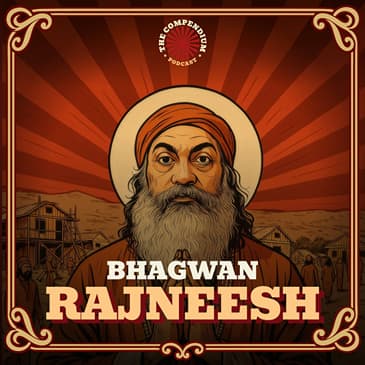
Bhagwan Shree Rajneesh promised enlightenment, freedom and a new kind of community. In Oregon, that vision became Rajneeshpuram: a desert city of red-clad followers, Rolls-Royces and political ambition that ended in surveillance, attempted murder and the largest bioterror attack in United States history.
The Rajneesh story contains almost every detail a documentary producer could want: a charismatic guru, a fearless second-in-command, a rural American town, free love, poisoned salad bars and a fleet of luxury cars. That strangeness can disguise the serious questions underneath. Thousands of people were searching for meaning and community. A small leadership circle learned how devotion could be converted into labour, money and obedience.
We trace the movement from Bhagwan’s rise in India to the creation of Rajneeshpuram in Oregon and the criminal plots associated with Ma Anand Sheela’s inner circle. The conflict is often presented as enlightened outsiders versus intolerant locals, but the reality grew far more complicated as land-use disputes became a struggle for political control and the commune’s language of love hardened into paranoia.
What Happened at Rajneeshpuram?
Bhagwan Shree Rajneesh was born Chandra Mohan Jain in India in 1931. He studied philosophy, developed a reputation as a provocative public speaker and rejected traditional religious restraint. His teaching combined elements borrowed from Eastern religions, Western psychology, capitalism and sexual liberation. Followers were encouraged to pursue meditation and pleasure rather than deny the body.
By the 1970s, his ashram in Pune attracted international visitors, particularly educated Westerners looking for spiritual transformation. New disciples became sannyasins, adopted new names, wore shades of orange, red and pink and carried malas bearing Bhagwan’s image. Dynamic meditation sessions used intense breathing, movement, shouting and emotional release. Reports of sexual freedom earned him the label “sex guru”, which repelled critics and attracted more curious followers.
The movement grew wealthy through donations, courses and a global network of centres. Bhagwan’s taste for watches and Rolls-Royces made him an unusual spiritual leader. Supporters treated material luxury as proof that he rejected guilt and hypocrisy; opponents saw a guru accumulating riches while disciples surrendered money, family ties and independence.
Pressure from Indian authorities and Bhagwan’s health problems helped prompt a move to the United States in 1981. His secretary, Ma Anand Sheela, purchased the vast Big Muddy Ranch in Wasco County, Oregon. The property was presented as agricultural land, but thousands of followers quickly constructed roads, homes, businesses, an airport and public services. The settlement became Rajneeshpuram.
The achievement was extraordinary. Volunteers turned an arid ranch into a functioning city with impressive speed. It also immediately collided with Oregon’s strict land-use rules. Residents in nearby Antelope feared that the commune would dominate local life. Rajneeshees bought property in the town, won seats on its council and renamed it Rajneesh. The movement argued that it faced religious prejudice; locals believed a much larger organisation intended to absorb them.
Bhagwan spent long periods in public silence while Sheela became the movement’s combative voice and effective administrator. Her television appearances made her famous for insults and absolute certainty. Inside the commune, her authority depended on proximity to the guru. Security expanded, weapons appeared and leaders described legal opposition as an existential threat.
When the commune sought influence over the 1984 Wasco County election, it launched a programme to bring homeless people to Rajneeshpuram from cities across America. Leaders expected the newcomers to register and vote. The plan created overcrowding and instability, and officials challenged the registrations. Some residents were reportedly sedated before many were eventually transported away and left in surrounding towns.
Members of Sheela’s inner circle then pursued an even darker way to suppress opposition turnout. They cultured Salmonella and tested methods of spreading it before contaminating food in restaurants in The Dalles. More than 750 people became ill. Nobody died, but the outbreak remains the largest bioterror attack in US history. At the time, officials initially treated it as a natural public-health event, and the connection to Rajneeshpuram was proved only later.
The poisoning was not the commune’s only crime. Investigators uncovered an extensive wiretapping system, immigration fraud involving arranged marriages and plots to kill public officials and perceived internal enemies. Bhagwan’s personal doctor survived an injection intended to cause his death. The leadership’s spiritual rhetoric had become cover for coercion, surveillance and violence.
In 1985, Sheela and several allies abruptly fled to Europe. Bhagwan broke his silence and accused them of serious crimes, inviting investigators into the ranch. His attempt to distance himself raised a question that has never entirely disappeared: how much did he know? Sheela clearly directed major operations, but Rajneeshpuram existed to serve Bhagwan, and senior decisions were made within a system built around his absolute authority.
Federal authorities arrested Bhagwan after his aircraft was intercepted. He entered an Alford plea on immigration charges, paid fines and agreed to leave the United States. Sheela was extradited, pleaded guilty to charges including assault, immigration fraud, wiretapping and conspiracy connected to the poisonings, and served 29 months of concurrent prison sentences.
Rajneesh returned to India and later adopted the name Osho. He died in 1990, but his books, recorded talks and meditation centres continue to reach a global audience. Sheela moved to Switzerland and has remained publicly unapologetic about much of her conduct. The Oregon ranch eventually became a Christian youth camp, a startling final transformation for land once advertised as the centre of a new spiritual civilisation.
Why This Story Matters
Rajneeshpuram matters because it refuses a simple cult stereotype. Many followers were intelligent, hardworking people who genuinely built community and found purpose. Their idealism does not erase the leadership’s crimes; it helps explain how those crimes could be hidden inside a project that felt beautiful and meaningful to its members.
The case also shows how quickly persecution narratives can justify escalation. The Rajneeshees did encounter hostility and prejudice, but leaders used every conflict as evidence that only total loyalty could keep the community safe. Political opposition became dehumanisation, then surveillance, poisoning and murder plots. A group can face discrimination and still become abusive itself.
We separate Bhagwan’s teachings, Sheela’s documented crimes and the experiences of ordinary sannyasins rather than treating everyone as identical. Listen to our full discussion for the dynamic meditation, Antelope takeover, homeless-voter scheme, salmonella plot and the power struggle that destroyed the commune from within.
Topics Include
Bhagwan Shree Rajneesh’s teachings and global following
Ma Anand Sheela and the building of Rajneeshpuram
The conflict with Antelope and Oregon land-use laws
The homeless-voter programme and 1984 election
The Rajneeshee salmonella bioterror attack
Wiretapping, murder plots and the commune’s collapse
Resources and Further Reading
“Wild Wild Country” (2018) - Documentary series on Netflix:
“Searching for Sheela” (2021) - Follow-up documentary on Netflix:
“Building Utopia” - Podcast by Russell King:
“What it was like to be a child in the commune” - Article in The Guardian
“A journalist's recent experience at an Osho retreat” - Article in The Guardian