
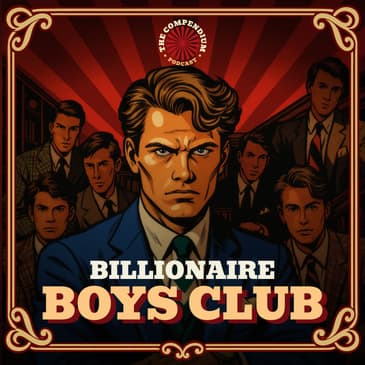
A self-proclaimed financial genius recruits his wealthy school friends into an exclusive Los Angeles investment club. The money pours in, the members embrace the millionaire lifestyle and the figures on paper look spectacular. Behind the Armani suits and sports cars, however, Joe Hunt’s Billionaire Boys Club is losing money. When deception can no longer hide the truth, a supposedly brilliant scheme descends into kidnapping, murder and an astonishing trail of incompetence.
In early-1980s Los Angeles, the Billionaire Boys Club offered privileged young men a seductive promise: they could become rich through their own brilliance rather than wait for their families’ wealth. Joe Hunt surrounded himself with former classmates, sold their relatives on a secret commodities-trading formula and created a culture built on loyalty, status and confidence. The name sounded playful, but the organisation would become linked to the disappearances and deaths of two men.
We follow the Billionaire Boys Club true crime story from Hunt’s reinvention as a financial prodigy to the murder of conman Ron Levin and the kidnapping of Hedayat Eslaminia. It is a case in which almost everybody claims to be richer, cleverer or more powerful than they really are. Scammers target scammers, friends turn on friends and a handwritten list gives investigators the clue Hunt should never have left behind. The full legal aftermath is as chaotic as the crimes, and the question of what happened to one victim remains unresolved.
What Happened to the Billionaire Boys Club?
Joe Hunt was born Joseph Henry Gamsky and grew up outside the world of extraordinary wealth he wanted to enter. A scholarship took him to the elite Harvard School for Boys in Los Angeles, where classmates came from families with money, influence and expectation. Hunt was intelligent, ambitious and intensely convinced of his own abilities. He left university after a short period and tried commodities trading in Chicago, but his early career ended with losses and regulatory trouble.
Returning to Los Angeles, he changed his name and created BBC, originally short for Bombay Bicycle Club. Hunt bought the clothes, car and watch that made success look visible, then contacted his former school friends. He claimed to have developed an unbeatable trading method and offered them the chance to build fortunes independent of their parents. Their family networks provided something Hunt lacked: a ready-made supply of investors who trusted the young men asking for money.
The group soon became known as the Billionaire Boys Club. Its members adopted a high-spending lifestyle filled with luxury cars, expensive restaurants, cocaine and bravado. Hunt’s charisma encouraged a cult-like loyalty, while generous commissions kept his recruits enthusiastic. The outward performance of success mattered because it attracted still more capital. To investors, the club looked like a new generation of financial talent. In reality, Hunt’s trades were producing serious losses.
Rather than admit failure, Hunt reported profits that did not exist. When investors requested returns, he used money from newer clients to pay them, creating the structure of a Ponzi scheme. Hunt appears to have believed the deception was temporary and that one successful run would restore the company. That conviction made the situation more dangerous. Every payment, commission and luxury expense widened the gap between the BBC’s image and its finances.
Hunt thought he had found a rescue when he met Ron Levin, a sophisticated Beverly Hills businessman with his own history of fraud. Levin appeared to place $5 million into an account for Hunt to trade. Hunt performed unusually well, apparently turning the balance into $13 million and expecting a $4 million share of the profit. When he tried to collect, he discovered that the account had contained no real money. Levin had persuaded a bank to create a realistic dummy account, supposedly for a documentary, then used its impressive statements to support a separate loan application.
The conman had conned the would-be conman. Hunt did not simply walk away. According to the prosecution, he decided to force Levin to surrender whatever money he actually possessed. On 6 June 1984, Hunt went to Levin’s home with Jim Pittman, a BBC security figure posing as a threatening creditor. The plan was designed to make Levin believe that Hunt’s life depended on payment. Levin reportedly claimed to have $2 million in a Swiss account and wrote a cheque before he was killed.
The promised fortune was another illusion. The cheque could not be honoured, and Levin was far less wealthy than he had appeared. Prosecutors said Hunt and Pittman disposed of his body in a remote area, but Ron Levin’s remains have never been recovered. Hunt has continued to deny killing him, and reported sightings have helped his supporters argue that Levin may have escaped. A jury would later accept the prosecution’s case without a body.
The BBC’s financial crisis remained. Hunt disclosed the failing business and elements of Levin’s disappearance to senior members, expecting their loyalty to hold. Some recoiled and contacted lawyers and police. Others embraced a new proposal from Reza Eslaminia, whose father Hedayat supposedly possessed a fortune of roughly $40 million. Reza suggested kidnapping him, obtaining control of the assets and sharing the proceeds.
In July 1984, members of the group abducted Hedayat Eslaminia from his home in Northern California and placed him in a car boot. Air holes had been made, but when he shouted during the drive, his captors covered them. By the time they reached Southern California, he had suffocated. The group buried his body in the desert and expected Reza to inherit. Once again, the fortune existed mainly in stories: Hedayat did not have the enormous assets his son had described.
Investigators initially struggled with Levin’s disappearance because there was no body and little obvious evidence of violence at his home. His abandoned dog and belongings suggested that he had not simply travelled. Then police found a detailed handwritten document headed with tasks relating to Levin. It included instructions about gloves, tape, handcuffs and the dog. Even more remarkably, it was written on Joe Hunt’s stationery and carried examples of his signature.
The document transformed suspicion into a case. Arrests fractured the brotherhood almost immediately. Dean Karny, Hunt’s close associate, secured immunity and became a central prosecution witness. He described the organisation’s finances, the plan against Levin and the disposal of Hedayat Eslaminia’s body. His testimony helped police locate Hedayat’s remains, although searches did not find Levin.
Hunt was tried first for Levin’s murder. Prosecutors presented the planning document, testimony from insiders and evidence of the financial motive. In 1987, he was convicted of murder and sentenced to life without the possibility of parole. The absence of Levin’s body made the case unusual, but it did not prevent the jury from concluding that he was dead and that Hunt was responsible.
The remaining proceedings became extraordinarily tangled. Pittman faced repeated trials in which juries could not agree before resolving his case through a plea. Reza Eslaminia and another participant were convicted in connection with Hedayat’s death, but those convictions were later overturned. Hunt represented himself in his own Hedayat Eslaminia trial and attacked the credibility of Dean Karny so effectively that the jury deadlocked. Prosecutors eventually declined to try Hunt again because he was already serving life for Levin’s murder.
The result is deeply unsatisfying. Hedayat’s death was real and his body was found, yet no murder conviction ultimately remained in place. Levin’s body was never found, yet Hunt remains imprisoned for killing him. The contrast has kept supporters, journalists and filmmakers interested in the case. Hunt’s family has argued for his innocence and offered money for information proving Levin survived, while prosecutors and jurors viewed the evidence of a planned killing as overwhelming.
Why This Story Matters
The Billionaire Boys Club was powered by more than ordinary greed. Hunt sold identity. His recruits were not simply buying an investment; they were buying proof that they could outperform their wealthy parents and belong to an elite of their own creation. The expensive clothes and cars were therefore not just rewards. They were marketing, group uniform and emotional reinforcement for a business that could not survive honest accounting.
Hunt’s self-belief made him persuasive and reckless. He treated every failure as a temporary obstacle that could be repaired by a larger gamble. Trading losses led to false statements, false statements required new investors and the collapsing scheme created motives for violence. This progression is common in fraud cases, even when murder is not. The offender does not experience each lie as a final choice; it becomes another bridge towards the success he insists is still coming.
The case also demolishes the comforting idea that wealth and education protect people from manipulation. BBC members had access to excellent schools, family advisers and money, but status made the pitch more attractive. Hunt understood their desire for independence and used friendship to bypass ordinary scepticism. Once members had recruited their own relatives, admitting the truth threatened their finances, reputations and family relationships all at once.
Ron Levin and Hedayat Eslaminia add another layer. Both were represented as holders of huge fortunes that did not materialise, and Levin appears to have been running his own deception. That irony can make the story sound comic, but it should not obscure the violence. Two men disappeared, one body was recovered and families were left with unanswered questions. Being dishonest or boastful did not make either man responsible for what was done to him.
We remember this story because the gap between image and reality is almost perfect. A club named for billionaires had no sustainable profits. A financial mastermind was leaving signed notes about an alleged murder plan. A code of brotherhood collapsed into immunity deals and testimony. Beneath the absurdity is a serious warning: when confidence becomes evidence, loyalty replaces scrutiny and every setback demands a more desperate solution, the performance of success can become deadly.
Topics Include
Joe Hunt’s reinvention and the creation of the Billionaire Boys Club
The failed commodities strategy and emerging Ponzi scheme
Ron Levin’s dummy investment account and disappearance
The kidnapping and death of Hedayat Eslaminia
Dean Karny’s immunity deal and the handwritten “to-do” list
The murder trials, overturned convictions and unresolved questions
Resources and Further Reading
“The Billionaire Boys Club: The Complete Story” by Sue Horton
“Billionaire Boys Club (1987)” - Mini series by Marvin J. Chomsky
“Billionaire Boys Club (2017)” - film starring Kevin Spacey
“Billionaire Boys Club” - Podcast by Marcia Clark