
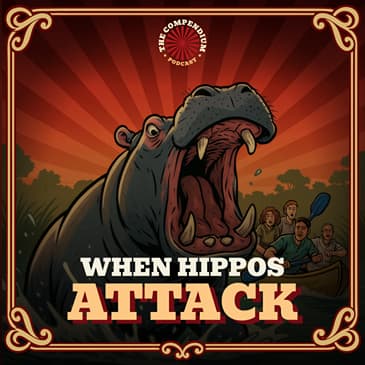
Two hippo attacks unfolded days and roughly 100 miles apart on the Zambezi River. One guide lost a leg; another group faced rising water, crocodiles and a night on a sandbar, armed with the blue paddle carried downstream from the first disaster.
Hippos look almost comic until you meet the reality: immensely powerful, territorial animals built to dominate the water around them. On the Zambezi, a calm surface can conceal an animal capable of launching a boat into the air. For two separate groups, that danger arrived without warning and turned an African river holiday into a chain of survival stories that sound too perfectly connected to be true.
We’re following canoe guide Phil Longden and, downstream, Arthur and Fay Taylor, Clive and Brenda Kelly and safari guide Alistair Gellatly. Their experiences include a shattered leg, a capsized motorboat, a crocodile death roll, rising water and an unlikely object drifting into exactly the right hands. This is wilderness survival at its most frightening, with small decisions mattering as much as strength.
What Happened During the Zambezi Hippo Attacks?
The first attack began on Easter Sunday during a canoe safari led by Phil Longden. Phil was an experienced guide who knew the river and its wildlife. His group of German tourists had linked their canoes side by side so they could drift together through a quiet channel and watch animals along the banks.
A lone male hippo suddenly charged from the reeds. Phil ordered the canoes to separate, but as he pulled his leg back into his own boat, the animal caught him. Its tusks drove through his leg and dragged him into the river. The hippo thrashed him violently before he broke free, leaving his limb torn and crushed.
The tourists pulled Phil from the water and began the desperate journey towards help. They had limited medical supplies and were far from a hospital. Infection and gangrene developed rapidly, and doctors ultimately had to amputate his leg. Amid the confusion, Phil’s blue paddle floated away and began travelling downstream.
Days later, another party went fishing much farther down the Zambezi. Arthur Taylor and his wife Fay were joined by Fay’s parents, Clive and Brenda Kelly, and their friend Alistair Gellatly. Their motorboat was struck from beneath by a hippo. One impact lifted the bow; another overturned the vessel and threw everyone into the river.
The hippo left, but the group’s problems multiplied. Arthur, Fay and Brenda were swept downstream until they found a submerged sandbar where they could stand. Clive and Alistair clung to the damaged boat. Crocodiles lived throughout the river, the current was strong and no one outside the group knew exactly where they were.
Clive eventually swam to the sandbar. Alistair decided he had to reach the bank and find help before nightfall. He entered the water and was carried downstream. Near shore, he encountered a Nile crocodile. Instead of retreating, he tried to frighten it and was attacked.
The crocodile bit Alistair’s leg and hand, then clamped onto his right arm and began a death roll. He wrapped his legs around the animal so his body would turn with it rather than being twisted apart. He tried striking its head and attacking its eye. Finally, he forced his injured hand deep into the crocodile’s mouth and pressed the flap that protects its airway underwater. The animal released him.
Alistair crawled onto land with devastating injuries. His arm was broken and badly torn, and he was losing blood. He improvised a bandage and tried to walk towards a fishing camp, but exhaustion forced him to rest beneath a tree. As darkness approached, the smell of blood threatened to attract predators. A Cape buffalo appeared, watched him and unexpectedly lay nearby rather than attacking.
Back in the river, the sandbar was disappearing as the water rose. Arthur, Fay, Clive and Brenda could not risk swimming after seeing what happened to Alistair. Then Arthur noticed a blue paddle floating towards them. It was Phil Longden’s, carried downstream from the first hippo attack. They grabbed it before it passed.
That paddle became their only practical defence. Through the night, the four stood together in the water while crocodiles approached the shrinking sandbar. Arthur slapped the surface and struck animals that came close. The group was cold, exhausted and exposed, but the paddle helped them hold their position until daylight.
Alistair survived the night and resumed his search for help. After hours of walking, he spotted a boat and managed to attract its occupants. They took him to a fishing camp, and rescuers returned for the others. Mechanical problems delayed the flight to hospital, allowing infection to become another serious threat.
Doctors saved Alistair’s life and most of the use of his arm through surgery, grafts and antibiotics. Phil also survived, though the damage and infection cost him his leg. Only later did he learn that his missing paddle had travelled downriver and helped four strangers survive. The same object lost in one disaster became a lifeline in another.
Why This Story Matters
The story corrects the harmless image many of us attach to hippos. They are not hunters targeting humans for food, but territorial behaviour around water can be lethal. Boats may unknowingly pass between an animal and deep water, or approach a hidden hippo before anyone sees it. Respecting distance and local guidance is essential.
It also shows how danger compounds in remote environments. Surviving the initial attack did not end either emergency. Blood loss, infection, currents, crocodiles, exposure, distance and failed transport all became separate threats. Wilderness rescue depends on the whole chain working, from first aid to communication and evacuation.
We’re struck by the mix of expertise and improvisation. Alistair’s wildlife knowledge helped him understand the crocodile’s anatomy, but challenging it first was a disastrous decision. Arthur had no specialist anti-crocodile tool, only a paddle and the determination to keep swinging. Survival rarely follows a clean heroic plan.
The blue paddle gives the story its almost mythic shape, yet its importance is practical. One group lost it through trauma; river currents carried it for days; another group used it to create noise, distance and a chance of defence. It did not make them safe, but it gave them something to do when helplessness might have been fatal.
Topics Include
Phil Longden’s hippo attack and emergency evacuation
The second boat capsizing involving five holidaymakers
Alistair Gellatly’s fight with a Nile crocodile
A night stranded on a rising Zambezi sandbar
How the lost blue paddle connected both survival stories
Resources and Further Reading
Terror on the Zambezi – by Hannes Wessels, Africa Unauthorized