
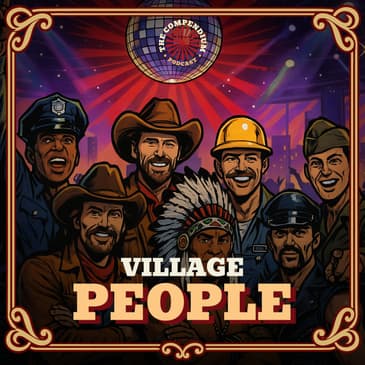
Village People turned disco into theatre: six hyper-masculine characters, enormous choruses and a catalogue whose gay subtext could hide in plain sight. This is how “Y.M.C.A.”, “Macho Man” and “In the Navy” carried queer culture from New York clubs into the global mainstream.
Put on “Y.M.C.A.” almost anywhere and people know what to do before the chorus arrives. Arms go up, strangers become a dance troupe and a record born from late-1970s New York suddenly belongs to everybody in the room. That cheerful familiarity can make Village People seem like a novelty act, but their story is sharper, stranger and more culturally important than the costumes suggest.
We are going back to the moment when disco was moving from Black, Latino and gay clubs into mass culture. Producers Jacques Morali and Henri Belolo built a group around masculine archetypes drawn from Greenwich Village, then found in Victor Willis the voice and songwriting talent capable of turning the concept into hits.
What Happened to Village People?
Morali and Belolo were French music producers looking towards the American market. Before Village People, they worked with the Ritchie Family and helped transform older material into club-ready disco. In 1977 Morali became fascinated by the visual language of Greenwich Village: cowboys, leather bikers, construction workers and other exaggerated symbols of American masculinity that also belonged to gay culture.
The project began in the studio rather than on stage. Victor Willis, an actor and singer who had appeared in The Wiz, recorded the lead vocals for the first Village People album with session singers. Tracks such as “San Francisco (You’ve Got Me)”, “In Hollywood (Everybody Is a Star)” and “Fire Island” made the intended audience difficult to miss. The name itself pointed towards Greenwich Village and its place in queer New York.
When demand arrived for television and live appearances, the image had to become a real group. Felipe Rose, whose Native American stage costume helped inspire Morali, joined Willis. Randy Jones became the cowboy, David Hodo the construction worker, Glenn Hughes the leather-clad biker and Alex Briley eventually the serviceman and sailor. Willis appeared as the policeman or naval officer. The line-up turned the male pin-up types of gay clubs into a pop-art ensemble.
The formula worked because it was more than a visual joke. Willis possessed a commanding baritone and co-wrote many of the best-known songs. Morali supplied melodies and an instinct for the dance floor, while Belolo handled the business and production operation. Horns, strings, percussion and insistent bass lines gave the records scale. The characters made every performance instantly legible.
“Macho Man”, released in 1978, established the group internationally. Its celebration of the muscular male body could be enjoyed as fitness-era fun, gay camp or both. That double reading became Village People’s greatest strength. Audiences could dance without acknowledging the subtext, while queer listeners recognised an exuberant world rarely represented so openly in mainstream entertainment.
“Y.M.C.A.” made that balance irresistible. Morali was intrigued by the Young Men’s Christian Association and the accommodation and recreation it offered young men. He and Willis turned the idea into a chorus simple enough to cross languages and generations. The now-famous arm movements were popularised after the record’s release rather than devised as the original promotional concept.
The song became a worldwide hit and eventually one of the most recognisable recordings in American popular culture. In 2020 the Library of Congress added “Y.M.C.A.” to the National Recording Registry, which preserves recordings considered culturally, historically or aesthetically significant. That recognition confirms what wedding floors and sporting crowds had demonstrated for decades: the song had escaped its moment without losing it.
“In the Navy” followed in 1979, surrounding another institution with camp spectacle and a pounding disco hook. The United States Navy briefly explored using the track for recruitment and allowed a promotional video to be filmed aboard a ship, before the association became politically awkward. Village People could appear patriotic and subversive in the same three minutes.
The group’s popularity coincided with disco’s peak and the backlash against it. “Disco Demolition Night” in Chicago in July 1979 became the most notorious expression of hostility towards the genre. Critics described musical fatigue, but racism and homophobia were also present in the contempt directed towards a form created and sustained by marginalised communities.
Willis left during the group’s commercial peak. Ray Simpson replaced him as lead singer, and Village People moved into film with Can’t Stop the Music in 1980. The lavish fictional origin story arrived as disco’s mainstream boom collapsed. It failed commercially and helped inspire the first Golden Raspberry Awards, but later found an audience as a camp cult film.
Line-ups and ownership disputes complicated everything that followed. Members departed and returned, different versions toured, and Willis fought to reclaim American copyright interests in songs he had written. The legal battles corrected part of a story in which the performers and writers who created enormously profitable music did not always share fairly in its rewards.
The group’s history also contains loss. Jacques Morali died from AIDS-related illness in 1991, Glenn Hughes died in 2001 and Henri Belolo died in 2019. Victor Willis returned to lead an official version of Village People in later years and continued to defend his interpretation of the catalogue. He died in July 2026 aged 74, closing a complicated life that had moved from Broadway and disco superstardom through addiction, legal conflict and renewed public recognition.
Arguments over whether “Y.M.C.A.” is a gay anthem have never stopped. Willis maintained that his lyrics were not written as coded references to sex. Other participants and historians emphasised the context created by Morali, the Village setting and the group’s deliberately queer imagery. Both facts can coexist: authorial claims matter, but audiences also create meaning, especially when a song becomes part of communal identity.
Why This Story Matters
Village People matter because they made queer visibility commercially unavoidable without asking mainstream audiences for permission. The group’s imagery was playful enough to travel through television, radio and family parties, yet recognisable enough to offer gay audiences a joyous reflection of their own culture.
They also challenge the idea that manufactured pop is automatically shallow. Village People were deliberately assembled, but the performance drew on real club culture, skilled studio musicianship and Willis’s songwriting. Construction did not prevent authenticity; it created a theatrical form capable of carrying multiple meanings at once.
Their success reveals how culture changes through ambiguity. A listener could hear “Macho Man” as a gym anthem, a camp fantasy or both. That flexibility helped queer aesthetics enter spaces that might have rejected an explicit political statement. It also created decades of argument about who gets to define a song.
The disco backlash reminds us that taste is rarely only about sound. Hostility towards disco often targeted the people who built it. Recovering that context lets us hear Village People not as an embarrassing relic but as part of a creative movement led by Black, Latino and LGBTQ communities.
Most of all, the songs survive because they work. The choruses are immediate, the arrangements are huge and the characters invite participation. Beneath the moustaches and uniforms lies a serious cultural achievement: Village People turned coded community knowledge into worldwide celebration.
Topics Include
Jacques Morali, Henri Belolo and the birth of the concept
Victor Willis and the creation of the original studio recordings
The cowboy, construction worker, biker and other characters
The meanings and global success of “Y.M.C.A.”
“Macho Man”, “In the Navy” and the disco backlash
Can’t Stop the Music, legal disputes and the group’s legacy
Resources and Further Reading
“The Village People's“- Official website
“Henri Belolo & Jacques Morali” - Disco Disco
“Can't Stop the Music Movie”- Wikipedia
“Golden Raspberry Awards story” - Wikipedia