
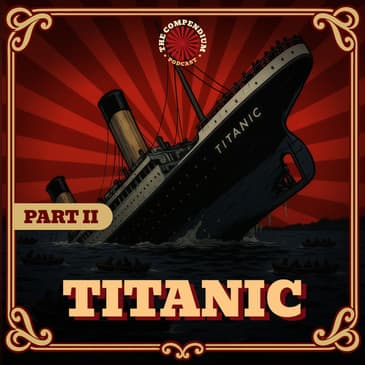
Titanic’s maiden voyage began as a display of luxury and engineering confidence, then became a fight for survival in the freezing North Atlantic. Part two follows the iceberg collision, the chaotic evacuation, the ship’s final moments and the safety reforms born from more than 1,500 deaths.
On 10 April 1912, RMS Titanic left Southampton carrying millionaires, emigrants, families and more than 800 crew members towards New York. For four days the voyage seemed to confirm every promise made about the new liner. First-class passengers moved through grand public rooms, while people below decks imagined the lives waiting for them in America.
By the night of 14 April, wireless operators had received repeated warnings of ice. The sea was exceptionally calm, there was no moon and the ship continued at high speed. What followed was not one mistake but a chain: an iceberg seen too late, a hull opened across too many compartments, lifeboats launched half empty and a rescue ship too far away to arrive before Titanic disappeared.
What Happened When Titanic Sank?
Titanic called at Cherbourg and Queenstown before heading west with roughly 2,200 people aboard. Daily life reflected the class system of the period. First class offered a swimming pool, gymnasium, restaurants and suites of astonishing luxury. Second class rivalled accommodation on other ships. Third class was simpler but still represented a major improvement for many migrants crossing the Atlantic.
The ship received several ice messages on 14 April. Some reached the bridge; others were delayed amid heavy passenger traffic handled by wireless operators Jack Phillips and Harold Bride. Shortly before midnight, lookouts Frederick Fleet and Reginald Lee saw an iceberg directly ahead. Fleet rang the warning bell and telephoned the bridge. First Officer William Murdoch ordered a turn and reversed the engines, but there was too little distance.
At about 11:40 p.m., the iceberg scraped along Titanic’s starboard side. The impact did not carve one enormous gash. Instead, plates buckled and seams opened in a series of narrow areas, allowing water into at least five forward compartments. Titanic could remain afloat with four flooded, but not five. As the bow settled, water rose over the tops of bulkheads and spilled progressively backwards.
Designer Thomas Andrews inspected the damage and understood the conclusion: the ship would sink. Captain Edward Smith ordered the lifeboats uncovered and wireless distress calls sent. Yet passengers were reluctant to leave a warm, apparently solid liner for small boats hanging above a black sea. Crew members had not held a full passenger boat drill, and the order “women and children first” was interpreted differently on each side.
Titanic carried lifeboat space for around 1,178 people, far fewer than everyone aboard but more than regulations required. Even that capacity was not used. Early boats departed with empty seats because officers feared the davits might not support a full load or could not persuade more people to enter. The British inquiry later calculated that only 652 people left Titanic in boats, with others rescued from the water or collapsible craft.
Class affected access and survival. First-class passengers were closer to the boat deck and more likely to receive clear information. Third-class passengers faced a maze of corridors and language barriers, and some routes were controlled to comply with immigration rules. The disaster was not a simple story of gates deliberately locking everyone below, but the ship’s physical and social divisions had deadly consequences.
Nearby, the liner Californian had stopped for ice, but its wireless operator had gone off duty and the crew did not recognise Titanic’s rockets as distress signals in time. RMS Carpathia received the call and raced towards the coordinates, but it was about four hours away. On Titanic, the bow continued to sink and the angle of the decks grew steeper.
The musicians reportedly played as the evacuation continued, though witnesses disagreed about the final tune. Phillips and Bride kept transmitting until late in the sinking. Engineers remained below to maintain power and lights. These acts became central to the legend, but they were also practical choices that bought other people time.
At around 2:20 a.m. on 15 April, Titanic broke apart and sank. The stern briefly rose before vanishing. Hundreds entered water cold enough to kill within minutes. Most lifeboats did not return promptly, their occupants fearing swimmers would swamp them. Carpathia arrived after 4 a.m. and rescued about 700 survivors. More than 1,500 passengers and crew had died.
Ships were sent to recover bodies, and survivors arrived in New York carrying grief, confusion and wildly unequal resources. American and British inquiries examined speed, ice warnings, lifeboats, wireless procedures and the Californian’s response. Public anger focused on the mismatch between Titanic’s image of safety and the preventable failures exposed by the sinking.
The aftermath changed maritime law. Ships were required to carry lifeboat capacity for everyone aboard, maintain continuous radio watches and conduct regular drills. The International Ice Patrol was created to monitor danger in the North Atlantic. The first International Convention for the Safety of Life at Sea followed in 1914, establishing a framework that remains fundamental to shipping safety.
Why This Story Matters
Titanic matters because it turned confidence into regulation. The ship met the rules of its time, but those rules were outdated and treated lifeboats mainly as ferries to another vessel rather than survival craft for a sinking at sea. Disaster exposed the distance between legal compliance and actual safety.
The tragedy also shows that accidents rarely have a single cause. The iceberg was the immediate hazard, but speed, visibility, design limits, communications, evacuation practice and social hierarchy shaped the death toll. Focusing only on the collision misses the decisions that determined who escaped.
Survival patterns reveal the values built into systems. Wealth did not guarantee life and courage crossed every class, yet access to information and physical routes was not equal. Women survived at higher rates than men, while third-class passengers faced particularly devastating losses. The statistics are a map of power aboard the ship.
Titanic became myth almost immediately. Stories of heroism, cowardice, doomed romance and divine punishment were fitted around real people before the survivors had even reached land. Films, books and exhibitions keep reshaping the disaster, sometimes clarifying the history and sometimes smoothing away its complexity.
We return to Titanic because the wreck is both distant and recognisable. It asks how organisations respond to warnings, why minimum standards become ceilings and how prestige can discourage challenge. Our fascination should not stop at the ship’s grandeur or final plunge. Its most important legacy is the insistence that catastrophe must become instruction.
Topics Include
Daily life aboard Titanic during the maiden voyage
The ice warnings and the collision on 14 April 1912
Why flooding spread beyond the ship’s watertight compartments
Lifeboat shortages, evacuation confusion and class differences
The final breakup, Carpathia rescue and survivor experiences
The inquiries, Ice Patrol and modern maritime safety reforms
Resources and Further Reading
"A Night to Remember" by Walter Lord
"Titanic" Wikipedia
"Titanic: The Tragedy Begins" The rest is history
“The official Titanic Museum” website
"Titanic” by James Cameron