
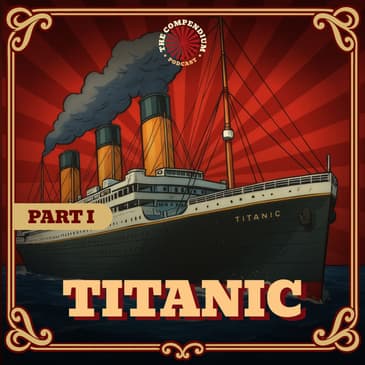
Before Titanic became history’s most famous shipwreck, it was a floating promise of modernity. Part one follows the people, money and engineering behind the liner, then steps aboard with the millionaires, migrants and crew whose lives reveal the sharply divided world of 1912.
We tend to meet Titanic at the iceberg, but the ship’s story began years earlier in boardrooms, drawing offices and one of the world’s greatest shipyards. It was created during an age intoxicated by size, speed and technology, when ocean liners were national symbols and the Atlantic was both a commercial highway and a route towards a new life.
To understand why Titanic still grips us, we have to see more than chandeliers and famous first-class names. We need to meet the Belfast workers who built it, the crew who kept it running, the emigrants carrying everything they owned and the business leaders who believed luxury and scale could conquer the sea.
What Happened Before Titanic’s Maiden Voyage?
At the beginning of the twentieth century, the North Atlantic passenger trade was ferociously competitive. Britain’s Cunard Line had launched the fast Lusitania and Mauretania, supported by the British government. White Star Line chose a different answer. Instead of chasing the speed record, it would offer extraordinary size, comfort and stability through three Olympic-class liners: Olympic, Titanic and Britannic.
White Star had become part of J. P. Morgan’s American-controlled International Mercantile Marine combine. Its chairman, J. Bruce Ismay, worked with Lord Pirrie of Harland and Wolff to turn the Olympic-class idea into steel. Titanic Belfast’s historical work shows that the Belfast yard itself had to be transformed: slipways were rebuilt and an enormous gantry erected so ships of this scale could be assembled.
Titanic’s keel was laid on 31 March 1909. Thousands of workers laboured amid rivet furnaces, scaffolding, noise and serious danger. The finished hull was launched on 31 May 1911 before fitting-out teams installed engines, cabins, public rooms, electrical systems and miles of pipework. Titanic was then handed over after sea trials on 2 April 1912, only eight days before its maiden voyage.
The liner was a technical compromise as much as a marvel. Two reciprocating steam engines powered the outer propellers, while a low-pressure turbine drove the centre one. Sixteen major compartments were divided by fifteen transverse bulkheads. Watertight doors could be closed from the bridge, but the bulkheads did not all extend high enough to stop water spilling from one compartment into the next if the bow sank deeply.
That limitation was not treated as reckless at the time. Titanic complied with contemporary rules and could survive several plausible collision scenarios. The problem was that regulation had not kept pace with ship size. The Board of Trade’s lifeboat formula was based largely on tonnage categories created for much smaller vessels. Titanic carried twenty boats with space for roughly 1,178 people: more than required, but only about half the number the ship could carry.
The interiors made a stronger public impression than the safety calculations. First class included grand staircases, restaurants, lounges, a gymnasium, Turkish baths and suites with private promenade decks. Second class offered standards associated with first class on older liners. Even third class was cleaner and more comfortable than steerage accommodation on many rival ships.
Yet the ship was not simply a hotel for the rich. Mass migration was central to the economics of Atlantic travel. Third-class passengers included families and individuals from Britain, Ireland, Scandinavia, the Middle East and across Europe. Many were travelling to join relatives, find work or begin again in the United States and Canada. Their fares were far lower than first-class prices, but collectively emigrant traffic was crucial business.
The passenger list placed some of the era’s wealthiest people beside those carrying nearly all they possessed. John Jacob Astor IV travelled with his pregnant wife Madeleine. Benjamin Guggenheim boarded with his entourage. Macy’s co-owner Isidor Straus travelled with his wife Ida. Margaret Brown, later mythologised as “the Unsinkable Molly Brown”, was returning home after learning that her grandson was ill.
Other names became famous because of what they represented. Bruce Ismay travelled as White Star’s chairman. Thomas Andrews, managing director of Harland and Wolff’s design department, led a guarantee group inspecting the new ship. Captain Edward Smith was the line’s celebrated senior captain. Second Officer Charles Lightoller had already survived shipwreck and disease before joining a voyage that would define him.
Behind them stood hundreds of less visible workers. Deck officers navigated, lookouts watched ahead and seamen maintained the ship. Engineers, firemen and trimmers worked in fierce heat below decks to feed coal into the boilers and keep electricity flowing. Stewards served meals, cleaned cabins and guided passengers through unfamiliar corridors. Musicians, postal clerks, cooks and wireless operators all formed part of the floating community.
Working conditions reflected the same class divisions found among passengers. Many crew members worked extremely long shifts for modest wages. Firemen emerged from boiler rooms drenched in sweat and coal dust. Stewards slept in shared quarters and were responsible for large numbers of passengers. When Titanic sailed, a missed train or late arrival could decide who took a berth and who remained safely ashore.
On 10 April 1912, passengers arrived at Southampton by boat train and gangway. Titanic nearly collided with the liner New York as the suction from its movement snapped the smaller ship’s mooring lines. Tugs prevented an accident, and the voyage continued to Cherbourg in France, where tenders carried more passengers aboard, then to Queenstown, now Cobh, in Ireland.
Those ports completed a human cross-section of the Gilded Age. First-class passengers brought servants, wardrobes and expensive possessions. Second-class teachers, professionals and families occupied comfortable cabins. Third-class travellers underwent inspections and navigated rules designed around immigration control. The same ship held radically different expectations of what the crossing meant.
Some famous people cancelled before departure, including J. P. Morgan, Milton Hershey and George Vanderbilt. Their absence later fuelled conspiracy theories, but late changes were ordinary in luxury travel and there is no credible evidence that Morgan arranged the disaster. The more revealing fact is how quickly coincidence becomes suspicion when catastrophe is retold.
As Titanic left Queenstown on 11 April, the ship was carrying about 2,200 passengers and crew towards New York. Its wireless room handled operational messages and a growing stream of paid passenger telegrams. Its kitchens fed several social worlds. Its engines pushed west through calm seas. Nobody aboard knew they were entering the final days of a story the whole world would inherit.
Why This Story Matters
Titanic matters because the ship captured both the confidence and inequality of its age. It was an astonishing achievement built by skilled workers, financed by global capital and marketed through luxury. It was also an emigrant vessel in which space, information and freedom of movement were shaped by class.
The familiar phrase “unsinkable” is less useful than the culture behind it. Titanic was not created by fools who believed nature had vanished. It emerged from systems that rewarded scale, prestige and compliance with existing rules. The tragedy would expose how meeting a minimum standard can still leave enormous risk untouched.
Its passenger stories keep the history human. Astor, Straus and Guggenheim were headline names, but the majority of people aboard were not celebrities. They were crew members doing demanding work and migrants pursuing ordinary hopes. Their stories resist the temptation to reduce the ship to a glamorous stage set.
The design story also helps us understand disasters as chains rather than single failures. The bulkheads, lifeboat regulations, wireless system, social layout and operating assumptions all mattered before the iceberg was visible. Part one therefore changes the question from “How could a ship hit ice?” to “What kind of world built this ship, and what did it believe safety meant?”
We still return to Titanic because it is a complete society compressed inside one hull. Wealth and labour, migration and celebrity, engineering and ambition all sailed together. Before we follow the collision and sinking in part two, this is the essential truth: Titanic was not only a machine. It was more than two thousand individual futures moving west across the Atlantic.
Topics Include
J. P. Morgan, Bruce Ismay and the White Star Line
Harland and Wolff, Thomas Andrews and Titanic’s construction
The Olympic-class design, watertight compartments and lifeboats
Luxury in first class and the realities of third-class migration
Captain Smith, Charles Lightoller and the ship’s working crew
Famous passengers, last-minute cancellations and the maiden voyage
Resources and Further Reading
"A Night to Remember" by Walter Lord
"Titanic" Wikipedia
"Titanic: The Tragedy Begins" The rest is history
“The official Titanic Museum” website
"Titanic” by James Cameron