
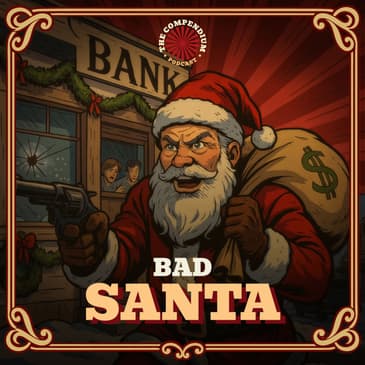
On 23 December 1927, four men robbed a bank in Cisco, Texas, and one wore a Santa Claus suit as a disguise. Children followed him into the bank, a gun battle erupted and the getaway became one of the largest manhunts in Texas history.
The plan sounded theatrical but practical. Christmas crowds would accept a man dressed as Santa, and the costume would hide Marshall Ratliff's face. Instead, the disguise attracted attention before the robbers even reached the First National Bank. We can see the fatal misunderstanding immediately: anonymity depends on being ignored, and a small-town Santa was the most conspicuous person on the street.
We follow the robbery minute by minute: the child who raised the alarm, the armed townspeople who surrounded the bank, hostages used as shields and a getaway car that could not take them far enough. The story is chaotic, violent and far removed from a clever holiday caper.
What Happened in the Santa Claus Bank Robbery?
Marshall Ratliff had already served time for bank robbery. In December 1927, he joined Henry Helms, Robert Hill and Louis Davis in a plan to rob the First National Bank in Cisco. Ratliff wore the Santa suit because people in the busy town would expect festive appearances.
That assumption worked too well. Children greeted Santa in the street and followed him into the bank. Once inside, the four men displayed weapons and ordered customers and staff to comply. They began collecting cash and valuables, but a witness escaped and ran towards the police department.
Texas banks had encouraged armed resistance through a reward offered for dead bank robbers. As word spread, police and civilians converged with rifles and pistols. The bank sat in a populated centre, making a quiet departure impossible. Gunfire came through windows and from inside the building.
Police Chief G. E. Bedford and officer George Carmichael were fatally wounded during the battle. Several other people were injured. The robbers took hostages and attempted to use them as protection while leaving with money, creating a moving scene in which officers and residents struggled to fire without hitting captives.
The gang reached a stolen car, but its fuel supply became a disastrous problem. They transferred to another vehicle and continued through the countryside with hostages. The escape was slowed by confusion, injuries and the enormous response gathering behind them.
Louis Davis had been badly wounded and later died. At one stage the robbers abandoned their money and hostages while fleeing on foot. Much of the cash was recovered, turning the original objective into dead weight that they could not safely carry.
Authorities organised what was described as the largest manhunt Texas had seen. Aircraft, officers, posses and local volunteers searched roads and rough ground. Newspapers carried the image of the Santa disguise, making anonymity impossible and adding a grotesque festive symbol to the violence.
Hill and Helms were captured after further confrontations. Ratliff, wounded and exhausted, was also taken into custody. The legal consequences varied, but the deaths of officers ensured that prosecutors sought severe punishments. Helms was executed in 1929.
Ratliff received a death sentence, but questions about his mental competence delayed proceedings. While held in Eastland County jail, he attempted an escape and killed jailer Tom Jones. A furious crowd seized Ratliff from the jail and lynched him in November 1929.
The lynching added another unlawful killing to a case already saturated with violence. Ratliff had committed serious crimes and was under sentence, but mob execution bypassed the legal process. The episode therefore cannot be told simply as a community delivering frontier justice.
The surviving robber, Robert Hill, served prison time and later lived under a different name. The bank building remained a local landmark, while the robbery became part of Texas folklore. Retellings often emphasise the absurd Santa image, but the event left officers, robbers and bystanders dead.
Why This Story Matters
The robbery matters because a disguise designed to reduce suspicion produced the opposite effect. Ratliff could conceal his identity, but he could not move anonymously. Children turned an apparently strategic choice into a procession that advertised the gang's arrival.
It also exposes the danger of rewarding armed civilians for killing criminals. The promise encouraged people to approach an active hostage situation and helped create uncontrolled crossfire. Courage and recklessness became difficult to separate once dozens of guns surrounded a public building.
The getaway failed through ordinary logistics rather than brilliant detection. Fuel, vehicles, wounds and the weight of money mattered more than cinematic planning. Crimes that appear ingenious in outline often collapse when real people, roads and mistakes enter the plan.
The lynching is essential to the legacy. Condemning Ratliff's violence does not justify a mob taking custody and killing him. Rule of law is tested most severely when an accused person is hated and the community believes guilt makes procedure unnecessary.
The episode further reveals how public rewards can change behaviour. A bounty for dead robbers did not merely express disapproval; it encouraged armed residents to enter a confused scene in pursuit of money and status. That incentive made every hostage and passer-by less safe. Modern policing debates still ask a related question: when institutions reward a result without accounting for the method, what dangerous choices become predictable? In Cisco, the answer arrived almost immediately through shattered windows, frightened hostages and a gunfight that nobody could properly control.
Listen to the episode for the festive disguise, the bank gunfight, the desperate vehicle changes, the manhunt and Ratliff's grim end. The Santa Claus bank robbery is memorable because it is bizarre, but important because almost every choice multiplied the danger for everyone caught in its path.
Topics Include
Marshall Ratliff, Henry Helms, Robert Hill and Louis Davis
The Santa disguise and children following the gang into the bank
The escape that alerted Cisco police and armed residents
The deadly gun battle, hostages and failed getaway vehicles
Texas's enormous manhunt and the capture of the surviving robbers
Ratliff's jail escape attempt and lynching in Eastland
Resources and Further Reading
"Santa Claus Bank Robbery" - Wikipedia