
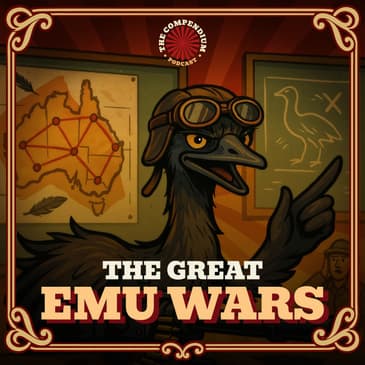
In 1932, struggling farmers in Western Australia asked the government for help when thousands of emus swept through their wheat fields. The response was one of history's strangest military operations: three artillerymen, two Lewis guns and 10,000 rounds sent to control birds that were faster, tougher and far harder to organise against than anyone expected.
The Great Emu War sounds like a joke written backwards from its punchline. Australia sent soldiers with machine guns into the Wheatbelt, the emus scattered, the ammunition ran low and the birds were declared the winners. That is the version repeated online, usually beside a photograph of an emu looking smug. The real story is still wonderfully absurd, but it is also more revealing than the meme suggests.
Behind the comedy were former servicemen trying to farm marginal land during the Great Depression, a government under pressure to protect a wheat harvest and roughly 20,000 native birds following their normal search for food and water. We are returning to the Campion district to ask what actually happened, why military weapons were used for wildlife control and how a short culling operation became known as a war that Australia lost.
What Happened in the Great Emu War of 1932?
After the First World War, governments encouraged returned soldiers to settle on rural blocks and build new lives as farmers. In Western Australia, many veterans took up land in the Wheatbelt east of Perth. The promise was independence and productive work, but the reality could be punishing. Some blocks were remote, poorly supplied and ill suited to inexperienced farmers. Roads, irrigation and strong fencing were limited, while the settlers often carried debts they could not easily repay.
By 1932, the Great Depression had driven wheat prices down and made those weaknesses more dangerous. Farmers were being encouraged to increase production even as promised assistance became a political argument. A good harvest was not simply welcome; for many families it represented the chance to survive another year.
Then the emus arrived. After breeding inland, large groups of the birds traditionally moved towards the coast in search of water and food. Cleared farmland, crops and newly created water supplies made the Wheatbelt attractive. Contemporary accounts put the number moving through the Campion area at about 20,000. They ate and trampled wheat, damaged fences and left openings through which rabbits could enter. To farmers already close to financial ruin, the losses felt like an emergency.
A group of the soldier-settlers travelled to seek help from the federal government. Because they were veterans and knew the destructive potential of automatic weapons, they asked for machine guns. Defence Minister Sir George Pearce agreed, provided that military personnel operated them and that the Western Australian government covered transport and accommodation. The operation was not a formal declaration of war. It was a government-authorised wildlife cull that newspapers quickly described in military language.
Major G. P. W. Meredith of the Royal Australian Artillery led the tiny detachment. He was accompanied by two other soldiers, two Lewis guns, 10,000 rounds of ammunition and, importantly for the story's survival, a cinematographer. Bad weather delayed the start, but on 2 November 1932 the men began work near Campion.
The first encounters exposed the central problem. Emus do not stand in disciplined ranks. When the guns opened fire, the birds split into smaller groups and ran across rough ground at close to 50 kilometres per hour. Their movement made sustained fire difficult, and the Lewis guns were more useful against concentrated human formations than fast targets spreading in several directions. An early attempt against a group near a water source produced few confirmed kills.
On 4 November, Meredith's team prepared an ambush for a much larger group. The birds came within range, but after a short burst one of the guns jammed. Most escaped. Attempts to pursue them by mounting a gun on a truck also failed because the vehicle bounced across uneven country while the emus ran and changed direction. The image is comic, but every missed burst represented expensive ammunition and limited practical help for the farmers.
The press soon turned the operation into national entertainment. Reports credited the emus with scouts, formations and guerrilla tactics. Parliamentarians mocked the campaign, and Pearce acquired the nickname “Minister of the Emu War”. Meredith, impressed by the birds' resilience, was reported as comparing their ability to absorb fire with tanks. These colourful remarks helped transform a small pest-control effort into a legendary contest between the Australian Army and a feathered enemy.
The first phase was halted after only a few days as criticism grew. Farmers continued to report serious damage, however, and the troops returned on 12 November. The second phase lasted into December and achieved more kills because the soldiers changed their tactics and worked more patiently. Meredith eventually reported 986 confirmed emus killed with 9,860 rounds, and believed that additional wounded birds later died. Those estimates have been disputed, and they made almost no difference to a population counted in the tens of thousands.
By 10 December the military operation was over. It had not stopped the migration or removed the farmers' wider problems. Requests for military assistance returned in later years, but the government rejected them. Bounties were used to encourage civilian culling, and barrier fencing ultimately offered a more durable way to protect crops.
So did Australia really lose a war against emus? Only if we accept the joke's rules. The birds did not organise an army, no war was declared and the human side suffered no combat deaths. Yet the operation plainly failed on its own terms. Modern weapons did not deliver quick control, the birds remained numerous and the government withdrew under ridicule. Calling it an emu victory is not literal history, but it captures why the episode has lasted in public memory.
Why This Story Matters
The Great Emu War matters because the absurdity can hide the conditions that produced it. The soldier-settlers were not foolish for fearing the loss of their crops. Many had been placed on difficult land through schemes that promised opportunity without always providing the infrastructure, expertise or financial protection required to succeed. Depression-era prices and debt left them with little room for another setback.
It also shows the danger of choosing a dramatic tool because it is available. Lewis guns looked decisive, especially to people who had seen them used in war. But a weapon designed for one kind of target was poorly matched to dispersed wildlife across vast, uneven terrain. The government responded visibly and forcefully without first solving the deeper agricultural problem. The spectacle of action became a substitute for an effective plan.
The emus were not invading foreign territory. They were native animals following established movements through a landscape that had been altered by settlement, crops and water supplies. Describing them as an enemy made killing seem like a military necessity and pushed ecological questions out of view. Their behaviour was not strategy in a human sense; scattering was simply an effective survival response.
We should also be cautious with the details that grow sharper every time the tale is retold. There were no tanks, Australia did not formally declare war and stories about commanding “general” emus belong to folklore. Even the casualty figures came from the officer running the operation and cannot be treated as exact. Separating those embellishments from the record does not make the story less entertaining. It makes the comedy more meaningful because the documented events are strange enough.
Nearly a century later, the Great Emu War remains a perfect collision of hardship, bureaucracy, technology and unintended consequences. We laugh because the birds refused to behave like an army, while the humans kept describing the problem as though they did. Listen to the episode for the failed ambushes, the jammed gun, the parliamentary jokes and the long road from machine-gun fire to the far less glamorous solution of better fences.
Topics Include
How soldier-settlement schemes placed veterans on difficult Wheatbelt farms
Why about 20,000 emus moved through the Campion district in 1932
Sir George Pearce, Major G. P. W. Meredith and the deployment of Lewis guns
The failed ambushes, jammed weapon and attempt to fire from a moving truck
How newspapers and politicians turned a wildlife cull into the “Emu War”
Why bounties and fencing proved more practical than military force
Resources and Further Reading
"The Great Emu War of 1932” by Jordan Sillers
"Emu War” - Wikipedia
"Western Australia Makes War On Emus” - youtube