
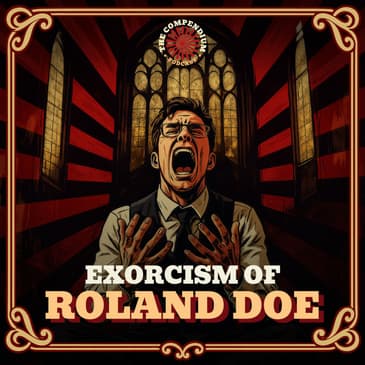
In 1949, a 13-year-old American boy underwent weeks of Catholic exorcism rites after his family reported scratching noises, moving furniture, violent outbursts and words appearing on his skin. The case of “Roland Doe” inspired The Exorcist, but the true story is far stranger, and far less certain, than the film.
The image most people know is Regan MacNeil turning her head, levitating above a bed and confronting two priests in a dark bedroom. William Peter Blatty’s novel and the 1973 film changed horror forever, yet their origin was not a possessed girl in Washington, DC. It was a teenage boy from Maryland whose identity was protected for more than seventy years.
We follow the reported events through family testimony, newspaper accounts and the diary attributed to Jesuit priest Raymond Bishop. These records show that an exorcism took place and that several clergy believed something extraordinary was happening. They do not prove a demon was responsible. The case lives in the space between faith, folklore, adolescent distress and stories that became more dramatic with every retelling.
What Happened During the Exorcism of Roland Doe?
“Roland Doe” and “Robbie Mannheim” were pseudonyms used to protect the boy now widely identified as Ronald Edwin Hunkeler. He was 13 in 1949 and lived with his family in the Maryland suburbs of Washington. Later accounts describe him as an only child who was especially close to an aunt interested in spiritualism and Ouija boards.
After the aunt’s death, the family reported unexplained disturbances. Scratching and dripping sounds appeared in the house, often at night. Roland’s bed allegedly shook, objects moved and incidents seemed to follow him. The family considered ordinary explanations, including rodents and emotional distress, before interpreting the activity as contact from the dead or something more threatening.
A Lutheran minister became involved and observed the boy. Some later versions claim the minister attempted an exorcism during which Roland injured him, but details vary substantially between sources. What is clear is that the family sought medical and religious help, and the case eventually reached Catholic clergy with connections to Georgetown and Saint Louis University.
Roland travelled to St Louis, where relatives introduced the family to Father Raymond Bishop. Bishop contacted Father William Bowdern, a Jesuit priest who became the principal exorcist. Church authorities authorised use of the Roman Ritual after preliminary investigation. The rites took place over several weeks in homes, a rectory and hospital settings.
Bishop’s diary is the central source for the most famous claims. It describes Roland entering trance-like states, reacting violently to prayers, speaking in a changed voice and developing scratches or marks on his body. Words were said to appear on his skin, sometimes interpreted as instructions about where to go or what religious steps to take. The priests reported that the boy displayed knowledge or strength they found difficult to explain.
The sessions were physically intense. Roland was restrained while priests recited prayers commanding any possessing spirit to identify itself and leave. Walter Halloran, then a Jesuit seminarian, later recalled assisting and said the boy broke Halloran’s nose during one outburst. Halloran did not claim certainty that the case was supernatural, a caution sometimes lost in sensational retellings.
The diary links the final phase to Roland’s reception into the Catholic Church. He was baptised and received Communion while the exorcisms continued. On 18 April 1949, the priests reported a climactic struggle followed by calm. Roland later said he had experienced a vision of Saint Michael defeating the devil. The disturbances were said to stop, and he returned home.
Contemporary newspaper coverage brought the case to the attention of William Peter Blatty, then a student at Georgetown University. He attempted to learn more and eventually transformed the story into his 1971 novel The Exorcist. Blatty changed the child into a girl, relocated the drama and created characters and events for fiction. William Friedkin’s film adaptation then made those inventions feel like cultural memory.
Author Thomas B. Allen later used a copy of Bishop’s diary and interviews for Possessed: The True Story of an Exorcism. His work strengthened the popular belief that the case was unusually well documented. A contemporaneous diary is valuable evidence of what clergy recorded and believed, but it is not independent verification of every event. The writers were participants interpreting the boy’s behaviour through a religious framework.
Sceptical researchers have proposed less supernatural explanations. Roland may have produced some scratches himself, manipulated objects when adults were not watching or escalated behaviour after seeing the effect it had. Grief, family attention, psychological distress and expectation could all have played a role. Reports also grew through lectures, books and journalism, making it difficult to separate the earliest observations from later embellishment.
The claim that an exorcism “cured” the problem does not settle the question. A ritual can create a powerful ending without its theology being literally true. It gave Roland, his family and the priests a shared explanation, a structured conflict and a moment when everyone agreed the crisis had finished. Psychological symptoms can also end abruptly, especially when attention, environment and belief change together.
Hunkeler went on to live privately and worked as an engineer connected with NASA projects. His name was publicly identified after his death in 2020, raising ethical questions about exposing someone whose family and clergy had deliberately protected his identity. Whatever happened in 1949, he spent adulthood trying not to be defined by the most frightening weeks of his childhood.
Why This Story Matters
The Roland Doe case matters because it demonstrates how a “true story” becomes mythology. There was a real child, real clergy and a real series of rites. Around that foundation grew details from family belief, priestly interpretation, press reports, lectures, a bestselling novel and one of cinema’s most influential horror films. Each layer changed what audiences thought the original evidence contained.
It also asks how we should understand behaviour before modern mental-health language was widely available. Calling the boy possessed may have reflected sincere faith, but it also subjected him to repeated restraint and frightening rituals. Declaring everything a prank can be equally simplistic when we lack a clinical assessment and reliable independent observation.
We do not tell you that demonic possession was proved, or that every witness fabricated what they saw. Listen to our full discussion for the Ouija-board story, Bishop diary, Roman Ritual, disputed physical phenomena and the creative choices that turned a boy’s private crisis into The Exorcist.
Topics Include
Ronald Hunkeler and the Roland Doe pseudonym
The reported Ouija-board activity and disturbances
Father William Bowdern and Raymond Bishop’s diary
The Roman Ritual and weeks of exorcism rites
Sceptical and psychological explanations
How the case inspired William Peter Blatty’s novel
Resources and Further Reading
Possessed: The True Story of an Exorcism by Thomas Allen
Exorcism of Roland Doe - Wikipedia
The Exorcist by William Peter Blatty
The Roman Ritual - Wikipedia
The Exorcism of Roland Doe - Paranormal documentary, available on YouTube