
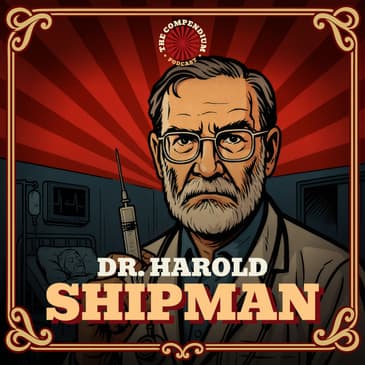
Harold Shipman used the trust and privacy of general practice to murder patients for decades. A forged will finally exposed a pattern that colleagues, records and death certification had failed to stop.
Harold Shipman was not a stranger who forced his way into his victims' lives. He was their family doctor: the person invited into homes, trusted with medicines and believed when he certified that an elderly patient had died naturally. That professional authority allowed murder to resemble ordinary care.
He was convicted of murdering fifteen women, but the public inquiry later concluded that he had killed far more patients across a medical career spanning decades. We are tracing how a respected GP in Hyde concealed lethal injections inside routine visits, why repeated warning signs failed to connect and how one daughter's attention to a forged will finally broke the pattern.
What Happened in the Harold Shipman Case?
Shipman was born in Nottingham in 1946. As a teenager he watched doctors give morphine to his mother, Vera, during her terminal cancer. It is impossible to reduce his later crimes to that experience, but the scene became a striking part of his biography: a trusted doctor arriving at home, relieving pain with an injection and controlling the final hours of life.
After training at Leeds, Shipman entered general practice. His early career already contained a serious warning. In the 1970s he became dependent on pethidine, obtained drugs through false prescriptions and was convicted of offences connected to that deception. Following treatment and disciplinary action, he was nevertheless able to return to medicine.
He later joined a practice in Hyde, Greater Manchester, and built an unusually loyal patient base. Colleagues often found him arrogant, but many patients saw an attentive, decisive doctor willing to make home visits. In 1992 he opened his own surgery, supported in part by money raised locally, and continued caring for many older people.
Deaths followed a recurring pattern. A patient, often an older woman who had recently appeared active, would die during or soon after a visit from Shipman. He could certify natural causes, discourage further examination and recommend cremation. Families had little reason to challenge a doctor who said their relative had died peacefully.
Some professionals did notice that his death rate seemed high. A local undertaker and GP raised concerns, but an early police inquiry did not uncover enough evidence and Shipman continued practising. Fragmented information, professional deference and weak systems for comparing mortality data prevented suspicions from becoming a coherent warning.
The decisive case was Kathleen Grundy, an energetic 81-year-old former mayor of Hyde. She died at home in June 1998 after Shipman visited. Her daughter, solicitor Angela Woodruff, discovered a new will leaving most of an estate worth hundreds of thousands of pounds to the doctor. The document did not resemble her mother's wishes or signature.
Woodruff contacted police. The will was traced to Shipman's own typewriter, and investigators examined Grundy's body rather than allowing the proposed cremation. Toxicology revealed diamorphine. Computer records showed that Shipman had added or altered medical entries after deaths, apparently trying to create histories that would make sudden endings seem plausible.
Other bodies were exhumed and other families interviewed. Evidence pointed to lethal doses of diamorphine administered during home visits, followed by false records and death certificates. Because many patients had been cremated, investigators could never test every suspected case. That uncertainty is one reason the true total remains a range rather than a single incontrovertible number.
In January 2000, Shipman was convicted of fifteen murders and forging Grundy's will. He received life sentences with a whole-life recommendation. He never provided a full confession or reliable explanation and died by suicide in prison in 2004, denying families the answers they had sought.
The Shipman Inquiry examined deaths associated with his practice and concluded that he had killed at least 215 patients, while identifying additional suspicious cases. Its reports looked beyond one offender to the systems that had allowed him to prescribe controlled drugs, certify deaths and avoid meaningful scrutiny.
Reforms followed in death certification, controlled-drug monitoring, appraisal and oversight of doctors. Yet the uncomfortable centre of the story remains personal as well as institutional. Shipman weaponised the very qualities patients are encouraged to value: confidence, continuity, privacy and trust.
Why This Story Matters
Harold Shipman's crimes matter because they expose the danger of treating professional status as evidence of innocence. Trust is essential to healthcare, but trust without verification protects the practitioner rather than the patient. A safe system must make scrutiny routine enough that questioning a doctor does not feel like an accusation against medicine itself.
The case also demonstrates why data has to travel. Undertakers, relatives, GPs, pharmacists and police each saw fragments. No single observation looked conclusive, while the combined pattern was extraordinary. Monitoring unusual mortality and prescribing is not a substitute for judgement, but it can reveal a question that isolated records conceal.
Angela Woodruff's role is a reminder that victims are often failed until somebody refuses an easy explanation. Her legal experience helped her recognise the will as wrong, but families should not need professional expertise to trigger a competent investigation into a sudden or suspicious death.
We should resist making Shipman the entire story. The inquiry named hundreds of people whose lives were reduced for years to numbers in a killer's total. They were parents, neighbours, friends and patients who believed a home visit was care. Their families carried both bereavement and the later discovery that the official account had been false.
Listen for the pethidine conviction, the mortality warnings, Kathleen Grundy's will, the computer timestamps and the inquiry's reforms. The most disturbing question is not how one doctor could be trusted. It is how many separate systems accepted his version of death without checking it.
Topics Include
Shipman's early pethidine conviction and return to practice
How home visits and death certification concealed murder
Warnings from local professionals that failed to stop him
Kathleen Grundy and Angela Woodruff's discovery
Diamorphine, falsified records and the 2000 trial
The Shipman Inquiry and changes to patient safeguards
Resources and Further Reading
"The Shipman Inquiry" - Available at the National Archives
"Inside the Mind of Harold Shipman" - A psychological analysis by Dr. Richard Badcock