
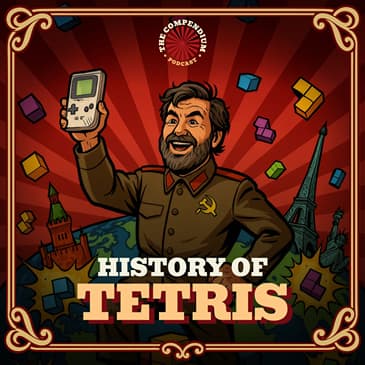
Tetris began as a spare-time puzzle on a Soviet research computer and became a global phenomenon through copying, confused contracts and a high-stakes battle over who owned the rights. Its simple falling blocks concealed one of gaming's most complicated business stories.
Most players understand Tetris within seconds: rotate four-square pieces, complete horizontal lines and delay the inevitable moment when the stack reaches the top. That clarity helped the game cross languages, hardware systems and the political boundary of the Cold War. We can recognise the game from a silent screen, a handful of colours or the first few notes of its familiar music, which is why its complicated origin story feels so surprising.
The journey from Moscow laboratory to Nintendo Game Boy was far less elegant. We follow Alexey Pajitnov's invention, the unofficial copies that carried it west, Robert Stein's disputed licences and Henk Rogers's decisive trip to the Soviet Union. The result was both a licensing maze and a lasting friendship.
What Happened in the Tetris Rights Battle?
Alexey Pajitnov worked at the Soviet Academy of Sciences' Computer Centre in Moscow. Fascinated by puzzles, he adapted the logic of pentominoes into pieces made from four squares. The Greek prefix tetra and his fondness for tennis inspired the name Tetris.
The first 1984 version ran on an Electronika 60, a computer without conventional graphics. Pajitnov represented blocks with text characters, but the central idea was already present: pieces fell, players rotated them and complete lines vanished. Colleagues found it difficult to stop playing.
Vadim Gerasimov helped create a version for the IBM PC, and copies spread rapidly through Soviet institutions. Software did not move through an ordinary commercial market. People copied disks, while Pajitnov's employment and Soviet law meant he could not simply establish a company and sell his creation abroad.
British software salesman Robert Stein encountered Tetris in Hungary and contacted Pajitnov by telex. Their exchange expressed interest but did not give Stein the completed agreement he believed he had. Nevertheless, Stein offered rights to Mirrorsoft in Britain and Spectrum HoloByte in America, companies linked to Robert Maxwell's publishing empire.
Those publishers released computer versions with Russian imagery and promoted the game's exotic origin. Meanwhile, the Soviet state export organisation ELORG asserted control over the licence. Stein eventually negotiated computer rights, but the meaning of terms such as computer, console and handheld would become crucial.
Henk Rogers saw Tetris at a Las Vegas trade show in 1988 and recognised that it could transform the Japanese market. His company released a successful Famicom version, but he still needed secure rights. When Nintendo prepared its handheld Game Boy, Rogers believed Tetris was the perfect bundled game.
Rogers travelled to Moscow in 1989, initially without a formal appointment. At ELORG he discovered that rival companies were claiming overlapping rights. He also met Pajitnov, and the two connected through their shared understanding of games rather than corporate manoeuvring.
ELORG's contract with Stein referred to personal computers, not dedicated consoles or handheld devices. Rogers negotiated handheld rights and helped Nintendo secure console rights. Mirrorsoft and Atari Games believed their agreements extended further, leading to a legal battle over competing versions.
Nintendo released Tetris with the Game Boy in 1989. The combination was extraordinary: the puzzle suited short or long sessions, required no language and appealed beyond traditional gaming audiences. More than 35 million Game Boy Tetris cartridges were sold, making game and machine inseparable in popular memory.
Pajitnov did not immediately receive the western fortune associated with his creation. He had assigned commercial rights through Soviet institutions for a period that lasted into the 1990s. After moving to the United States, he worked with Rogers to regain control when those arrangements expired.
The pair formed The Tetris Company to manage licences and establish consistent rules and presentation. Tetris continued across consoles, phones, competitions and even space. Its commercial history became tidier, but the original scramble remains a lesson in how rapidly digital ideas could travel ahead of the contracts intended to contain them.
Why This Story Matters
Tetris matters because its design is almost irreducibly simple. There are only seven tetrominoes, yet their sequence creates endless variation. The game offers constant small successes while steadily increasing pressure, producing the mental after-image known informally as the Tetris effect.
The rights dispute shows that ownership of software is not merely about who wrote the code. Territory, platform and definitions inside contracts can determine who profits. Several businesses believed they owned Tetris because each held a different part of an incomplete licensing chain.
Its Soviet origin complicates the familiar lone-genius story. Pajitnov created the game, colleagues helped adapt it, state bodies controlled export and western companies supplied distribution. Innovation crossed the Iron Curtain through personal copying before official negotiators caught up.
Rogers's role also matters. He was a commercial operator, but his friendship with Pajitnov helped the creator benefit from the work later. Their partnership offers a more generous ending than many stories in which an inventor permanently loses control of an idea.
There is also a wider cultural lesson in the way Tetris travelled. Soviet institutions could control contracts but not enthusiasm, and western companies could control packaging but not the game's basic appeal. Players repeatedly copied, adapted and rediscovered it because the rules were easy to understand and difficult to master. The story is therefore not simply capitalism defeating communism or Nintendo defeating Atari. It is about an idea moving through several systems, with people in each one trying to define what ownership meant.
Listen to the episode for the primitive first screen, Stein's telex, the Maxwell companies, the Moscow negotiations and Nintendo's legal victory. Tetris conquered the world because the game was beautifully clear, even when everything surrounding it was not.
Topics Include
Alexey Pajitnov, pentominoes and the Electronika 60
How copied disks spread Tetris through the Soviet Union and Europe
Robert Stein, Mirrorsoft, Spectrum HoloByte and disputed licences
ELORG and the contractual difference between computers and consoles
Henk Rogers, Nintendo and the 1989 Game Boy launch
The Tetris Company and Pajitnov's eventual control of his creation
Resources and Further Reading
"The Tetris Effect" by Dan Ackerman - A lively dive into the game's fascinating backstory.
Interviews with Alexey Pajitnov - Insights straight from the Tetris master himself.
"From Russia with Love: The Journey of Tetris" - A captivating documentary on Tetris's origins.
"Henk Rogers: Mastering the Game" - Get up close and personal with Tetris's key promoter.
"Tetris - From the USSR to Today" - An article that pieces together Tetris's global impact.