
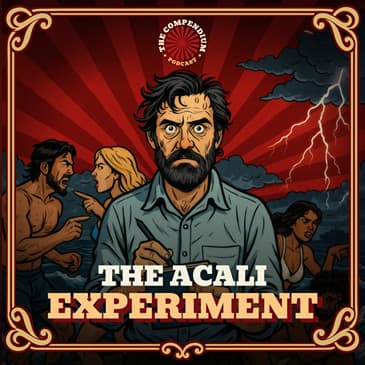
In 1973, anthropologist Santiago Genovés put eleven people on a tiny raft and sent them across the Atlantic to study violence and sexual attraction. The press called it the “Sex Raft”, but the Acali Experiment produced a far stranger result: the crew cooperated while the researcher tried to provoke them.
Take six women, five men, one 12-by-7-metre steel raft and almost no privacy. Give them a sail but no engine, place them thousands of miles from home and ask deeply personal questions about sex, jealousy and aggression. It sounds less like a controlled study and more like reality television invented three decades too early.
We’re crossing the Atlantic aboard Acali, the “house on the water” created by Spanish-born Mexican anthropologist Santiago Genovés. He wanted to learn whether human beings were naturally violent, particularly when sex and competition entered the picture. Instead, his handpicked crew kept solving problems together, and the person creating the most conflict turned out to be the scientist himself.
What Happened During the Acali Experiment?
Genovés’s fascination with survival at sea did not appear from nowhere. He had sailed with Thor Heyerdahl on the Ra expeditions, which tested whether papyrus boats could cross the Atlantic. In 1972, after experiencing an aircraft hijacking, Genovés became even more determined to study human violence under pressure.
His plan was the Peace Project: an isolated society that he could observe from beginning to end. Acali was about 12 metres long and seven metres wide, with a single cramped cabin and no meaningful private space. It would travel from the Canary Islands towards Mexico using wind and currents, making escape from the group practically impossible.
Hundreds applied after Genovés advertised for volunteers. He selected people from different nationalities, faiths and professions, hoping their differences would create a miniature version of the world. He also believed sexual competition might generate aggression, so physical attraction influenced his choices. That decision helped the press turn a supposed peace study into the “Sex Raft” before the voyage had properly begun.
The group included an anthropologist, a doctor, a priest, a photographer, radio operators, researchers and a diver. Genovés deliberately placed women in operational authority, with Swedish mariner Maria Björnstam serving as captain. In theory, this challenged traditional power structures. In practice, the greatest difficulty accepting Maria’s expertise often came from Genovés.
Acali left Las Palmas in May 1973. Eleven people would spend 101 days crossing the Atlantic and Caribbean before reaching Cozumel, Mexico. They slept side by side, used an open toilet at the edge of the raft and relied upon each other for navigation, radio communication, medicine, food and maintenance.
Genovés recorded their behaviour constantly. His questionnaires asked who irritated them, whom they trusted, whom they desired and whom they would remove from the raft. He tracked moods alongside weather, waves and even phases of the moon. The problem was that he was not a detached observer: he lived inside the group, controlled the research and wanted a particular result.
Sex did happen aboard Acali, but not in the continuous frenzy imagined by newspapers. More importantly for the stated experiment, widespread violence did not. The crew established routines, shared labour and adapted to the lack of space. They disagreed, but their dependence on one another rewarded cooperation.
A dramatic moment arrived when the group caught and killed a shark for food. Genovés interpreted the bloody scene as primitive aggression finally surfacing. Yet butchering an animal for meat was not the same as people attacking one another, and the expected chain of interpersonal violence never followed.
As the voyage continued peacefully, Genovés became anxious that his experiment was failing. He read intimate questionnaire answers aloud, told participants what others had supposedly said about them and tried to manufacture confrontations. Instead of turning on each other, the crew recognised what he was doing and withdrew from him.
The imbalance between research and manipulation became impossible to ignore. Participants gathered without him and discussed removing him from power. Some even talked about ways he might be killed, although no plan was carried out. The irony was extraordinary: Genovés’s attempts to provoke hostility united the group against the authority figure interfering with their community.
Danger at sea made Maria’s competence essential. When Genovés refused to follow her advice about a developing storm, she stepped down rather than accept responsibility for his decision. He took control and the raft endured the bad weather, but the conflict exposed the risk of treating real lives as variables in a theory.
Later, a container ship appeared to be heading directly towards Acali. According to participants’ recollections, Maria organised the response: radio calls, flares, the horn and every possible attempt to attract attention. The vessel altered course and avoided the raft. Genovés restored her as captain, while the crew’s calm coordination offered another result he struggled to appreciate.
After 101 days, Acali reached Cozumel. The participants discovered that the outside world had reduced their work to salacious stories about a floating orgy. Genovés published his account in 1975, but the project never became persuasive social science. Its sample was tiny and deliberately selected, the variables were uncontrolled and the lead researcher repeatedly altered the conditions he claimed to observe.
Decades later, director Marcus Lindeen found the surviving participants and reunited them for the 2018 documentary The Raft. They sat inside a reconstruction of Acali while original 16mm footage restored their voices to a story long dominated by Genovés and the press.
Why This Story Matters
The Acali Experiment is a warning about confirmation bias. Genovés began with a theory connecting violence, sex and competition, then designed the crew and environment to produce the evidence he expected. When the group behaved differently, he treated cooperation as failure instead of considering that it might be the finding.
It also raises sharp questions about consent and scientific power. Participants agreed to an unusual voyage, but Genovés controlled the questions, the private information and the narrative. Reading intimate answers aloud or deliberately provoking people was not neutral observation. It changed the experiment while placing real relationships and safety at risk.
We find the accidental lesson far more hopeful. In a confined and dangerous environment, people with different languages, beliefs and backgrounds developed routines and relied on expertise. Conflict did not vanish, but the group’s shared survival depended upon cooperation. The conditions designed to expose selfishness repeatedly rewarded solidarity instead.
Genovés later helped draft the 1986 Seville Statement on Violence, which rejected the idea that war is biologically inevitable. That does not transform Acali into sound research, but it gives the story a fascinating final turn. The man who crossed an ocean looking for proof of inherent violence eventually supported a very different conclusion.
Topics Include
Santiago Genovés’s theory about violence and sexual competition
Maria Björnstam’s role as captain of the Acali raft
The questionnaires, manipulation and ethics of the Peace Project
How the crew responded to storms, isolation and danger at sea
Marcus Lindeen’s documentary The Raft and the experiment’s legacy
Resources and Further Reading
"Mutiny on the Sex Raft” - The Guardian
"The Raft Tells Of Sex, Chaos And Mutiny In A Crazy 1973 Social Experiment" - Forbes
"The Raft Chronicles an Extreme Experiment with Human Nature" - The New Yorker
"The Seville Statement on Violence" - Wikipedia
"Acali" - Wikipedia
“The Raft (2018)" - Documentary by Marcus Lindeen