
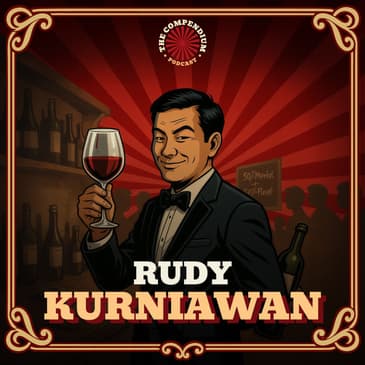
Rudy Kurniawan entered America's rare-wine elite with an extraordinary palate, an apparently bottomless cellar and a gift for friendship. He was also manufacturing counterfeit vintages at home, turning cheaper wine, used bottles and forged labels into millions of dollars before one impossible Burgundy exposed the fraud.
A bottle of old Burgundy can contain wine, history and status in equal measure. Its value depends not only on taste but on trust: trust in the label, the cork, the auction house and the story explaining where it has been stored for decades. Rudy Kurniawan understood that system so well that he was able to counterfeit more than the liquid. He counterfeited certainty.
For years, wealthy collectors welcomed him to their tables and competed for bottles from his mysterious cellar. Then a French producer noticed wines that could not possibly exist. We are uncorking the rise and collapse of the most famous fraud in modern wine collecting, from record-breaking auctions to the home laboratory that gave the FBI overwhelming evidence.
What Happened in the Rudy Kurniawan Wine Fraud?
Kurniawan was born in Indonesia to a family of Chinese heritage and moved to the United States as a student. In the early 2000s he appeared in the California wine scene, where collectors quickly noticed his memory, palate and appetite for rare bottles. He could identify producers and vintages with remarkable confidence, spoke fluently about flavour and appeared willing to spend extraordinary sums.
That combination opened a world usually guarded by wealth and reputation. Kurniawan joined exclusive tasting groups, paid enormous restaurant bills and shared bottles that few people would otherwise encounter. He became known as “Dr Conti” because of his enthusiasm for Domaine de la Romanée-Conti. His background remained vague, but friends accepted stories of family wealth and treated the mystery as part of his charm.
Rare wine is an unusually effective environment for fraud. Old bottles naturally vary, and very few drinkers know exactly how a particular Burgundy from half a century ago should taste. Provenance records can be incomplete. Once respected collectors and auction specialists endorse a bottle, later buyers often rely on that confidence. Admitting a mistake can damage both a collection's value and its owner's reputation.
Kurniawan became a major client and consignor for the auction house Acker Merrall & Condit. In 2006, two auctions of wine from his collection brought in tens of millions of dollars. His presence helped energise the Burgundy market, and the rising prices made his apparently rare holdings even more valuable. Buyers saw abundance as proof of access rather than a reason for suspicion.
The scheme worked by combining ordinary and more respectable wines into blends that resembled an imagined old vintage. Kurniawan obtained genuine empty bottles, then used forged labels, corks, capsules and artificial ageing to complete the effect. A skilled palate helped him produce convincing liquid, but social expectation did the rest. Guests tasting a bottle sold as a legendary vintage were primed to find complexity and greatness.
Warning signs appeared before the final collapse. Collectors and specialists noticed labels, bottle shapes and vintages that did not match producers' records. Billionaire collector William Koch was already pursuing sellers of counterfeit wine after discovering fakes in his own cellar. The decisive public challenge, however, came from Laurent Ponsot of Domaine Ponsot.
In 2008, an Acker auction catalogue offered dozens of bottles consigned by Kurniawan and labelled as old Ponsot wines. Some purported to be Clos Saint-Denis from vintages between the 1940s and 1970s. There was a fundamental problem: Domaine Ponsot did not begin producing wine from that vineyard until 1982. Another bottle pre-dated the domaine's practice of estate bottling. These were not subtle questions of taste. The labels described products that had never existed.
Ponsot travelled from Burgundy to New York and ensured that the suspect lots were withdrawn. At first, it was still possible to imagine that Kurniawan had unknowingly bought counterfeits and passed them on. His explanations about their source did not resolve the problem, and Ponsot continued investigating. Other collectors, journalists and federal agents were also following the expanding trail.
Kurniawan's finances added another layer. Behind the lavish dinners, luxury cars and valuable property, he had borrowed heavily. Prosecutors later proved that he fraudulently obtained a $3 million loan by concealing debts, misrepresenting expenses and falsely claiming permanent US residency. The glamorous persona depended on money continuing to flow.
On 8 March 2012, FBI agents searched his home in Arcadia, California. They found what one agent described as a fake-wine laboratory. Empty prestige bottles were soaking in sinks. Corks, wax, stamps and thousands of labels filled the rooms. Open bottles, funnels and a re-corking device sat on the kitchen counter. The evidence showed that Kurniawan was not merely reselling bottles he failed to authenticate. He was manufacturing them.
A federal jury convicted him in December 2013 of fraud involving counterfeit wine and the fraudulent loan. In August 2014, a judge sentenced him to ten years in prison, ordered him to forfeit $20 million and imposed more than $28 million in restitution. The FBI estimated that his connections had helped him sell approximately $30 million of counterfeit wine.
Kurniawan was released from prison in 2020 and deported to Indonesia in 2021 because he had remained in the United States without lawful status. His conviction did not remove every counterfeit bottle from private cellars. Some owners may never know what they have, while others may prefer uncertainty to an admission that a prized investment is worthless.
Why This Story Matters
The Rudy Kurniawan story matters because it demonstrates that expertise does not eliminate social pressure. Many victims were sophisticated, successful and deeply knowledgeable about wine. That knowledge operated inside a community where reputation shaped perception. If a celebrated collector opened a supposedly priceless bottle, challenging it risked insulting the host and exposing one's own uncertainty.
The fraud also reveals how markets can authenticate their own stories. Kurniawan bought conspicuously, raised demand and then sold into the excitement he helped create. High prices became evidence of rarity, and rarity justified higher prices. Auction catalogues and elite tastings gave false bottles a public history that could follow them into later sales.
It is tempting to treat the case as harmless because many victims were rich. Yet forgery damages records as well as bank balances. Counterfeits distort understanding of how old wines taste, corrupt price information and undermine legitimate producers whose names appear on the labels. The harm spreads beyond the first buyer.
We should also resist the neat idea that Kurniawan succeeded only because everyone around him was foolish. His fraud combined technical knowledge, labour, social intelligence and a market with weak verification. Mocking the victims may be satisfying, but it can prevent us from noticing the same vulnerabilities in art, watches, memorabilia and other collectables.
The final irony is that Kurniawan really did possess rare-wine expertise. He used that ability to imitate prestige instead of building it honestly. Listen to the episode for the extravagant tasting clubs, the impossible Ponsot vintages, the collectors who pursued him and the moment agents opened the door on a counterfeiting operation hidden in plain sight.
Topics Include
How Rudy Kurniawan entered the closed world of elite wine collecting
The “Dr Conti” persona and his record-breaking auction consignments
How cheaper wines, old bottles and forged labels created convincing counterfeits
Laurent Ponsot and the vintages that could not possibly have existed
The 2012 FBI search and the fake-wine laboratory inside Kurniawan's home
His conviction, ten-year sentence, restitution and deportation to Indonesia
Resources and Further Reading
"Sour Grapes" – Netflix Documentary
"The great wine fraud" The Gaurdian by Ed Cumming
"Con that shook the world of wine" The New Yorker by By Bianca Bosker
"A Vintage Crime" Vanity fair by Michael Steinberger