
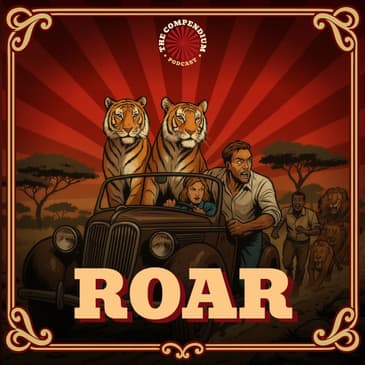
Roar was supposed to prove that humans and big cats could live in harmony. Instead, Tippi Hedren, Noel Marshall, Melanie Griffith and their crew spent years being bitten, clawed and chased through a film whose real danger is visible in almost every frame.
“No animals were harmed in the making of this film,” Roar announces. It says nothing about the people. The 1981 adventure comedy placed its cast inside a house with more than 100 lions, tigers, leopards and other big cats, many of them moving freely and unpredictably around the set. When someone screams, falls or bleeds, the reaction may not be acting. Roar has earned its reputation as the most dangerous film ever made because the production repeatedly allowed real peril to become footage.
We revisit the astonishing making of Roar, from a well-intentioned conservation idea to an 11-year obsession that consumed money, relationships and any ordinary concept of workplace safety. The story involves Hollywood star Tippi Hedren, producer Noel Marshall, a teenage Melanie Griffith, future Speed director Jan de Bont and an ever-growing collection of wild animals. Injury totals vary across accounts, and the 2015 re-release turned the film’s danger into a marketing hook, but the documented attacks are extraordinary enough without exaggeration.
What Happened During the Making of Roar?
The idea began after Hedren and Marshall visited Africa in the late 1960s. They encountered lions occupying an abandoned lodge and imagined a film that would challenge the image of big cats as monsters. Their planned story followed a family visiting a zoologist who shared his home with a huge mixed pride. Chaos would unfold, but the underlying message would be conservation: these animals deserved protection rather than fear or fashionable fur.
Experienced trainers warned them that bringing numerous adult lions together inside a confined set was dangerously unrealistic. One suggestion was that animals raised together from a young age might be more tolerant of each other and the family. Hedren and Marshall embraced the idea and began acquiring cubs, initially keeping them at their Beverly Hills home with their children. Photographs showed an apparently idyllic household in which a full-grown lion lounged on furniture, entered the swimming pool and climbed into bed.
The images were captivating, but the arrangement was neither domestic nor safe. As the animals grew and neighbours complained, the family moved the collection to a ranch north of Los Angeles. More rescued lions arrived, followed by tigers, leopards, cougars, jaguars and elephants. The production’s original concept kept expanding to accommodate the animals they had taken in. Feeding and housing them cost a fortune before a usable scene had even been filmed.
Production began in 1976 with Noel Marshall directing, writing, producing and starring. Hedren played his on-screen wife, while Marshall’s sons and Melanie Griffith played their children. The animals were not conventional trained performers capable of repeating precise actions. Cameras had to keep rolling until something useful happened. Food, noise and improvised tactics encouraged movement, but the cats ultimately decided where they went and what they did.
That method gave Roar an unnerving texture. Actors hide, run and attempt dialogue while enormous animals climb over them, destroy rooms and fight nearby. The film presents the encounters as playful slapstick, yet the physical force is unmistakable. Marshall is knocked down and bitten. Hedren is handled roughly by an elephant. Griffith is pinned and clawed. What the story calls harmony often looks like a family attempting to survive its own premise.
The injuries were severe. Melanie Griffith required treatment after a lion struck her face. Hedren suffered bites, fractures and other wounds during production. Cinematographer Jan de Bont was partially scalped by a lion and needed extensive stitches before returning to work. Noel Marshall endured repeated attacks and dangerous infections. Other cast and crew members were bitten or mauled, and many left. Published totals differ, with some accounts citing around 70 injured people and later publicity making broader claims, so we focus on what can be established rather than treating a promotional number as a medical record.
The danger did not end with animal attacks. The ranch stood in an area vulnerable to natural disaster. A flood destroyed sets and damaged enclosures, allowing animals to escape; some were killed during the emergency. Fire later threatened the property as well. Each setback required more money and more rebuilding. A project expected to take months stretched across years, with the family selling assets and searching for funding as costs climbed towards a reported $17 million.
Marshall’s determination blurred into obsession. The family’s fear could be used as authentic performance, while the absence of normal controls left them exposed to decisions no responsible modern set should accept. The conservation argument made it easier to keep going: if the film might save wild cats, perhaps another injury or delay could be justified. Sunk costs added their own pressure. After so many years and so much money, stopping would mean admitting that the entire undertaking had failed.
When Roar finally appeared internationally in 1981, it did not become the hit its creators expected and received no contemporary US cinema release. The thin plot could not compete with the real spectacle of its production. Hedren and Marshall later divorced, and the project effectively ended Marshall’s film career. Hedren retained the property and developed Shambala Preserve, continuing animal-welfare work while campaigning against private ownership and exploitation of big cats.
For years, the film was difficult to see. Its 2015 American re-release repositioned it as a cult experience, promoting the injuries and using the phrase “the most dangerous movie ever made”. That campaign found the audience the original conservation comedy never did. Viewers were invited to watch not because the fiction worked, but because they knew the danger was real.
Why This Story Matters
Roar matters because good intentions do not protect people or animals from harmful decisions. Hedren and Marshall wanted audiences to care about wildlife, yet their production placed a family, a crew and a collection of traumatised animals in an environment built for conflict. The film’s central belief, that love and familiarity could overcome wild instinct, was tested repeatedly, and the injuries supplied the answer.
It is also a lesson in how ambition changes ethical boundaries. Each accident should have forced a reassessment. Instead, the footage made the film seem more valuable and the years already invested made withdrawal harder. The same danger that horrified distributors later became the selling point of the re-release. Roar therefore sits uncomfortably between cautionary tale and entertainment product: we condemn the conditions while being fascinated by what they captured.
We do not reduce the story to a list of gruesome injuries. It is about conservation, family power, non-union filmmaking, animal welfare and the seduction of an idea that nobody is willing to abandon. Listen to the full episode for the escaped lions, flooded ranch, on-camera attacks and impossible choices behind a film where the making-of story is far more compelling than the screenplay.
Topics Include
Tippi Hedren and Noel Marshall’s conservation idea
Living and filming with more than 100 big cats
Melanie Griffith and the Marshall children on set
Jan de Bont’s injury and the production’s safety failures
The flood, fire and escalating cost of Roar
Shambala Preserve and the film’s 2015 cult revival
Resources and Further Reading
Shambala Preserve - Tippi Hedren’s Big Cat Sanctuary
Interview with John Marshall on the making of Roar - Grantland
Roar: The most Dangerous Movie Ever Made - YouTube
Roar Production details - IMDB