
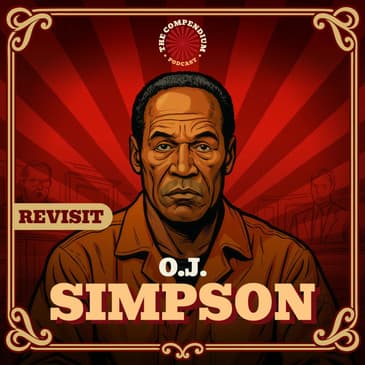
O.J. Simpson was acquitted of murdering Nicole Brown Simpson and Ron Goldman after a televised trial that divided America. A civil jury later held him liable for both deaths, leaving two verdicts, one body of evidence and a cultural argument that never ended.
On 12 June 1994, Nicole Brown Simpson and Ronald Goldman were found stabbed to death outside her home in Brentwood, Los Angeles. Within days, one of America’s most recognisable athletes was a suspect, and his slow flight from police in a white Ford Bronco had become live national television.
We are revisiting the evidence, the domestic-abuse history, the defence attack on the LAPD and the very different outcomes of the criminal and civil cases. The point is not to pretend that a famous acquittal never happened. It is to understand what the jury was asked to decide, why reasonable doubt took hold and why the wider record did not disappear with the verdict.
What Happened in the O.J. Simpson Case?
Orenthal James Simpson was born in San Francisco in 1947 and became one of the greatest running backs in American football. He won the Heisman Trophy at the University of Southern California, starred for the Buffalo Bills and crossed into advertising, commentary and film. His easy television persona made him a celebrity far beyond sport.
Simpson met Nicole Brown in 1977 while she was working at a Beverly Hills restaurant. He was still married to his first wife. Nicole and Simpson married in 1985 and had two children, but the relationship included repeated accusations of control and violence. In 1989 he pleaded no contest to spousal battery after police found Nicole injured. They divorced in 1992, yet continued an unstable relationship.
Nicole documented incidents in photographs, diary entries and calls for help. On one recording she told a 911 dispatcher that Simpson had broken down a door and warned that officers had attended the home many times before. That history mattered because prosecutors argued that the murders were the culmination of escalating coercion and rage, not an inexplicable attack between strangers.
On the evening of 12 June, Nicole ate with family at the Mezzaluna restaurant. Her mother left a pair of glasses behind, and waiter Ron Goldman volunteered to return them after his shift. Shortly after midnight, a neighbour discovered their bodies near the front gate of Nicole’s Bundy Drive home. Her two children were asleep inside.
Police found a dark knitted cap and a bloodied leather glove at the scene. A matching glove was later discovered at Simpson’s Rockingham estate. Investigators also documented blood in and around his Ford Bronco, along a path at his property and inside the house. Simpson had flown to Chicago that night and returned after police contacted him.
His left hand had a cut. During an initial interview he gave uncertain explanations about how it happened and about his movements before the flight. The questioning was brief, and Simpson was released while prosecutors assessed the evidence. Days later, authorities agreed that he could surrender voluntarily.
He did not appear at the arranged time. Instead, his friend Al Cowlings drove him in a white Bronco while Simpson sat in the back with a gun and spoke to police by telephone. Television networks interrupted normal programming as the vehicle travelled slowly along Los Angeles freeways. Crowds gathered on bridges and outside Simpson’s home before he finally surrendered.
The criminal trial began in January 1995 and was broadcast to an enormous audience. Prosecutors Marcia Clark and Christopher Darden presented DNA, blood, fibres, shoe impressions, the gloves and the history of domestic abuse. Statistical evidence linked blood at key locations to Simpson, Nicole and Goldman, but DNA profiling was still unfamiliar to many viewers and the explanations became long and technical.
The defence team, led in court by Johnnie Cochran, did not have to prove an alternative killer. It needed to show that the investigation was unreliable enough to create reasonable doubt. Lawyers attacked collection procedures, raised the possibility of contamination and argued that racist or corrupt officers might have planted evidence.
Detective Mark Fuhrman became central to that strategy. He had found the glove at Rockingham and testified that he had not used a racial slur during the previous decade. Recordings then revealed him repeatedly using the slur and describing police misconduct in conversations with a screenwriter. When recalled, he invoked the Fifth Amendment rather than answer questions, devastating the prosecution’s credibility.
The gloves produced the trial’s defining image. Darden asked Simpson to try them on over latex gloves. They appeared too tight, allowing Cochran to build his closing argument around the phrase, “If it doesn’t fit, you must acquit.” The leather had been soaked in blood and frozen during testing, while Simpson was wearing protective gloves underneath, but the visual impression was simpler than any scientific explanation.
Race shaped how the trial was understood. The case followed the videotaped beating of Rodney King and the acquittal of the officers involved, events that had exposed deep mistrust of the LAPD. For many Black Americans, Fuhrman’s lies confirmed that scepticism towards police was rational. Other viewers saw overwhelming physical evidence being eclipsed by misconduct unrelated to whether Simpson committed the murders.
On 3 October 1995, after less than four hours of deliberation, the jury found Simpson not guilty of both murders. An acquittal means the prosecution failed to prove guilt beyond a reasonable doubt. It is not a judicial declaration that every piece of evidence was false, and it did not prevent the victims’ families from bringing civil claims under a lower standard of proof.
In 1997, a civil jury found Simpson liable for the wrongful deaths of Nicole Brown Simpson and Ron Goldman and awarded their families $33.5 million. The civil trial was not televised and included evidence handled differently from the criminal case. Photographs of Simpson wearing rare size 12 Bruno Magli shoes were especially important because bloody impressions at the crime scene matched that make and size.
Simpson later collaborated on a book describing how he might have committed the killings. Public outrage stopped its original release, and after litigation the Goldman family obtained rights to publish it as If I Did It: Confessions of the Killer, with the word “If” visually minimised on the cover. Simpson maintained that the account was hypothetical.
His later imprisonment came from an unrelated case. In 2008 a Nevada court convicted him of offences arising from an armed confrontation over sports memorabilia in a Las Vegas hotel. He served nine years before being paroled in 2017. The sentence did not legally punish him for the 1994 deaths, although public discussion often blurred the cases.
Simpson died from prostate cancer in Las Vegas on 10 April 2024, aged 76. His death ended any possibility of further personal accountability, but not the financial claims or the arguments over his legacy. Nicole Brown Simpson and Ron Goldman remain the people whose lives were taken; the celebrity, courtroom strategy and cultural symbolism should not obscure them.
Why This Story Matters
The case matters because it exposed the difference between factual belief and legal proof. A criminal jury considers whether guilt has been established beyond a reasonable doubt, while a civil jury decides liability under a lower standard. The acquittal and civil verdict are not the same question answered inconsistently; they are different legal tests applied to overlapping evidence.
It also showed how police misconduct can damage a prosecution even when other evidence is powerful. Fuhrman’s racism and false testimony gave the defence a genuine credibility crisis to use. Institutions that tolerate dishonesty make it harder to secure justice, because jurors cannot be expected to separate a compromised witness neatly from the investigation he helped conduct.
Nicole’s history demonstrates why domestic violence should not be treated as background colour. Abuse can escalate after separation, when an abuser feels control slipping away. Records of earlier assaults, threats and emergency calls are not gossip about a troubled marriage; they are evidence of risk and a warning that may become clear only after a victim is killed.
The trial also transformed news and celebrity culture. Cameras made lawyers, witnesses and the judge into recurring television characters. Commentary blurred with entertainment, and the white Bronco, the glove and the verdict became shared images long before social media existed. Later celebrity trials inherited that format.
Finally, the story resists a comforting single lesson. The LAPD’s racism was real, the prosecution made serious errors and the physical evidence remained extensive. Holding those facts together is harder than choosing one side, but it is the only way for us to understand why the verdict became a referendum on far more than two murders.
Topics Include
Nicole Brown Simpson’s documented history of domestic abuse
The murders of Nicole and Ron Goldman on 12 June 1994
The white Bronco pursuit and Simpson’s surrender
DNA evidence, the gloves and Mark Fuhrman’s testimony
The 1995 acquittal and 1997 civil liability verdict
If I Did It, Simpson’s later imprisonment and his death in 2024
Resources and Further Reading
"The Run of His Life: The People v. O.J. Simpson" by Jeffrey Toobin
ESPN's Documentary: "O.J.: Made in America"
"Without a Doubt" by Marcia Clark
"American Crime Story: The People v. O.J. Simpson" - FX Series
“You’re Wrong About” - Podcast by Sarah Marshall and Michael Hobbs