
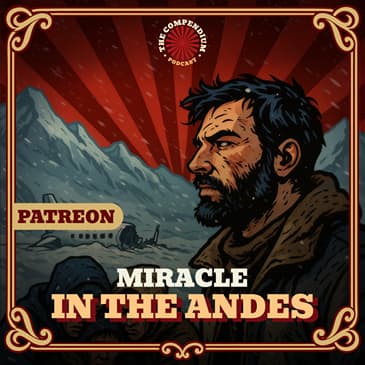
When Flight 571 crashed high in the Andes in October 1972, its passengers faced freezing temperatures, starvation and an abandoned search. Sixteen people survived 72 days before rescue.
The story commonly called the Miracle of the Andes is often reduced to its most shocking survival decision. That does not capture what happened. The survivors of Uruguayan Air Force Flight 571 endured injury, altitude, exposure, an avalanche, bereavement and the knowledge that official search efforts had stopped. To understand Miracle of the Andes, we need to separate the image that survived in popular culture from the chronology preserved in records, testimony and later research. That approach keeps the story compelling without allowing a dramatic claim to outrun the evidence.
What Happened in the Miracle of the Andes Story?
Flight 571 left Montevideo carrying members and associates of the Old Christians Club rugby team towards Chile. Bad weather forced an overnight stop in Mendoza. On 13 October 1972, a navigation error during the resumed journey placed the aircraft inside the mountains before it had safely crossed the Andes. That detail is central to understanding Miracle of the Andes because it connects the public story to the practical choices that shaped what followed.
The plane struck a ridge, losing its wings and tail before the fuselage slid onto a glacier. Some people died immediately and others succumbed to injuries in the following days. The survivors used luggage and wreckage to block the open fuselage and improvised protection against temperatures far below freezing. Contemporary accounts and later reconstructions do not agree on every minor detail, so the safest reading keeps the documented sequence separate from later embellishment.
Food consisted of a few snacks, wine and small amounts of chocolate. With no plants or animals at that altitude, the group eventually decided to eat the bodies of those who had died. Survivors have described the decision as agonising, collective and necessary, shaped by their Catholic beliefs and desire to keep one another alive. Seen in sequence, the event was not an isolated twist but part of a chain in which earlier decisions narrowed the options available later.
A radio brought devastating news: after eight days, the official search had been called off. Later, an avalanche buried the fuselage and killed eight more people. The survivors dug themselves out and remained trapped inside for days, turning the wreckage into both shelter and tomb. It is also where popular retellings tend to compress the timeline, turning a complicated development into a single dramatic moment.
Nando Parrado and Roberto Canessa eventually set out west with a sleeping bag sewn from insulation. After crossing peaks they had wrongly hoped would reveal nearby civilisation, they walked for ten days until they encountered Chilean horseman Sergio Catalán across a river and sent him a written message. The distinction matters for search readers because it answers not only what happened, but why the episode unfolded in that particular way.
Rescue helicopters reached the wreck on 22 and 23 December. Sixteen people came home after 72 days. Their later testimony reframed the story around teamwork, adaptation and consent rather than the lurid language that had dominated the first headlines. Later fame has sometimes overshadowed this stage, even though it provides the strongest evidence for how the story actually developed.
Why This Story Matters
Flight 571 is a study in collective survival. Leadership shifted according to need: some treated injuries, some rationed supplies, some repaired shelter and others accepted the physical risk of expeditions. It gives the story significance beyond its most famous image and makes clear why people continue to search for it.
The story also challenges easy moral judgement. Decisions made in an environment with no food cannot be evaluated as if they occurred in ordinary life. The survivors’ own explanations deserve priority over sensational retellings. That wider context is essential if the episode page is to inform readers rather than simply repeat a familiar headline.
Its endurance in books and films reflects a deeper question: how do people create meaning when rescue, rules and familiar institutions have disappeared? The answer was not individual heroism alone, but a fragile community repeatedly choosing to continue. For audiences today, the lasting value lies in recognising the mechanism, not only remembering the outcome.
The timeline also protects against hindsight. Once we know the outcome of Miracle of the Andes, earlier warnings can look obvious and every participant can appear to be moving towards a fixed ending. In reality, people around Uruguayan Air Force Flight 571 acted with partial information, competing loyalties and assumptions that made sense to them at the time. Reconstructing that uncertainty is more accurate than treating the conclusion as inevitable.
Another reason the story continues to attract attention is the gap between the evidence and the version most easily repeated. Terms such as Flight 571 survivors or Andes plane crash 1972 can lead readers towards a dramatic answer before they have encountered the underlying record. A careful account does not drain the story of suspense; it shows exactly where certainty ends and interpretation begins.
The people and institutions connected to Miracle of the Andes did not stop existing when the most famous event ended. Investigations, court decisions, scientific reviews, public memory and commercial retellings continued to reshape what later audiences believed. That afterlife is part of the history, particularly when discussion centres on parrado and canessa’s mountain crossing and the rescue of 16 survivors after 72 days rather than on the original chronology.
The strongest conclusion is therefore a measured one. We can state what documents, physical evidence and reliable testimony establish; we can identify the leading explanation where one exists; and we can label unresolved points honestly. That method makes Miracle of the Andes more useful as history because it respects both the reader’s curiosity and the lives changed by the events.
For us, the enduring question is not simply what makes Miracle of the Andes fascinating. It is what the evidence asks us to notice about institutions, incentives, memory and human behaviour. The strongest version of this story preserves uncertainty where it exists and gives documented experience more weight than a perfect ending.
Topics Include
The navigation error and crash of Flight 571
Life inside the broken fuselage
The decision to use the dead for food
The avalanche and cancelled search
Parrado and Canessa’s mountain crossing
The rescue of 16 survivors after 72 days