
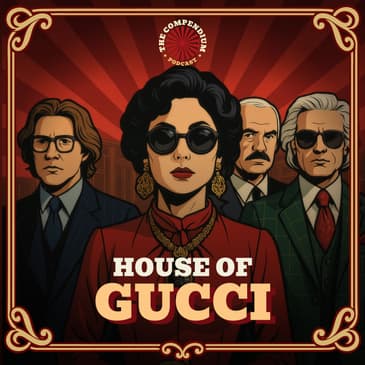
Maurizio Gucci inherited half of Italy’s most famous fashion house, forced his relatives out and then sold the family’s final stake. Two years later he was murdered in Milan, and his ex-wife Patrizia Reggiani was convicted of arranging the killing.
On the morning of 27 March 1995, Maurizio Gucci walked into the entrance of his office building on Via Palestro in Milan. A gunman shot him four times and escaped. The murder initially appeared to offer too many possible motives: Maurizio had fought relatives for control of Gucci, accumulated business enemies and endured an acrimonious divorce.
We are tracing how a Florentine luggage workshop became a global symbol of luxury, how family ownership collapsed under inheritance battles and licensing deals, and why investigators eventually looked back towards Maurizio’s former wife. The real story is dramatic enough without treating every scene in House of Gucci as documentary fact.
What Happened in the House of Gucci Murder?
Guccio Gucci founded the company in Florence in 1921. As a young man he had worked at London’s Savoy Hotel, where the luggage carried by wealthy guests helped shape his idea of refined travel goods. He combined that English association with Florentine leather craftsmanship and built a business whose name became inseparable from status.
Shortages during Italy’s Fascist period and the Second World War encouraged experiments with alternative materials. Bamboo handles, canvas and the diamond-pattern fabric that evolved into Gucci’s recognisable designs were not simply decorative inventions; they were answers to restricted supplies. Products such as the Bamboo bag, horsebit loafer and later the Jackie handbag turned practical adaptation into brand mythology.
Guccio’s sons Aldo, Vasco and Rodolfo expanded the company after his death in 1953. Aldo drove international growth, opening stores abroad and cultivating film stars, political families and the travelling elite. The family structure, however, tied corporate control to personal relationships. Shares passed through branches of the family, and every disagreement about a shop or licence could also become an argument about inheritance and loyalty.
When Vasco died without children, Aldo and Rodolfo each controlled half of the company. Aldo had three sons involved in the business, while Rodolfo had only one child, Maurizio. That meant Maurizio could eventually inherit an undivided 50 per cent stake while each of his cousins expected a much smaller portion. The arithmetic created resentment before the inheritance even arrived.
Maurizio had lost his mother as a child and grew up under Rodolfo’s protective control. In 1970 he met Patrizia Reggiani at a party. Patrizia came from a less established family but moved confidently through Milanese society, while Maurizio was shy and cautious. Rodolfo suspected that she wanted the Gucci name and fortune, but the couple married in 1972 and later had two daughters.
After a period of estrangement, Maurizio reconciled with his father and entered the family business. He and Patrizia lived between Milan, New York and holiday properties, projecting exactly the glamorous identity that Gucci sold. Patrizia became closely identified with the family name and expected to play a lasting part in its future.
By the 1980s the brand faced a contradiction. Licensing had made the double-G logo visible on hundreds of products and generated money, but ubiquity weakened its claim to exclusivity. Counterfeits multiplied, quality varied and the relatives blamed one another for diluting the house. Family meetings became legal warfare.
Rodolfo died in 1983, leaving Maurizio his half of Gucci. Maurizio then used alliances, litigation and outside capital to gain control. He briefly worked with his cousin Paolo against Aldo, and information supplied during the struggle contributed to Aldo’s conviction for US tax evasion. The spectacle of an elderly patriarch going to prison showed how completely corporate competition had consumed the family.
Maurizio arranged for Investcorp, the Bahrain-based investment group, to buy out other relatives. By 1989 he was chairman and the only Gucci family member still controlling the company. His goal was to restore scarcity and prestige by ending indiscriminate licences, closing weaker outlets and investing in fashion rather than logo-covered merchandise.
The strategy anticipated Gucci’s later revival but cost heavily. Maurizio hired experienced fashion executive Dawn Mello, who recruited new talent including Tom Ford, yet sales and finances remained under pressure. Investcorp eventually lost confidence. In 1993 Maurizio sold his remaining stake for a reported $170 million, ending more than seven decades of Gucci family ownership.
The irony is that the company flourished after the family left. Tom Ford became creative director in 1994 and, with executive Domenico De Sole, helped transform Gucci into one of the defining fashion brands of the decade. The name survived because professional management could make decisions without treating each collection as a referendum on family rank.
Maurizio’s marriage had already collapsed. In 1985 he left Patrizia, initially communicating the separation through a friend rather than confronting her directly. Their divorce was finalised in 1994. Patrizia received a substantial annual settlement, but money did not replace the identity, influence and future she associated with being a Gucci.
Friends and witnesses later described her anger, particularly over Maurizio’s relationship with Paola Franchi and the possibility that he might remarry. Patrizia had also undergone surgery for a brain tumour, and her defence would later argue that the operation affected her personality. That medical history became part of the trial, but it did not prevent conviction.
Investigators made little progress for nearly two years. The breakthrough came from information about people discussing the murder and demanding money. Police used surveillance and recorded conversations to identify a network around Patrizia’s friend and spiritual adviser Giuseppina Auriemma. Prosecutors said Auriemma helped connect Patrizia with organisers and the hired gunman Benedetto Ceraulo.
Authorities arrested Patrizia and the others in January 1997. At trial, prosecutors presented the killing as a paid conspiracy driven by jealousy, resentment and fear that remarriage would reduce what Patrizia’s daughters inherited. A diary entry she made on the day of the murder, consisting of the Greek word “paradeisos”, or paradise, became one of the case’s most memorable details.
In November 1998, Patrizia Reggiani was found guilty of arranging Maurizio’s murder and sentenced to 29 years in prison. Ceraulo received a life sentence, while Auriemma and other participants received substantial terms. Patrizia’s sentence was later reduced, and she was released in 2016 after serving eighteen years.
She has continued to deny ordering the murder in some interviews while making remarks that keep public fascination alive. Her daughters have argued that illness and manipulation affected her actions. The conviction, however, remains the legal conclusion: Maurizio’s death was not the work of a business rival or dispossessed cousin, but a murder-for-hire plot organised through his former wife’s circle.
Why This Story Matters
The Gucci saga matters because it separates a durable brand from the family that created it. Customers often buy luxury goods partly for a story of heritage and continuity. Behind that story, ownership can be fragmented, debt can dictate strategy and relatives can be removed without the public-facing identity changing at all.
It is also a case study in the dangers of family governance. The Guccis did not lack talent. Aldo internationalised the business, Maurizio recognised the damage caused by uncontrolled licensing and later managers proved that the brand could recover. What they lacked was a structure capable of resolving disputes without turning succession into personal combat.
Patrizia’s story complicates the familiar caricature of a rejected socialite. She experienced the marriage, company and Gucci name as a single identity. Losing them did not excuse violence, but it helps explain why a generous settlement could feel, to her, like humiliation rather than security. The murder converted a dispute over status into an irreversible crime.
The story also demonstrates why dramatic adaptations need careful handling. Ridley Scott’s film compresses years of business manoeuvring, invents private conversations and heightens personalities for entertainment. It can be a gateway to the history, but the documentary record is found in company timelines, contemporary reporting and the court case.
Gucci’s continuing success provides the final irony. The family destroyed its own control while fighting to protect the name, yet the company became more coherent after the last Gucci sold out. Maurizio did not live to see the full commercial revival, and Patrizia’s attempt to preserve her place in the dynasty ensured that she would be remembered for the act that placed her permanently outside it.
Topics Include
Guccio Gucci’s Savoy Hotel inspiration and 1921 Florence shop
Aldo, Rodolfo and the inheritance structure behind the family feud
Maurizio Gucci’s marriage to Patrizia Reggiani
Investcorp’s takeover and the end of Gucci family ownership
Maurizio’s 1995 murder and the police investigation
Patrizia’s conviction, sentence and release from prison
Resources and Further Reading
"The House of Gucci" by Sara Gay Forden
"Gucci: The Making of" by Frida Giannini, Katie Grand, and Peter Arnell
"The Gucci Mane" by Gucci Mane and Neil Martinez-Belkin
"Fashionopolis: The Price of Fast Fashion and the Future of Clothes" by Dana Thomas
"Empire of Fashion" by Gilles Lipovetsky