
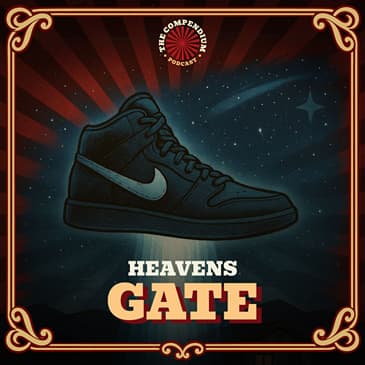
Heaven’s Gate fused Christian prophecy, UFO belief and the language of science fiction into a promise of escape. When Comet Hale-Bopp appeared in 1997, that promise led Marshall Applewhite and 38 followers towards one of America’s most haunting mass deaths.
The Heaven’s Gate cult is often remembered through a handful of surreal images: matching black-and-white Nike trainers, purple shrouds, a comet and an early website that still looks frozen in the 1990s. Those details are real, but they can make the group seem like a bizarre footnote rather than a movement that held people’s loyalty for more than two decades. Behind the spectacle were ordinary men and women who had surrendered their names, relationships, possessions and eventually their lives to a belief system that promised they could leave humanity behind.
We are tracing how Marshall Applewhite and Bonnie Nettles turned a shared fascination with religion, mysticism and extraterrestrial life into a closed world with its own rules. Their followers did not join a group openly advertising catastrophe. They were offered purpose, community and the chance to become something higher than human. The unsettling question is how that hopeful promise became a system in which obedience felt like freedom and death could be described as “graduation”.
What Happened to the Heaven’s Gate Cult?
Heaven’s Gate began in the early 1970s after Marshall Herff Applewhite met Bonnie Lu Nettles. Applewhite had grown up in a deeply religious Texas family and had studied theology before pursuing music and teaching. Nettles was a nurse with an interest in astrology, séances and other New Age ideas. Both were searching for a larger explanation of their lives, and their intense friendship persuaded them that their meeting had a cosmic purpose.
They began travelling together, studying subjects that ranged from biblical prophecy to UFOs and reincarnation. Over time, the pair concluded that they were the “Two Witnesses” described in the Book of Revelation. Their teaching blended Christianity with the language of extraterrestrial evolution: the Kingdom of Heaven became a literal “Next Level” above humanity, while Earth was a place due to be “recycled”. Applewhite and Nettles claimed that they had been sent to help a small number of people prepare to leave it.
During public meetings in the mid-1970s, the pair attracted people already exploring alternative spirituality and communal living. They were known by several sets of names, eventually becoming “Do” and “Ti”. New recruits were told that the human body was only a temporary vehicle. To become ready for the Next Level, they had to overcome the habits and attachments that defined ordinary human life.
That preparation demanded an extraordinary degree of control. Members gave up possessions, contact with families, romantic relationships and sexual activity. They adopted new names, similar clothes and closely cropped hair. Daily routines, meals and even small personal decisions were regulated. Pairing members together meant that each person was almost constantly observed by another. From outside, these rules look plainly coercive; from inside the group, they were presented as exercises in discipline and evidence of spiritual progress.
The group was not static. Its theology changed when reality contradicted earlier promises. At first, followers expected a physical transformation that would carry their living bodies aboard a spacecraft. Nettles’s death from cancer in 1985 created a profound crisis because one of the supposedly advanced beings had died in an unmistakably human way. Applewhite reframed her death as proof that a soul could leave its human “vehicle” and continue to the Next Level. That shift made abandoning the body compatible with the group’s beliefs.
By the 1990s, Heaven’s Gate had survived years of isolation, disappointment and predictions that had not come true. Members supported themselves partly through computer work and created a website to spread their message. The internet suited them: it allowed a physically withdrawn community to address the world while maintaining control over its own presentation. The surviving Heaven’s Gate site is therefore more than a curiosity. It shows how an apocalyptic movement adapted to a new technology at the very beginning of the commercial web.
The discovery of Comet Hale-Bopp transformed the group’s long wait into a final deadline. An unsupported rumour claimed that a spacecraft was travelling behind the comet. Applewhite treated it as confirmation that Ti had returned and that the opportunity to leave Earth had arrived. In late 1996, the group rented a large house in Rancho Santa Fe, near San Diego, where they recorded statements, prepared matching clothing and organised what they believed would be their departure.
In March 1997, as Hale-Bopp approached its closest point to Earth, Applewhite and 38 followers died over several days in the house. They left farewell recordings in which many spoke calmly and enthusiastically about going “home”. Their language is one of the most disturbing parts of the story because it shows how thoroughly death had been redefined. They did not describe themselves as choosing an ending; within the reality Applewhite had built, they believed they were stepping out of disposable bodies and joining a higher form of life.
The bodies were discovered on 26 March after a former member received a package and alerted authorities. The matching outfits, “Heaven’s Gate Away Team” patches, new Nike Decades and purple coverings immediately became symbols of the tragedy. They also made the deaths unusually easy to turn into a visual joke. That reaction obscured the individual lives involved and the long process that had narrowed their choices.
To understand what happened, we have to resist the comforting idea that 38 foolish people suddenly accepted an absurd command. Members had spent years inside a tightly bounded social system. Their families were distant, their old identities had been stripped away, and their future outside the group could appear frightening or empty. Each sacrifice made the next sacrifice easier to justify. By 1997, the belief was supported not by one persuasive speech but by decades of shared language, routine, loyalty and sunk cost.
Why This Story Matters
Heaven’s Gate matters because it demonstrates how extreme control can grow out of a search for belonging. Recruits were not attracted by purple shrouds or a plan for mass death. They heard an explanation for why the world felt alienating and an invitation to join a community with a special purpose. The movement gave uncertainty a structure: there was a reason for suffering, a deadline for change and a small group of people who supposedly understood the truth.
It also shows that destructive groups do not need to rely on constant physical violence. Heaven’s Gate controlled members by redefining ordinary needs as evidence of spiritual failure. Hunger, sexuality, affection, privacy and doubt became impulses to defeat. When every human attachment is treated as contamination, dependence on the group can feel like personal enlightenment. The followers’ apparent consent cannot be separated from the environment that shaped what choices seemed possible.
Nettles’s death reveals another important mechanism: failed prophecy does not always destroy a belief system. Applewhite converted a contradiction into a new doctrine. Instead of proving that the leaders were mortal, her death became proof that bodies were merely containers. That flexibility allowed the system to absorb disconfirming evidence and move towards a more dangerous conclusion. A closed belief can become stronger precisely because every challenge is reinterpreted as persecution or confirmation.
The story is also part of internet history. Heaven’s Gate used web design and online communication before most organisations understood what the internet would become. The group’s site offered doctrine, recruitment material and an apparently direct route to a hidden community. Today, online communities can create similarly self-reinforcing worlds at far greater speed and scale. The technology has changed, but the vulnerability remains: isolation can coexist with constant communication when every source inside a network repeats the same explanation.
Finally, the way the deaths were covered matters. The trainers, science-fiction vocabulary and comet were irresistible to comedians and headline writers. Those details deserve attention because they reveal the group’s culture, but ridicule can become a way of avoiding harder questions. The members were neither aliens nor caricatures. They were people whose desire for certainty was gradually turned against their own survival.
We return to Heaven’s Gate because the distance between devotion and delusion was not crossed in a single moment. It was built through thousands of small concessions, each made meaningful by the one before it. Following that progression helps us understand not only an infamous tragedy in 1997, but how intelligent people can lose the space to imagine a life beyond the group that claims to save them.
Topics Include
How Marshall Applewhite and Bonnie Nettles created Heaven’s Gate
The group’s mixture of Christian prophecy, UFO belief and the “Next Level”
Why members surrendered identity, relationships and personal choice
How Nettles’s death changed the cult’s teaching about the human body
The Hale-Bopp comet, the alleged spacecraft and the Rancho Santa Fe deaths
Why the Heaven’s Gate website and media response still matter
Resources and Further Reading
"Heaven's Gate: America's UFO Religion" by Benjamin E. Zeller
“Heavensgate.com” - official website
"Heaven's Gate: The Cult of Cults" – documentary series
"Heavens Gate” - Podcast by Glynn Washington
"The Psychology of Cults" – by Nisi Verity