
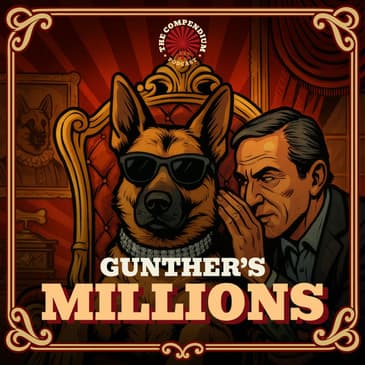
Gunther VI was advertised as the world's richest dog, heir to a German countess and owner of mansions, yachts and football clubs. Behind the headlines stood Maurizio Mian, a family fortune and a story that kept changing.
The headline is almost irresistible: a German shepherd inherits hundreds of millions from a reclusive countess and begins living the kind of life usually reserved for royalty. Gunther has been photographed beside pools, surrounded by attendants and associated with Madonna's former Miami mansion. The image works because it combines wealth, eccentricity and an animal apparently untouched by ordinary human ambition.
Yet the dog is only the most visible part of a complicated structure. Italian entrepreneur Maurizio Mian managed the fortune, promoted the Gunther legend and attached the name to property, sport, entertainment and experiments in happiness. We are separating the playful publicity from the more credible history, including the pharmaceutical wealth behind Mian's family and the uncertainty surrounding the famous countess.
What Happened Behind Gunther's Millions?
The public story begins with Countess Karlotta Liebenstein, said to have left a vast estate to her beloved German shepherd after the death of her son. The fortune supposedly passed through a line of dogs all named Gunther, each cared for by a trust. It is a neat origin myth, complete with grief, nobility and an heir who cannot answer questions.
Investigations and Mian's own later comments complicated that account. The countess was described as a convenient invention connected to financial and tax arrangements rather than the literal source of every euro. The underlying money was linked to Mian's family, whose wealth came from the Italian pharmaceutical company Istituto Gentili and a treatment for osteoporosis.
Putting assets in a dog's name makes for excellent publicity, but animals do not independently negotiate contracts, purchase property or direct investment strategies. Human trustees and companies make those decisions. Gunther's image therefore functioned as a brand and a story through which Mian's network could attract attention to assets that were controlled by people.
One of the best-known purchases was a Miami property formerly owned by Madonna. Reports of a dog buying the mansion circulated internationally and reinforced the fantasy of canine extravagance. The property was later offered for sale at a much higher price, demonstrating how the Gunther narrative could turn an ordinary luxury real-estate transaction into global news.
The empire extended into football. Gunther-linked companies acquired clubs and explored ambitious plans for training, talent and entertainment. In Italy, ventures involving Pisa and other teams mixed genuine investment with spectacle. The dog's name made every move more memorable, but the practical results did not always match the extravagant announcements.
Mian also assembled groups of attractive young people to live together in villas under the Gunther banner. The projects were presented as research into happiness, pleasure and freedom. Cameras recorded relationships, arguments and sexual experimentation, while rules and surveillance made the supposed utopia feel closer to reality television than independent scientific study.
The Gunther Group released music, staged publicity events and cultivated an aesthetic of endless leisure. Participants lounged beside pools, travelled and promoted a world in which money had removed ordinary limits. At the centre was Mian, who could use the dog as both mascot and emotional shield: criticism of the enterprise was easily redirected towards the absurd charm of its canine owner.
Figures attached to the fortune varied widely, rising from tens of millions to hundreds of millions of dollars. Asset values, corporate estimates and promotional claims were often blended together. Without transparent accounts, the exact total is difficult to verify. The uncertainty is part of the story rather than a small bookkeeping detail.
Gunther himself still benefited from extraordinary care, property and attention, but describing his life as personal choice is misleading. Dogs value routine, companionship and safety, not newspaper valuations or ownership deeds. The human fascination lies in projecting our own ideas of status onto an animal whose needs are far simpler.
The Netflix series brought these contradictions to a large audience by allowing Mian and former participants to recount the story in their own words. It did not reveal one tidy answer so much as display how a promotional legend can contain real wealth, invented biography, sincere attachment and deliberate theatre all at once.
Why This Story Matters
Gunther's Millions matters because the story demonstrates how wealth becomes more persuasive when it is narrated through personality. A trust or holding company is dry; a billionaire dog is irresistible. The same assets feel magical once attached to a face, a name and a succession story that can be repeated in a headline.
It also shows why opacity benefits the very rich. Different companies, trustees and jurisdictions can make ownership difficult to follow even before publicity adds a fictional countess. We should be cautious whenever an entertaining explanation asks us to stop examining the legal people and structures doing the real work.
The happiness experiments raise a separate question. Money can create comfort, privacy and opportunity, but it cannot guarantee meaning or healthy relationships. Participants lived amid luxury while still confronting jealousy, hierarchy and control. Their experiences challenge the assumption that removing material scarcity removes every other human problem.
There is tenderness in the attachment to the dogs, and the project should not be reduced to a single cynical trick. At the same time, affection can coexist with branding. The Gunther identity sold properties, documentaries and fantasies because audiences wanted to believe in an animal who had somehow beaten capitalism at its own game.
Listen for the countess who may never have existed, the pharmaceutical fortune, the Miami mansion, the football schemes and the carefully managed communities. The richest-dog claim is less interesting as a number than as a window into who controls a fortune and why an extravagant story can make that control disappear.
Topics Include
The legend of Countess Karlotta Liebenstein
Maurizio Mian and the Gentili pharmaceutical fortune
The Miami mansion formerly owned by Madonna
Football clubs and the Gunther business network
Happiness experiments, villas and surveillance
Why the exact value and ownership remain difficult to verify