
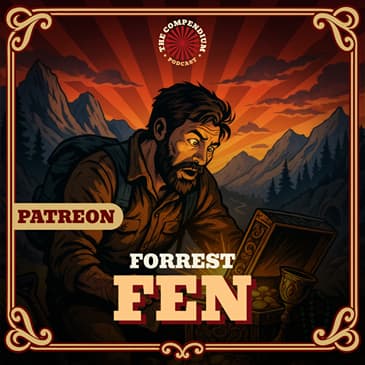
Art dealer Forrest Fenn said he hid a bronze chest filled with gold and jewels somewhere in the Rocky Mountains. A cryptic poem drove a decade of searching before the treasure was found in 2020.
Forrest Fenn offered an irresistible proposition: everything needed to find a fortune was hidden inside a poem. Searchers could transform geography, history and intuition into a route through the Rockies. The hunt created community and adventure, but it also produced obsession, danger and arguments that outlived the discovery. To understand Forrest Fenn treasure, we need to separate the image that survived in popular culture from the chronology preserved in records, testimony and later research. That approach keeps the story compelling without allowing a dramatic claim to outrun the evidence.
What Happened in the Forrest Fenn treasure Story?
Fenn was a former Air Force pilot and Santa Fe art dealer who survived cancer. In his 2010 memoir The Thrill of the Chase, he wrote that he had hidden a bronze chest containing gold coins, nuggets, jewellery and artefacts. A 24-line poem contained nine clues leading to it. That detail is central to understanding Forrest Fenn treasure because it connects the public story to the practical choices that shaped what followed.
He said the chest was in the Rocky Mountains north of Santa Fe, at an elevation between roughly 5,000 and 10,200 feet, and not in a graveyard, mine or dangerous structure. Phrases such as “warm waters halt”, “home of Brown” and “blaze” generated thousands of solutions. Contemporary accounts and later reconstructions do not agree on every minor detail, so the safest reading keeps the documented sequence separate from later embellishment.
Searchers travelled repeatedly through New Mexico, Colorado, Wyoming and Montana. Online communities compared maps and parsed Fenn’s interviews for unintended hints. Authorities urged caution after several people died while searching, and critics argued that the hunt encouraged risky behaviour in remote terrain. Seen in sequence, the event was not an isolated twist but part of a chain in which earlier decisions narrowed the options available later.
Fenn announced in June 2020 that the chest had been found, initially withholding the finder’s identity and precise location. Photographs showed Fenn examining the recovered objects. The secrecy triggered accusations, lawsuits and claims that the hunt was fraudulent or had ended unfairly. It is also where popular retellings tend to compress the timeline, turning a complicated development into a single dramatic moment.
Medical student and journalist Jack Stuef later identified himself as the finder. He described solving the poem through Fenn’s emotional connection to a place rather than a purely mechanical cipher. Court proceedings and later disclosures indicated that the chest had been found in Wyoming. The distinction matters for search readers because it answers not only what happened, but why the episode unfolded in that particular way.
After Fenn’s death in September 2020, debate continued over the exact site. Evidence released through legal disputes has pointed towards Yellowstone National Park, while the location has not been formally promoted as a public destination. The chest was later sold at auction in separate lots. Later fame has sometimes overshadowed this stage, even though it provides the strongest evidence for how the story actually developed.
Why This Story Matters
The hunt shows how ambiguity can sustain participation. The poem offered enough structure to feel solvable and enough openness for almost any landscape to fit. It gives the story significance beyond its most famous image and makes clear why people continue to search for it.
It also raises ethical questions about responsibility. Searchers made their own decisions, but the creator knew that a game involving treasure and wilderness could push people beyond ordinary caution. That wider context is essential if the episode page is to inform readers rather than simply repeat a familiar headline.
The continuing demand for the exact spot suggests that discovery did not end the story. For many participants, the real object was proof that their interpretation of Fenn mattered. For audiences today, the lasting value lies in recognising the mechanism, not only remembering the outcome.
The timeline also protects against hindsight. Once we know the outcome of Forrest Fenn treasure, earlier warnings can look obvious and every participant can appear to be moving towards a fixed ending. In reality, people around Forrest Fenn acted with partial information, competing loyalties and assumptions that made sense to them at the time. Reconstructing that uncertainty is more accurate than treating the conclusion as inevitable.
Another reason the story continues to attract attention is the gap between the evidence and the version most easily repeated. Terms such as where was Forrest Fenn treasure found or Thrill of the Chase poem clues can lead readers towards a dramatic answer before they have encountered the underlying record. A careful account does not drain the story of suspense; it shows exactly where certainty ends and interpretation begins.
The people and institutions connected to Forrest Fenn treasure did not stop existing when the most famous event ended. Investigations, court decisions, scientific reviews, public memory and commercial retellings continued to reshape what later audiences believed. That afterlife is part of the history, particularly when discussion centres on jack stuef’s 2020 discovery and why the exact location remains contested rather than on the original chronology.
The strongest conclusion is therefore a measured one. We can state what documents, physical evidence and reliable testimony establish; we can identify the leading explanation where one exists; and we can label unresolved points honestly. That method makes Forrest Fenn treasure more useful as history because it respects both the reader’s curiosity and the lives changed by the events.
For us, the enduring question is not simply what makes Forrest Fenn treasure fascinating. It is what the evidence asks us to notice about institutions, incentives, memory and human behaviour. The strongest version of this story preserves uncertainty where it exists and gives documented experience more weight than a perfect ending.
Topics Include
Forrest Fenn’s life and hidden chest
The nine clues in The Thrill of the Chase
Search communities and competing solutions
Deaths and official safety warnings
Jack Stuef’s 2020 discovery
Why the exact location remains contested