
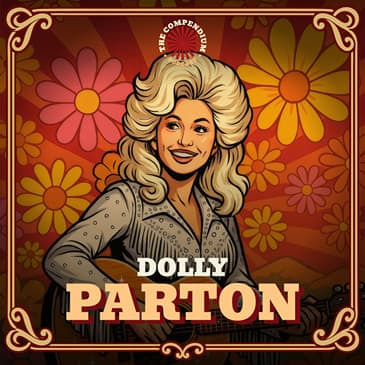
Dolly Parton turned a childhood in rural Tennessee into a songwriting catalogue, a global entertainment career and a business empire. Her philanthropy and carefully guarded private life made her influence reach far beyond country music.
Dolly Parton understood the power of appearance before the rest of the world understood her talent. The towering hair, rhinestones and self-deprecating jokes invited people to underestimate her, while she protected her publishing, wrote songs with startling emotional precision and built businesses around a public image that belonged entirely to her. The joke was never on Dolly.
Her story stretches from a one-room cabin in the Great Smoky Mountains to Nashville, Hollywood, Dollywood and millions of books mailed to young children. Following that journey means looking beyond a collection of hits. We see a songwriter who treated ownership as freedom, a performer who made warmth feel effortless and a philanthropist whose projects reflected the circumstances of her own family.
What Happened in Dolly Parton's Remarkable Career?
Dolly Rebecca Parton was born in 1946 in Sevier County, Tennessee, one of twelve children. Her family had little money, but music was abundant through church, relatives and Appalachian traditions. She began performing locally as a child and appeared on radio and television programmes before she was old enough to drive herself to Nashville.
The day after graduating from high school, she moved to Nashville. Early success came as a songwriter, including recordings by other artists, while record executives initially encouraged her towards pop material. Her country breakthrough gathered pace when Porter Wagoner invited her onto his television show in 1967, introducing her to a large weekly audience.
The Wagoner partnership produced hit duets and gave Dolly a powerful platform, but it also created tension as she sought control of her solo career. She wrote I Will Always Love You when leaving the professional partnership, turning a difficult goodbye into a song of gratitude. The composition later became a global phenomenon through Whitney Houston's recording.
Jolene displayed a different strength. Built around a simple guitar figure and direct plea, it transformed jealousy into empathy by addressing the other woman rather than attacking her. Coat of Many Colors drew on childhood poverty without romanticising hunger. Across both songs, Dolly used specific images to make private feelings immediately understandable.
Her crossover years brought wider audiences without severing her country roots. The film 9 to 5 allowed her to act, write its title song and join a workplace comedy about sexism and unequal power. She reportedly developed the song's rhythm by clicking her acrylic nails, turning an everyday detail into one of the most recognisable openings in popular music.
Business independence was equally important. Dolly retained valuable publishing rights and famously declined Elvis Presley's proposed recording of I Will Always Love You when the arrangement required a share of the copyright. The decision cost an exciting opportunity in the short term but protected an asset that later generated extraordinary income.
Dollywood, developed in partnership with Herschend Family Entertainment in the 1980s, connected her brand to her home region. It created jobs, attracted visitors and presented Appalachian culture through an entertainment business. The park's success demonstrated that Dolly's commercial instincts extended beyond recordings and screen roles.
Her private life remained unusually stable and protected. She married Carl Dean in 1966, but he largely avoided publicity. Dolly joked freely about crushes, appearance and rumours while drawing a firm line around the marriage itself. That contrast helped her remain open with audiences without surrendering every part of her identity.
The Imagination Library began in 1995 in her home county, inspired in part by her father, who could not read or write. The programme mails free books to children from birth to school age and expanded internationally. Its model turns a personal family memory into a practical intervention repeated month after month in millions of homes.
Dolly also supported disaster recovery, education, medical care and research. During the COVID-19 pandemic, her donation to Vanderbilt University Medical Center helped fund work connected to the Moderna vaccine. The contribution became another example of her ability to make generosity visible without making it feel like a performance of superiority.
Her later years brought new collaborations, honours and a continuing willingness to cross genres. The catalogue outlived fashion cycles because the central craft remained strong. Even when the wigs grew larger and the jokes became familiar, the songs still carried stories of ambition, shame, desire, work and home.
Dolly Parton died in August 2026, prompting tributes from music, film, literacy organisations and the communities shaped by her businesses. The scale of that response reflected more than celebrity. It marked the loss of an artist whose work had entered family memories and whose institutions will continue operating beyond her lifetime.
Why This Story Matters
Dolly's career matters because she converted authenticity into control rather than allowing other people to package it for her. She could exaggerate her image while remaining exact about contracts, publishing and ownership. That combination challenges the lazy idea that glamour and business intelligence belong to different kinds of women.
Her songwriting also demonstrates the value of clarity. The language is often conversational, but the emotional structure is sophisticated. Jolene allows admiration and fear to coexist; I Will Always Love You makes departure loving rather than cruel. We remember the hooks because the human dilemmas beneath them are instantly recognisable.
The philanthropy is powerful because it is tied to place and experience. Literacy was not an abstract cause when her father had been unable to read. Jobs in East Tennessee were not a branding exercise when she understood the region's poverty. Her projects turned biography into infrastructure rather than simply using hardship as an origin story.
There are contradictions worth keeping. Dollywood is both regional investment and a commercial attraction; her public persona is both sincere and meticulously constructed. Admiring Dolly does not require pretending those tensions disappear. It means recognising how skilfully she made commerce, creativity and community reinforce one another.
Listen for the mountain childhood, Porter Wagoner, the publishing decision that protected I Will Always Love You, the fingernail rhythm of 9 to 5 and the first books mailed through the Imagination Library. Behind the rhinestones was a lifelong argument that kindness and ambition do not have to cancel each other out.
Topics Include
Dolly Parton's childhood in Sevier County, Tennessee
Porter Wagoner and the launch of her national career
Jolene, Coat of Many Colors and I Will Always Love You
9 to 5, acting and crossover success
Dollywood, publishing rights and business independence
The Imagination Library and her philanthropic legacy
Resources and Further Reading
Dolly: My Life and Other Unfinished Business autobiography
Dolly Parton: Here I Am available on Netflix
Songteller: My Life in Lyrics" by Dolly Parton for those interested in her songwriting process.
Dolly Parton’s Imagination Library for her philanthropic efforts:
Dolly Parton Delivers Commencement Address at the University of Tennessee 2009
This Weeks Guest:
Lizzie Evans - "A Local Gal Born & Bred."
Follow Lizzie @elizabeth.k.evans