
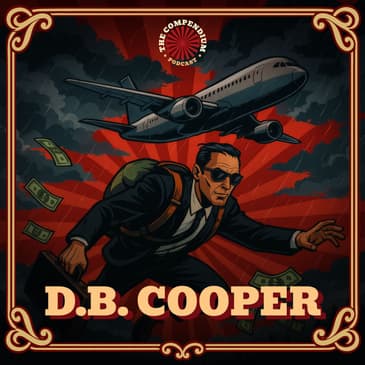
On 24 November 1971, a man calling himself Dan Cooper hijacked Northwest Orient Flight 305, collected $200,000 and parachuted into a stormy night. Neither the hijacker nor most of the ransom was ever found.
The only unsolved hijacking in American commercial aviation history began with a cash ticket and a quiet passenger in a business suit. There was no dramatic takeover of the cockpit. Cooper passed a note to a flight attendant, calmly described a bomb and negotiated while the Boeing 727 continued towards Seattle.
We retrace the flight, the ransom exchange and the extraordinary jump from the aircraft's rear stairs. Then we examine the physical evidence, the money found beside the Columbia River and the suspects who have attracted attention. The mystery survives because every answer creates another question: did Cooper plan brilliantly, improvise recklessly or die before he could spend a dollar?
What Happened in the DB Cooper Hijacking?
On the afternoon before Thanksgiving, a man bought a one-way ticket from Portland to Seattle under the name Dan Cooper. A reporting error later transformed him into "D. B. Cooper", the name by which he became famous. Witnesses described a white man in his mid-forties wearing a dark suit, white shirt, black tie and loafers.
After take-off, Cooper handed flight attendant Florence Schaffner a note. She initially assumed it was a telephone number, but he told her to read it and showed what appeared to be a bomb in his case. He demanded $200,000 in twenty-dollar notes, four parachutes and a fuel truck ready when the plane landed in Seattle.
Authorities assembled the ransom and recorded every serial number. The demand for multiple parachutes discouraged police from supplying sabotaged equipment because it suggested Cooper might force a hostage to jump with him. When Flight 305 landed, the passengers and two flight attendants were released in exchange for the money and parachutes.
Cooper kept a small crew aboard and ordered the plane towards Mexico City. He specified a low altitude, slow speed, landing gear down and the rear airstair extended. The crew explained that the aircraft could not take off safely with the stairs lowered, so Cooper agreed to deploy them after departure.
Somewhere over south-west Washington, after 8pm, a pressure change indicated that the rear stairs had moved. Cooper had tied the money bag with cord cut from a reserve parachute and jumped into darkness, rain, wind and cold. He wore unsuitable shoes and had no visible protective equipment. The crew landed safely in Reno; Cooper was gone.
The FBI named the investigation NORJAK, for Northwest Hijacking. Agents searched the aircraft, interviewed witnesses and examined a clip-on tie, cigarette butts and fingerprints. The cigarettes were later lost, and the fingerprints could not conclusively identify the hijacker. The tie has generated later theories based on particles found on it, but those findings do not name a person.
Search teams attempted to calculate the drop zone from the aircraft's speed, course, weather and stair movement. The variables created a wide and difficult area of forest and river. No parachute, body or complete ransom bundle was recovered. Investigators debated whether an inexperienced jumper could have survived those conditions.
In 1980, eight-year-old Brian Ingram found three deteriorating packets of twenty-dollar bills at Tena Bar on the Columbia River. The $5,800 matched the ransom serial numbers. The discovery proved that some Cooper money reached the river area, but how and when it arrived remains disputed.
The FBI considered more than 800 suspects within the first five years. Richard McCoy carried out a similar parachute hijacking months later, but investigators identified differences and did not conclude that he was Cooper. Other frequently named candidates have included experienced parachutists, pilots, criminals and people identified by relatives after death.
Suspect stories often fit selected details while conflicting with age, appearance, location or evidence. Memory also changes. Witnesses who saw Cooper briefly under stress were later asked to compare him with photographs years or decades afterwards. A resemblance can generate a theory without proving identity.
In 2016, the FBI redirected resources away from the active case while preserving evidence for future analysis. The bureau has not declared that Cooper survived or identified him. Private researchers continue to examine documents, landscape changes, money movement and new names, but the official mystery remains unresolved.
Why This Story Matters
The hijacking changed aviation. Cooper exploited an era when passengers could buy a ticket with cash and board without modern security screening. Airlines later introduced metal detectors and fitted Boeing 727s with a device, nicknamed the Cooper vane, that prevented rear stairs from being lowered in flight.
The story also demonstrates how mystery can romanticise crime. Cooper is often portrayed as a gentleman outlaw who embarrassed powerful institutions and vanished cleanly. That version minimises the fear imposed on the crew and passengers and the real risk created by carrying what appeared to be a bomb aboard an aircraft.
His survival is not established. A night jump into rough country with poor clothing, an uncertain parachute and a heavy money bag could easily have been fatal. Yet the absence of remains allows the escape narrative to flourish, while the unspent ransom encourages both interpretations.
The case is a useful lesson in evidence. A tie, a pressure bump and three packets of money are tangible; a confident family story is not the same kind of proof. The strongest theory must explain all of the evidence, not only the details that make one suspect attractive.
Listen to the episode for Cooper's precise demands, the flight crew's decisions, the dangerous jump, Tena Bar and the leading suspects. Half a century later, the image endures: a man in a suit stepping from an airliner into darkness and becoming a legend before anyone knew whether he reached the ground alive.
Topics Include
Dan Cooper's cash ticket and the origin of the D. B. Cooper name
The bomb note, ransom demand and four requested parachutes
Northwest Orient Flight 305's rear stairs and night-time jump
The NORJAK investigation, fingerprints, cigarettes and clip-on tie
The ransom money discovered at Tena Bar in 1980
Leading suspects, survival arguments and the FBI's 2016 decision
Resources and Further Reading
"Skyjack: The Hunt for D. B. Cooper" by Geoffrey Gray.
The DB Cooper page on the FBI's official website. 3. "The Mystery of DB Cooper" - HBO Documentary.
"DB Cooper: Where are you" - 2022 Netflix documentry
"Into The Blast – The True Story of D.B. Cooper" by Skipp Porteous and Robert Blevins.