
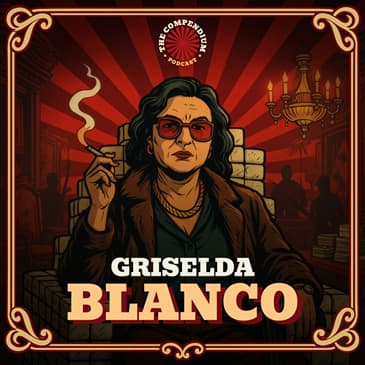
Griselda Blanco helped build a cocaine network that stretched from Colombia to New York, Miami and California, while investigators linked her organisation to extraordinary violence. Her rise made her one of the most feared traffickers of the “Cocaine Cowboys” era, but the legend now surrounding her is often harder to separate from the documented record.
Griselda Blanco has been called the Cocaine Godmother, the Black Widow and the Queen of Cocaine. Each nickname makes her sound like a character created for television: a ruthless woman who entered a male-dominated criminal world, outmanoeuvred her rivals and built an empire through nerve and violence. The real history is more complicated, and far less glamorous.
Blanco's life sits at the intersection of Colombia's expanding cocaine trade and the surge of money and murder that transformed parts of Miami in the late 1970s and early 1980s. We are following the evidence from an enormous New York conspiracy case to her arrest in California, while separating criminal convictions from allegations, family stories and the mythology repeated by documentaries and dramas.
What Happened to Griselda Blanco, the Cocaine Godmother?
Griselda Blanco Restrepo was born in Colombia in 1943 and grew up in Medellín. Reliable details about her childhood are scarce. Later accounts describe poverty, abuse and early involvement in crime, but many of the most sensational stories cannot be independently verified. That uncertainty matters because popular biographies often present rumour as fact in order to make her later violence appear inevitable.
By the early 1970s, Blanco was connected to a cocaine-trafficking operation moving drugs from Colombia into the United States. She and her second husband, Alberto Bravo, used New York as a major distribution centre. The business expanded at precisely the moment cocaine was becoming a fashionable and extremely profitable American drug. Smugglers developed concealed clothing, false documents and networks of couriers to move product across borders and cash back to suppliers.
Federal investigators responded with Operation Banshee. In April 1975, prosecutors in New York indicted Blanco and more than 30 alleged associates in what was then an unusually large cocaine-conspiracy case. Court records later described testimony about a network operating between Colombia, Miami and New York. Blanco was not arrested with the others. She returned to Colombia and remained beyond the reach of American authorities.
Her relationship with Bravo ended violently. Accounts differ on the precise circumstances, but he was killed in Colombia and Blanco acquired the “Black Widow” name as rumours spread that she had arranged or personally committed the killing. Similar uncertainty surrounds the deaths of other partners. Her reputation became a form of power in itself: people feared not only what could be proven, but what they believed she was capable of doing.
By the end of the 1970s, Blanco's organisation was heavily involved in South Florida. Miami had become a gateway for Colombian cocaine, and vast profits intensified competition between traffickers. The violence burst into public view in July 1979 when gunmen attacked a liquor store at Dadeland Mall. The event became a symbol of the “Cocaine Cowboys” period, when contract killings and heavily armed confrontations made drug trafficking impossible for the city to treat as an invisible underground economy.
Blanco's network was associated with markets in Miami, New York and Los Angeles. Estimates of its revenue vary, and claims that she was a billionaire should be treated cautiously, but investigators regarded the operation as exceptionally large. She also developed a fearsome reputation for ordering deaths over debts, betrayal and personal disputes. Law-enforcement officers investigated dozens of killings connected to her circle, though she was never convicted for anything close to the hundreds of murders sometimes attributed to her.
One particularly notorious case involved the 1982 killing of two-year-old Johnny Castro during an attempt on his father's life. Prosecutors later charged Blanco in connection with that murder and others. The child's death stripped away any romantic idea of targeted underworld violence. The cocaine trade's victims were not limited to people who knowingly entered it.
As pressure increased in Miami, Blanco moved to California. Investigators used an informant connected to her sons to gather evidence and locate her. On 17 February 1985, Drug Enforcement Administration agents arrested her at a home in Irvine. A decade after the New York indictment, the woman who had repeatedly used aliases and moved between countries was finally in federal custody.
Blanco was convicted on federal drug charges and received a 15-year prison sentence. Florida prosecutors later attempted to build murder cases around testimony from Jorge “Rivi” Ayala, a former hitman. That prosecution was damaged by a scandal involving Ayala and staff in the state attorney's office. In 1998, Blanco pleaded guilty to three counts of second-degree murder and received concurrent 20-year sentences. The plea secured murder convictions, but it also meant that many wider allegations were never tested before a jury.
She was released from prison in 2004 and deported to Colombia. After years of publicity, she kept a comparatively low profile in Medellín. On 3 September 2012, gunmen shot her outside a butcher's shop. Reports said the attacker approached on a motorcycle, an ending widely presented as poetic because motorcycle assassins had become associated with the violence of the cocaine era. Her murder was never reduced to a single, publicly proven motive.
Blanco's family also paid a devastating price. Three of her older sons were killed after returning to Colombia. Her youngest, Michael Corleone Blanco, survived and later spoke publicly about growing up amid guards, luxury and repeated danger. His name, taken from The Godfather, is one of the clearest signs that the family itself participated in building the mythology now sold back to audiences.
Why This Story Matters
Griselda Blanco's story matters because popular culture often mistakes exceptionality for empowerment. She did achieve power in a criminal economy dominated by men, but that does not make the enterprise liberating. The organisation depended on exploitation, intimidation, addiction and murder. Calling her a “girlboss” with guns turns real victims into background decoration for a stylish antihero.
The history also helps explain Miami's transformation. Cocaine money entered property, nightlife and legitimate businesses, while law enforcement, courts and morgues struggled with the accompanying violence. Blanco was important, but she was not the sole ruler of the city's drug trade. Many organisations competed and cooperated across Colombia, the Caribbean and the United States. Focusing on one charismatic figure can obscure that larger system.
We also need to distinguish the documented Blanco from the legend. Stories claim that she invented motorcycle drive-by killings, mentored Pablo Escobar or controlled every major cocaine route. The evidence for such neat origin stories is weak or contested. Her power and brutality do not need exaggeration. The 1975 indictment, the 1985 arrest, the drug conviction and the later murder pleas already establish a consequential criminal career.
That distinction becomes especially important when television dramatises private conversations, motives and relationships that no surviving record can confirm. A series can create emotional coherence where history offers gaps. Viewers may leave with a vivid impression while forgetting which scenes were invented, compressed or borrowed from competing accounts.
Blanco remains fascinating because her life exposes how fear becomes a brand. Nicknames, rumours and stories protected her while she was active, then kept her marketable after death. We can acknowledge the intelligence required to evade capture for years without admiring the harm it served. Listen to the episode for Operation Banshee, the Miami drug wars, the undercover route to her arrest and the extraordinary collapse of the murder prosecution.
Topics Include
Griselda Blanco's early life in Colombia and the uncertain stories surrounding it
Operation Banshee and the 1975 New York cocaine-conspiracy indictment
Miami's “Cocaine Cowboys” era and the violence linked to Blanco's organisation
The informant operation that led DEA agents to arrest her in California
Her drug conviction, murder pleas, deportation and 2012 killing in Medellín
How documentaries and dramas turned the Cocaine Godmother into an antihero
Resources and Further Reading
"Griselda Blanco" - Wikipedia
"Griselda" – Netflix Series 2024
"The True Story of Griselda Blanco" – by Kalia Richardson
"Cocaine Economics: - by Peter S. Green
"Michael Corleone Blanco (EP2) – The Sit Down" - Berners Round Table Podcast