
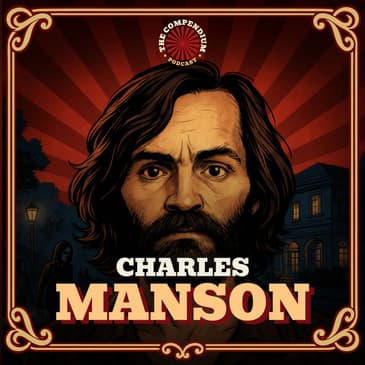
Charles Manson turned a Beatles song about a fairground slide into an apocalyptic prophecy. But was “Helter Skelter” really the motive behind the Manson Family murders, or the story that made an impossible prosecution possible?
The Charles Manson murders have been retold so often that their most familiar explanation can feel settled. In August 1969, followers of a failed musician entered two Los Angeles homes and murdered seven people across two nights. The victims included actress Sharon Tate, who was heavily pregnant, and Leno and Rosemary LaBianca. Prosecutor Vincent Bugliosi argued that Manson ordered the killings to help ignite a race war he called “Helter Skelter”, borrowing the name from a song on the Beatles' White Album.
That version explains how a man who was not present for most of the killings could be convicted alongside those who carried them out. It also transformed a piece of popular music into part of America's darkest mythology. We trace how Manson built control over a group of vulnerable followers, how his frustration with the music industry collided with his increasingly violent beliefs, and why journalist Tom O'Neill's Chaos has forced people to look again at the official motive. The crimes are not in doubt. The difficult question is whether the story told about why they happened contains the whole truth.
What Happened in the Charles Manson Murders?
The Charles Manson murders were committed by members of the group commonly known as the Manson Family, under Manson's influence and direction. On the night of 8 August 1969, Tex Watson, Susan Atkins, Patricia Krenwinkel and Linda Kasabian went to 10050 Cielo Drive in Los Angeles. The house had previously been occupied by record producer Terry Melcher, whom Manson had pursued for help with his music career. Melcher no longer lived there.
Inside were Sharon Tate, Jay Sebring, Abigail Folger and Wojciech Frykowski. Steven Parent, who had been visiting the property's caretaker, was leaving in his car. All five were killed. The following night, Manson accompanied several followers while searching for another target, eventually entering the home of Leno and Rosemary LaBianca. After tying up the couple, he left. Watson, Krenwinkel and Leslie Van Houten then murdered them. Words including “rise” and a misspelled “Healter Skelter” were written at the scenes.
These attacks did not emerge from nowhere. By 1969, Manson had spent much of his life in institutions and prisons. After his release in 1967, he entered San Francisco's counterculture at precisely the moment when young people were arriving in Haight-Ashbury searching for freedom, community and identity. Manson presented himself as a musician, philosopher and spiritual guide. He offered belonging, then steadily replaced his followers' independence with his own authority.
Women including Mary Brunner, Lynette “Squeaky” Fromme, Patricia Krenwinkel and Susan Atkins became central to the group. Drugs, sex, isolation and Manson's constant reframing of reality helped create an environment in which obedience was presented as enlightenment. Calling them simply gullible misses the mechanics of coercive control. Many were young, estranged from family or searching for a place to belong. Manson learned how to turn those needs into loyalty.
His ambitions were not originally centred on murder. Manson wanted to become a recording artist. Through members of the group, he met Beach Boys drummer Dennis Wilson and moved himself and his followers into Wilson's home. The Beach Boys recorded an altered version of Manson's song “Cease to Exist” as “Never Learn Not to Love”, without crediting him as its writer. Wilson also introduced him to figures in the Los Angeles music industry, including Terry Melcher, but the record deal Manson imagined never arrived.
At Spahn Ranch, where the group later lived, Manson's teaching became increasingly apocalyptic. He treated the Beatles' 1968 White Album as a collection of messages intended specifically for him. Songs including “Blackbird”, “Piggies”, “Revolution 9” and “Helter Skelter” were forced into a racist prophecy: Black Americans would rise against white society, a catastrophic war would follow, and the Manson Family would survive before emerging to rule what remained.
The Beatles intended nothing of the kind. Paul McCartney's “Helter Skelter” was named after a British fairground slide and conceived as an attempt to make an especially loud, dirty rock record. Manson supplied the murderous meaning himself. The album did not instruct his followers; he used it as an authority outside himself, something that appeared to confirm the worldview he was already teaching.
Violence escalated before the Tate-LaBianca murders. Manson shot drug dealer Bernard “Lotsapoppa” Crowe, mistakenly believing he had killed him. Members of the Family then became involved in the detention and killing of musician Gary Hinman. Bobby Beausoleil was arrested for that murder. These events provide important context because they show a group already crossing the boundary into serious violence, with motives involving drugs, money, loyalty and efforts to protect one another.
Police did not initially connect the two nights of killings. The case broke open through confessions, physical evidence and Linda Kasabian's cooperation with prosecutors. At trial, Bugliosi used the Helter Skelter theory to demonstrate Manson's control and establish a shared plan. Manson, Krenwinkel, Atkins, Watson and Van Houten were ultimately convicted. Death sentences were later commuted to life when California temporarily invalidated capital punishment.
That trial narrative became the foundation for Bugliosi and Curt Gentry's bestselling book Helter Skelter. It remains the best-known explanation of the crimes. Yet motive does not need to be singular, and the certainty of Bugliosi's version has been challenged. Rejected musical ambition, drug disputes, attempts to free Beausoleil by creating copycat crimes, personal grudges and Manson's need to preserve authority may all have intersected with his apocalyptic preaching.
Why This Story Matters
The story matters first because the mythology of Charles Manson can overwhelm the people he harmed. Manson cultivated spectacle in court and throughout his imprisonment. The press helped turn him into an almost supernatural symbol of evil. That image risks granting him the cultural power he spent his life seeking, while Sharon Tate, Steven Parent, Jay Sebring, Abigail Folger, Wojciech Frykowski, Leno and Rosemary LaBianca are reduced to names in somebody else's legend.
It also matters because the case offers a stark lesson in coercive control. Manson did not need conventional authority, wealth or physical stature to dominate his followers. He controlled access to belonging, reshaped language, encouraged isolation and made resistance feel like betrayal. Understanding that process is more useful than treating everyone around him as hypnotised or inherently monstrous.
Tom O'Neill's 2019 book Chaos: Charles Manson, the CIA, and the Secret History of the Sixties, and Errol Morris's later documentary, revisit contradictions in the investigation and Bugliosi's presentation of the case. O'Neill documented troubling questions about witnesses, evidence, Manson's repeated avoidance of parole consequences and links between figures in his orbit and government-funded drug research. He also explores MKUltra, the CIA's real programme of experiments involving LSD and behavioural control.
Those connections require careful language. There is no documentary proof that Manson was created or directed by MKUltra, or that the CIA ordered the murders. O'Neill himself does not claim to have solved the case with a single alternative theory. His strongest contribution is showing where the official account appears incomplete, contradictory or shaped to win a trial. A genuine government programme and a set of unexplained overlaps are not, by themselves, proof of a government plot.
That tension is why the case remains compelling. The familiar story contains established facts, persuasive testimony and a prosecutorial theory that secured convictions. It also contains gaps large enough to support decades of speculation. In the full episode, we follow the path from the White Album to Spahn Ranch, the two nights that terrified Los Angeles and the claims that ask us to separate a documented conspiracy from a seductive one.
Topics Include
Charles Manson, the Manson Family and coercive control
Sharon Tate and the Tate-LaBianca murders of August 1969
How Manson distorted the Beatles' “Helter Skelter”
Dennis Wilson, Terry Melcher and Manson's failed music career
Vincent Bugliosi's Helter Skelter motive and the murder trial
Tom O'Neill's Chaos, MKUltra claims and the unanswered questions
Resources and Further Reading
Helter Skelter: The True Story of the Manson Murders – by Vincent Bugliosi and Curt Gentry.
Chaos: Charles Manson, the CIA, and the Secret History of the Sixties – by Tom O'Neill with Dan Piepenbring.
The Manson Family – Wikipedia
Chaos the Manson Murders Netflix Documentry – Errol Morris