
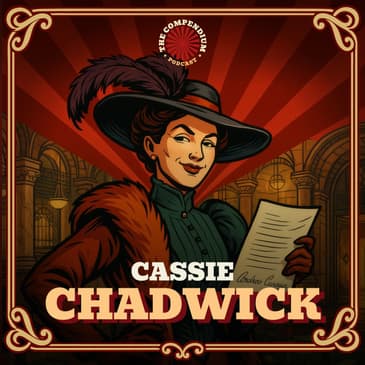
In 1857 Cassie Chadwick convinced American bankers that she was Andrew Carnegie’s secret daughter and borrowed a fortune against an inheritance that did not exist. Her Gilded Age con ruined a bank and exposed how greed could overwhelm basic due diligence.
Long before Anna Delvey invented a European trust fund, Cassie Chadwick discovered that apparent wealth could generate real credit. We are following how she carried forged promissory notes bearing Andrew Carnegie’s name, hinted at an enormous future inheritance and allowed Cleveland’s financial elite to spread the secret for her.
The scale of the fraud was extraordinary, but the method was simple. Cassie did not need every banker to believe her. She needed one respected man to accept the papers, another to interpret that acceptance as verification and a network of ambitious lenders to fear missing a profitable relationship with Carnegie’s supposed heir. Her story asks us to look at the bankers’ appetite for the fiction as closely as the woman who created it.
What Happened in the Cassie Chadwick Scam?
Cassie was born Elizabeth Bigley in Eastwood, Ontario, in 1857. Stories of her early life vary in detail, but the pattern appeared young. As a teenager she forged a letter announcing an inheritance, opened accounts and used the expectation of future wealth to obtain goods on credit. An early prosecution ended without a lasting conviction, reportedly after she was judged mentally unwell.
After moving to Cleveland, she adopted new names and identities. As Lydia DeVere and other aliases, she worked as a clairvoyant, married repeatedly and persuaded clients or admirers to lend her money. In 1889, a forgery case in Toledo brought a sentence of nine and a half years. She served only part of it before being paroled by Ohio governor William McKinley.
Returning to Cleveland, she used the name Cassie Hoover and became associated with a brothel or boarding house. There she met Dr Leroy Chadwick, a wealthy widower. Cassie claimed she had been innocently trapped in a disreputable establishment and persuaded him to remove her from it. They married in 1897, giving her the surname by which history remembers her and entry into Cleveland’s Millionaires’ Row.
Marriage gave Cassie a respectable address and the appearance of existing wealth. She spent extravagantly on jewellery, furniture, art and clothing, often on credit. Yet Dr Chadwick’s resources could not support the scale of her consumption. To keep the lifestyle moving, she devised a claim large enough to make ordinary questions seem impolite.
In New York, Cassie asked a Cleveland lawyer named James Dillon to accompany her to a mansion belonging to steel magnate Andrew Carnegie. She went inside on a harmless pretext, stayed long enough to create the desired impression and returned carrying an envelope she had brought herself. Inside were forged notes and securities apparently signed by Carnegie.
Cassie then told Dillon that she was Carnegie’s illegitimate daughter. Her supposed father had given her promissory notes and would leave her a vast inheritance, but the arrangement had to remain secret. Dillon’s promise of discretion worked exactly as Cassie intended: he returned to Cleveland and repeated one of the most valuable pieces of gossip the city had heard.
Carnegie was a brilliant choice. He was fabulously wealthy, private enough to discourage personal enquiries and famous for giving money away. Bankers could imagine that he might quietly support a daughter born outside marriage. Social convention made approaching him directly feel risky, while the potential business encouraged lenders to accept lesser forms of proof.
Cassie deposited forged securities for safekeeping and persuaded a bank officer to issue a receipt stating their supposed value. The receipt did not authenticate the securities, but it looked official. She then used it, the Carnegie rumour and her husband’s social standing to obtain loans from institutions in Ohio and elsewhere.
She often paid early loans with money from later ones, strengthening her reputation as a reliable borrower. She also offered unusually high interest and private rewards to the men arranging credit. Those incentives gave bankers reasons not to examine a story they wanted to believe.
The most destructive lending came from Citizens National Bank of Oberlin. Its president, Charles T. Beckwith, advanced Cassie sums far beyond prudent limits, including money connected to his own interests, without proper approval. The exposure exceeded what the small bank could safely absorb. When Cassie failed to repay, the institution collapsed and depositors faced ruin.
The scheme began to break in 1904 when Massachusetts banker Herbert B. Newton sued to recover a large unpaid loan. Public litigation made secrecy impossible. Reporters connected Cassie Chadwick to earlier aliases and convictions, lenders compared notes and Andrew Carnegie finally denied knowing her. His supposed daughter had built millions in credit on a relationship that a single direct question could have disproved.
Authorities arrested Cassie in New York and returned her to Cleveland. Her trial became a national spectacle. Carnegie attended and examined the forged documents, reportedly astonished that his name had carried so much value without verification. Newspapers treated Cassie as both a criminal and a symbol of reckless finance.
In March 1905 a federal jury convicted her on seven conspiracy counts connected to improperly certified bank cheques. She received a lengthy prison sentence and a $70,000 fine. The legal framing reflected the national bank laws available to prosecutors: Cassie was punished for conspiring with bank officials even though she had engineered the deception that drew them in.
She entered the Ohio Penitentiary in January 1906. Her health deteriorated, and she died there on 10 October 1907. Estimates of the total loss differ, but the Ohio History Connection calculates that she stole approximately $633,000, worth more than $20 million in modern terms. The number may be incomplete because embarrassed victims had powerful reasons to remain silent.
The aftermath reached beyond the courtroom. Beckwith lost his position and fortune, and Citizens National Bank disappeared. Carnegie assisted some affected residents and Oberlin College, later funding a library building. Cassie’s Cleveland home briefly became a tourist attraction, turning the material evidence of her spending into one final commercial spectacle.
Why This Story Matters
The Chadwick fraud matters because it was not a triumph of forgery alone. The signatures were fake, but the decisive evidence was social. A mansion visit, a fashionable address, a bank receipt and rumours among influential men created a structure of belief stronger than the documents deserved.
Gender shaped that structure. Women had limited formal power in early twentieth-century finance, yet bankers interpreted Cassie’s apparent dependence as reassuring. She was imagined as a protected daughter who would eventually receive male-controlled wealth, not as a financial operator making independent claims. The prejudice that underestimated her also made her story believable.
Greed did the rest. Lenders expected high interest, fees and privileged access to Carnegie money. Proper verification risked insulting a valuable client or losing her business to a competitor. Each exception could be described as relationship management until the bank no longer had enough capital to survive the truth.
The case is also an early example of institutional contagion. One bank’s custody receipt became another bank’s reassurance. One respected lawyer’s gossip became another lender’s background check. Nobody intended to certify the whole fiction, but each participant contributed a fragment that Cassie presented as independent confirmation.
Modern frauds still exploit the same weaknesses. Today the props may be altered PDFs, social-media photographs and impressive advisers rather than calling cards and forged railway securities. The defence remains unchanged: verify assets directly, understand what a document actually proves and never confuse somebody else’s confidence with evidence.
Cassie Chadwick did not hypnotise bankers, despite contemporary jokes about her “hypnotic eye”. She offered them a story in which they wanted a role. That explanation is less supernatural and more unsettling, because it means the vulnerability did not die with the Gilded Age.
Topics Include
Elizabeth Bigley’s early inheritance frauds and many aliases
Her marriage to Dr Leroy Chadwick and entry into Cleveland society
The staged visit to Andrew Carnegie’s mansion
Forged promissory notes and the power of a bank receipt
The collapse of Citizens National Bank of Oberlin
Cassie’s 1905 conviction, imprisonment and financial legacy
Resources and Further Reading
"Cassie Chadwick” - Wikipedia
"Cassie Chadwick: The Female Wizard of Finance” - Ohio History Connection
"Greed in the Gilded Age" - by William Elliott Hazelgrove
"The High Priestess of Fraudulent Finance" – by Karen Abbott