
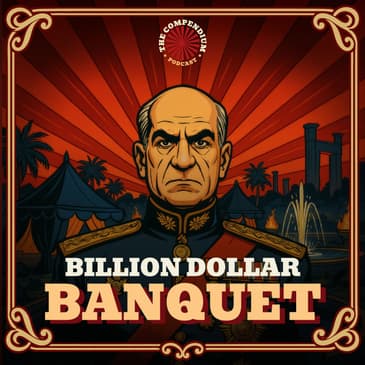
In 1971, the Shah of Iran invited royalty and political leaders into the desert for a celebration designed to link his dynasty to Cyrus the Great. What followed became one of the most enduring symbols of royal excess on the road to the Iranian Revolution.
There are extravagant parties, and then there is the Shah of Iran’s celebration at Persepolis. A purpose-built tent city appeared beside the ruins of an ancient imperial capital. Trees and turf were brought into the desert. Maxim’s de Paris supplied the banquet, while monarchs, presidents and dignitaries arrived from around the world. The official occasion was the 2,500th anniversary of the Persian monarchy, but Mohammad Reza Shah Pahlavi was also making a statement about his own rule: modern Iran, as he presented it, was the heir to one of history’s greatest empires.
We step inside the 1971 Persepolis celebration and ask how a festival intended to project strength became shorthand for a government losing touch with its own people. You may have seen it described as the “billion-dollar banquet”, although the true cost remains fiercely disputed. That uncertainty is part of the story. We look beyond the eye-watering menus and desert spectacle to the political message, the criticism surrounding it and the much larger tensions building inside Iran. The party did not single-handedly cause the 1979 Iranian Revolution, but it created an image that opponents of the Shah would never forget.
What Happened at the Shah of Iran’s Persepolis Party?
Mohammad Reza Shah Pahlavi ruled a country changing at extraordinary speed. Oil revenue was transforming Iran, while the Shah’s White Revolution promoted land reform, education, industrialisation and expanded rights for women. Supporters saw a ruler trying to turn Iran into a modern global power. Critics saw authoritarian modernisation imposed from above, accompanied by censorship, political imprisonment and the feared security service SAVAK. Elections offered little meaningful challenge to royal power, and the benefits of development were not experienced equally.
Against that background, the Shah planned a celebration that would connect the Pahlavi dynasty with the founding of the Achaemenid Empire by Cyrus the Great. The setting was Persepolis, the ancient ceremonial centre near Shiraz. In October 1971, foreign royals, heads of state and official representatives gathered there for several days of ceremonies. The symbolism was unmistakable: the Shah was not simply hosting a diplomatic event. He was placing himself inside a 2,500-year story of Iranian kingship.
The temporary encampment was designed to feel less like camping and more like a palace built from silk and canvas. European firms helped create elaborate guest tents, landscaped avenues and richly furnished reception spaces. Imported plants helped turn the arid site into a carefully managed oasis. Behind that beauty sat an enormous logistical operation involving transport, security, catering and communications. The contrast between an ancient archaeological site and this highly controlled display of modern luxury was exactly what made the event so visually powerful.
Food became one of its defining legends. Maxim’s de Paris oversaw the grand banquet, with staff, ingredients, equipment and wine brought in for an elite guest list. Accounts dwell on rare delicacies, elaborate courses and exacting service in the desert. Some details have grown in the retelling, but the essential point is clear: the meal was engineered to impress the most powerful people in the world. For the Shah, it was evidence that Iran belonged at the centre of international affairs. For his opponents, it looked like foreign luxury being staged at a distance from ordinary Iranian life.
The ceremonies extended beyond dinner. There were formal tributes to Cyrus the Great, an enormous historical military parade and events in Tehran connected with the Shahyad monument, now known as the Azadi Tower. The programme turned Iran’s past into political theatre. Soldiers appeared in costumes representing successive Persian dynasties, allowing centuries of history to march before the invited guests. It was ambitious, meticulously produced and impossible to separate from the Shah’s effort to legitimise his monarchy.
Then there is the question that still dominates searches about the Persepolis party: how much did it cost? The answer depends on which estimate, accounting method and political source you accept. The Shah’s government defended a much lower figure, while critics offered totals running into the tens or even hundreds of millions of dollars in 1971 money. Later retellings converted the highest estimates into modern values exceeding a billion dollars, helping create the “billion-dollar banquet” label. We explore those competing claims throughout our telling, because presenting the largest number as settled fact would miss how the cost itself became political ammunition.
The scale of security also mattered. The monarchy feared attacks and opposition activity, so the celebrations unfolded under an intense security operation. Reports describe preventive arrests and restrictions around the event, reinforcing the sense that the perfect imperial picture had to be protected from the country beyond it. Even if many Iranians supported modernisation or felt pride in their ancient heritage, critics could ask a devastatingly simple question: who was this celebration really for?
That question followed the Shah long after the final guest had departed. Images of chandeliers, imported catering and royal visitors offered his opponents an unusually clear symbol. A complicated argument about repression, inequality, cultural identity, foreign influence and political participation could be condensed into one scene: an elite banquet beside the ruins of Persepolis. The spectacle did not create every grievance, but it gave those grievances a memorable stage.
Why This Story Matters
The 1971 Persepolis celebration matters because political power is often judged through images as much as policies. The Shah wanted the event to show continuity, confidence and national greatness. Yet a display can communicate something very different from what its creator intends. To many critics, the tent city suggested distance rather than unity, dependence on foreign luxury rather than national self-belief, and personal grandeur rather than accountable government.
It is tempting to tell the Iranian Revolution as a neat morality tale in which one outrageously expensive party sparked an uprising eight years later. History is not that tidy. The revolution emerged from a far broader coalition and a much deeper set of pressures: autocratic rule, the suppression of opponents, religious and secular resistance, unequal development, economic disruption, anger about foreign influence and the destabilising pace of social change. The Persepolis banquet is significant not because it explains all of that, but because it concentrated so many tensions into a single unforgettable event.
We also have to be careful about whose version becomes the accepted story. Supporters pointed to the infrastructure, cultural projects and international attention associated with the anniversary. Opponents highlighted extravagance and repression. Cost estimates became part of that battle, repeated so often that disputed numbers hardened into apparent fact. Separating evidence from political mythology does not make the celebration less astonishing. It makes the episode more revealing, because we can see how public memory is built and how symbols are weaponised.
Most of all, this is a story about the danger of governing through spectacle. The Shah tried to use ancient history to secure the future of his dynasty. Instead, the celebration became part of the case against him. We take you through the astonishing details, the political calculation and the backlash without pretending that one banquet alone toppled a monarchy. Listen to the full episode for the excess, the contradictions and the chain of events that turned a desert celebration into a warning from modern history.
Topics Include
The Shah of Iran’s 1971 Persepolis celebration
The disputed cost of the “billion-dollar banquet”
Cyrus the Great and 2,500 years of Persian monarchy
Maxim’s de Paris and the luxury desert tent city
SAVAK, political repression and opposition to the Shah
How the celebration became a symbol before the Iranian Revolution
Resources and Further Reading
The Shah of Iran - Documentary narrated by Orson Welles.
Persepolis: The History and Legacy of the Ancient Persian Empire’s Capital City
Barbara Walters’ Interview with the Shah - Youtube
Decadence and Downfall In Iran: - Youtube