
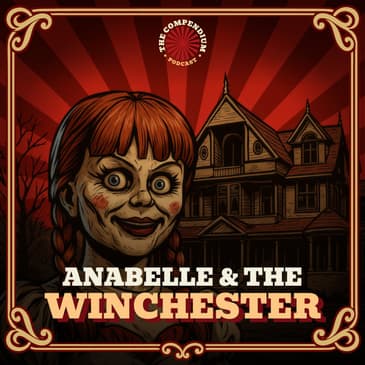
In this episode of the Compendium, Adam and Kyle bring you two tales from the world of the paranormal. Together we delve deep into the enigmatic worlds of the Annabelle Doll and the Winchester Mystery House. Adam tells us all about the mysterious doll known as Annabelle, considered the world's most haunted doll. Annabelle has baffled psychic investigators and intrigued fans of unexplained phenomena for years, the question is, Is Anabelle really haunted?
Then, Kyle takes us on a journey through the labyrinthine of corridors within the Winchester Mystery House, a California haunted house that defies all architectural logic. Built by Sarah Winchester, the mansion's twisting hallways and seemingly endless rooms serve as a testament to spiritualism and the history and lore of the Winchester family.
Whether it's the cultural impact of the Winchester Mystery House or the eerie history behind the Annabelle Doll, this episode promises to uncover the true stories that have left even skeptics questioning. Join us as we explore what makes these tales so haunting and their legacies so enduring.
Resources and Further Reading
"Annabelle" - Wikipedia
A Raggedy Ann doll kept by paranormal investigators and a sprawling San Jose mansion became two of America's most famous haunted attractions. Their legends reveal as much about storytelling and grief as they do about ghosts.
The cinematic Annabelle is a cracked porcelain nightmare, but the object displayed by the Warrens' estate is an ordinary Raggedy Ann doll with red yarn hair and a triangle nose. The Winchester Mystery House is similarly transformed by retelling: a wealthy widow's endlessly altered home became a maze supposedly designed to confuse the spirits of people killed by rifles.
Both stories begin with real objects and real people, then accumulate claims that are difficult to test. We are putting the legends beside the record, not to drain away their atmosphere, but to understand how haunting narratives grow. A doll in a glass case and a strange house can remain fascinating even when certainty is impossible.
What Happened with Annabelle and the Winchester House?
According to Ed and Lorraine Warren's account, a nursing student named Donna received the Raggedy Ann doll from her mother in 1970. Donna and her flatmate Angie reportedly noticed small changes in its position, then found it in different rooms and discovered handwritten messages. A friend named Lou said he distrusted the doll and later claimed it attacked him.
A medium allegedly told the women that the spirit of a dead child called Annabelle Higgins inhabited the doll. The flatmates responded with sympathy, but the Warrens offered a darker interpretation. They said a non-human presence was using the child's story to gain permission and influence, a claim that fitted their Catholic approach to demonology.
The Warrens removed the doll and placed it in their occult museum in Connecticut, eventually securing it inside a wooden and glass case marked with warnings. Stories circulated about visitors who mocked it and later suffered accidents. These claims are central to the legend, but they rely largely on accounts from the people promoting and preserving the object.
Hollywood changed the visual language. The Conjuring introduced a much more menacing antique-style doll, and the Annabelle films built an elaborate fictional mythology around it. The real Raggedy Ann would have been difficult to license and perhaps too familiar to frighten audiences. The redesign demonstrates how adaptation can replace the source in public memory.
Across the country, Sarah Lockwood Pardee Winchester inherited substantial wealth after the deaths of her infant daughter and husband, William Wirt Winchester. In 1886 she bought an eight-room farmhouse near San Jose. Over the following decades she expanded and remodelled it into a vast property now known as the Winchester Mystery House.
Popular legend says a medium warned Sarah that spirits killed by Winchester firearms would pursue her and that construction must never stop. Supposedly she built stairs leading nowhere, doors opening onto walls and confusing corridors to mislead ghosts. The story offers guilt, spiritualism and eccentric architecture in one memorable explanation.
Documentary evidence for that neat version is weak. Sarah was private and wealthy, but surviving correspondence shows a woman engaged with business, property and family. Constant renovation was common for someone with her resources and interests. The 1906 San Francisco earthquake damaged the house and may explain several abrupt or sealed features later interpreted as supernatural design.
The building still contains genuine oddities. Changes in floor level, narrow stairs, interior windows and unfinished spaces create a disorienting visitor experience. Some features served practical purposes, including shallow steps that may have helped Sarah move comfortably with arthritis. Others reflect decades of plans being revised by different workers.
After Sarah died in 1922, her furnishings went to relatives and the property was leased and opened to visitors. Tourism helped standardise the ghost story. Guides, newspapers and later films repeated the image of a guilt-ridden widow building through the night, because that version gave every strange corner a single dramatic cause.
Annabelle and the Winchester house therefore occupy different categories. One is a portable object whose supernatural history comes mainly from paranormal investigators. The other is a documented historic residence onto which a haunting explanation was layered. They share a cultural mechanism: uncertainty invites a story, and repetition makes the story feel like evidence.
Neither case can produce a laboratory answer about ghosts. What can be checked are ownership, dates, architecture, testimony and the commercial systems surrounding each legend. Separating those layers allows belief, scepticism and enjoyment to coexist without presenting promotional claims as established fact.
Why This Story Matters
These stories matter because objects feel more persuasive than abstract tales. Visitors can see the doll and walk through the house, so the legends acquire physical authority. Yet an object proves its own existence, not every event attributed to it. We still have to ask who recorded each claim and when it entered the narrative.
The Winchester legend also shows how eccentricity is gendered. A wealthy, independent widow who redesigned her home became easy to portray as grief-stricken and irrational. Sarah may have held spiritual beliefs, but reducing decades of building to guilt and fear can erase her agency, architectural curiosity and role as an employer.
Annabelle demonstrates the feedback loop between investigation and entertainment. The Warrens' reputation made the doll famous; films amplified it; the amplified legend made the original object more culturally valuable. That does not by itself prove or disprove paranormal claims, but it gives everyone involved an incentive to preserve mystery.
Haunted places also provide a safe language for difficult subjects. Grief, death, guilt, domestic space and inherited violence become ghosts that can be toured and discussed. The stories last because they organise emotions as effectively as they organise facts, even when those two jobs pull in different directions.
Listen for Donna and Angie, the Warrens' interpretation, the Hollywood redesign, Sarah Winchester's losses and the earthquake-damaged mansion. Whether or not we believe in spirits, the journey shows exactly how a private object and a private home became public machines for producing wonder.
Topics Include
Donna, Angie and the original Raggedy Ann doll
Ed and Lorraine Warren's demonic interpretation
How The Conjuring films redesigned Annabelle
Sarah Winchester's family losses and fortune
The expansion and earthquake damage of the San Jose mansion
How tourism turned architectural oddities into a ghost legend
Resources and Further Reading
"Annabelle" - Wikipedia
"Winchester Mystery House” - Wikiepdia
"The Winchester Mystery House" - Official Website
“Meet the Real Haunded Doll Behind Annabelle”- allthatsinteresting.com
“Pictures of the Winchester Mystery House” - The Compendium Podcast Offical Show Notes
Host & Show Info
Hosts: Kyle Risi & Adam Cox
Intro Music: Alice in dark Wonderland
Community & Calls to Action
Review & follow on: Spotify & Apple Podcasts
Instagram: @theCompendiumPodcast
Website: thecompendiumpodcast.com
Support us: Sign up to Patreon