
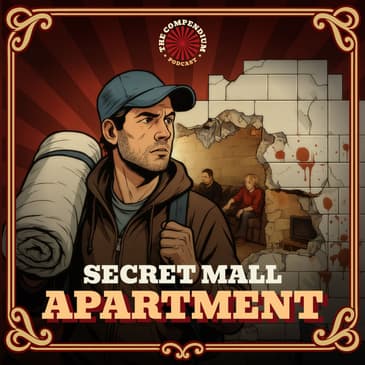
Eight artists discovered an unused void inside Providence Place Mall and turned it into a hidden apartment. What began as a seven-day experiment became four years of sofas, art, PlayStation sessions and living secretly behind the walls.
Most of us have imagined what it would be like to be locked inside a shopping centre after closing time. Michael Townsend and seven friends went several enormous steps further: they found a room no one seemed to know existed, furnished it and quietly treated it as a second home. The result sounds like a prank, but the secret mall apartment was also a piece of performance art shaped by eviction, gentrification and a very literal question about who gets to occupy a city.
We love this story because it keeps changing shape. It begins with painters’ tape and a community of Providence artists, becomes an urban exploration caper, then ends as an unexpectedly thoughtful argument about commercial space. Nearly two decades later, Jeremy Workman’s documentary Secret Mall Apartment brought the group’s footage and memories to cinemas, including the cinema inside the very mall that had banned Townsend.
What Happened Inside the Secret Mall Apartment?
Michael Townsend moved to Rhode Island in 1989 to study at the Rhode Island School of Design. On his first night there, he began experimenting with tape as a drawing material. That simple idea became the centre of his practice. Working with other people, he created enormous temporary murals from coloured tape, sometimes stretching across entire buildings. The process mattered as much as the finished work: strangers collaborated, built something together and eventually tore it down.
Townsend became part of the creative community around Olneyville, a former industrial neighbourhood filled with old mills, cheap studios and unconventional venues. One of those venues was Fort Thunder, an artist-run warehouse space that became home to music, exhibitions and communal living. As Providence redeveloped, however, the neighbourhood’s inexpensive buildings attracted commercial interest. Fort Thunder was demolished, and its former site became a car park.
At the same time, Providence Place Mall had risen nearby as a vast symbol of the new city. The enormous building had to fit around roads, rivers and an awkward site. While watching it under construction, Townsend noticed strange gaps between the planned rooms, what he later called “nowhere spaces”. When a radio advert joked that the mall contained everything anyone needed to live, Townsend and his friends began wondering whether a person genuinely could.
The original idea was a seven-day experiment. Participants would eat in the food court, use the gym showers, visit public toilets and buy whatever they needed from shops inside the mall. The hardest question was where to sleep. Remembering those accidental spaces, Townsend and Adriana Valdez Young searched the building’s exterior and found a narrow opening near the car park and cinema. Beyond it was a network of unfinished passages and a large, roughly L-shaped room hidden inside the structure.
Townsend, Valdez Young and six friends formed a group known as Trummerkind and changed the plan. Rather than remain for one week, they would use the space for as long as possible. Members stayed according to a rota, carried construction debris out in backpacks and brought supplies back a little at a time. They agreed that most furnishings should come from the mall itself, keeping the project inside what they called the mall ecosystem.
At first the apartment was basic: lamps, a heater, extension cables and a mattress resting on blocks. As months passed without discovery, caution gave way to confidence. The group built walls and a locking door. They added a dining table, cabinets, a television, a PlayStation, rugs, plants, artwork and a four-piece sofa set. The approximately 750-square-foot space had electricity but no running water, so every toilet trip still required a presentable walk into the mall.
Moving furniture through a shopping centre was surprisingly easy. In a building that sold mattresses and sofas, people carrying those objects did not automatically look suspicious. The group avoided noisy work at night, dressed like ordinary shoppers and tried not to draw attention to the access point. Their hidden home sat in the bones of a busy commercial complex, concealed partly because everyone assumed the mall’s architecture made sense.
The experiment lasted from 2003 until 2007. Its end began when security guards discovered the door, entered the apartment and removed objects that might identify its residents. Thinking someone had burgled them, the artists tightened their rules. Townsend later broke one of those rules by showing the space to a visiting friend. Mall staff were waiting, and Townsend greeted them with a raised pair of hands and a cheerful “Surprise!”
Police arrested Townsend for trespassing. Mall management reportedly wanted broader charges, but there was no convincing evidence of theft or serious damage. The outcome was minor compared with the audacity of the project, although Townsend received a lifetime ban from Providence Place. The group lost its extraordinary home, and the mall sealed off the space.
Once the story became public, people often treated it as a brilliant stunt. Townsend and Valdez Young appeared in the press, while other participants initially remained anonymous. Yet the artists saw the apartment as more than a joke. Their community had been displaced for redevelopment, then they quietly reclaimed a forgotten piece of the development that had helped change the neighbourhood. They were not rejecting the mall from outside; they were living within it and testing its promise that every human need could be bought there.
Director Jeremy Workman met Townsend while filming another project and understood that deeper theme. The resulting documentary uses the group’s own recordings to show both the practical adventure and the friendships behind it. After premiering at the 2024 SXSW Film Festival, the film opened theatrically in 2025. Providence Place welcomed Townsend back, lifted his long ban and allowed him to revisit the remains of the hidden space. A story that began as covert occupation ended with a public homecoming.
Why This Story Matters
The secret mall apartment is delightful because it exposes a gap between ownership and use. The room belonged to a private development, but it had no intended purpose and might have remained empty forever. The artists gave it one. That did not grant them a legal right to live there, but it makes the ethical question more interesting than a straightforward tale of trespassing.
It is also a story about gentrification told through physical space. Fort Thunder was messy, collaborative and culturally productive, yet the forces reshaping Providence treated its building as land for redevelopment. The mall represented the polished city replacing that informal creative world. By establishing a home inside its unused architecture, Trummerkind created a funny, peaceful act of resistance.
We’re fascinated by how the group hid in plain sight. Shopping centres are designed to manage crowds, money and movement, but their scale creates blind spots. The artists succeeded not through sophisticated technology but by understanding expectations. A person carrying a sofa in a mall looks ordinary. A locked door in a service corridor looks official. Sometimes the best hiding place is inside the story everyone already tells themselves about a building.
Finally, the documentary reframes the people behind the viral premise. Townsend’s wider art is collaborative, temporary and rooted in community, and the apartment followed the same logic. It mattered because eight friends made it together, documented it and allowed it to disappear. The sealed room is gone, but the questions it raised about home, consumption and belonging are still very much alive.
Topics Include
Michael Townsend, tape art and the Trummerkind collective
Fort Thunder, redevelopment and gentrification in Providence
The discovery of a hidden void inside Providence Place Mall
Four years of furniture, electricity and life behind the walls
The 2007 discovery and Jeremy Workman’s documentary
Resources and Further Reading
Secret Mall Apartment (2024) - by Jeremy Workman
Trummerkind - Micheal Townsend Blog