
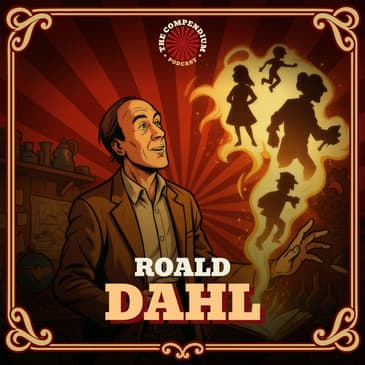
Before Roald Dahl created Matilda, Willy Wonka and the BFG, he survived a wartime plane crash, flew combat missions and entered the secretive world of British intelligence. His extraordinary life helps explain both the darkness of his stories and the contradictions of the man behind them.
Roald Dahl is remembered as one of the most inventive children’s authors of the twentieth century. His books speak directly to young readers, turn cruel adults into grotesque villains and give apparently powerless children the chance to fight back. He created words that sounded meaningful before anyone had defined them, filled ordinary rooms with danger and made chocolate factories, giant peaches and friendly giants feel close enough to enter.
Yet the life behind those stories was stranger, harsher and more complicated than the familiar author photograph suggests. Dahl was a Welsh-born son of Norwegian parents, a schoolboy who hated institutional cruelty, an RAF fighter pilot, a wartime writer and a man connected to British intelligence work in Washington. He also experienced devastating family loss, helped develop a medical device and left behind antisemitic statements that remain impossible to excuse. We are looking at how those experiences shaped the imagination that produced Charlie and the Chocolate Factory, Matilda, The BFG and so many other classics.
What Happened in Roald Dahl’s Life?
Roald Dahl was born in Llandaff, near Cardiff, in 1916 to Norwegian parents. His early childhood was marked by loss. His sister Astri died from appendicitis when she was seven, and his father died only weeks later. Dahl’s mother remained in Britain because her husband had wanted their children to receive an English education, a decision that placed Roald inside the boarding-school system he would later describe with anger and vivid detail.
At school, Dahl encountered caning, rigid authority and adults who appeared to enjoy frightening children. One youthful prank involved placing a dead mouse in a sweet jar belonging to a shopkeeper he disliked. At Repton, he watched punishments that made him question both the school’s morality and its religion. Those experiences later surfaced in stories where children immediately recognise that respectable adults can be ridiculous, hypocritical or dangerous. Miss Trunchbull in Matilda and the child-hating antagonists of The Witches feel exaggerated, but their emotional logic came from Dahl’s own memories of power.
Repton supplied a happier seed as well. Cadbury occasionally sent pupils boxes of experimental chocolates and asked for their opinions. Dahl imagined himself inventing a bar that would impress the company. Decades later, the private testing rooms, secret recipes and competitive world of chocolate manufacturing helped inspire Charlie and the Chocolate Factory.
Dahl did not leave school expecting to become an author. He wanted travel and adventure, so he joined Shell and worked in East Africa. When the Second World War began, he enlisted in the Royal Air Force and trained as a pilot. At six feet six inches tall, he was an awkward fit in a small cockpit, but he was sent to fly Gloster Gladiators in North Africa.
In September 1940, inaccurate directions sent him towards the wrong landing area in the desert. Running low on fuel as night approached, Dahl attempted an emergency landing. His aircraft struck the ground and caught fire. He escaped with serious injuries, including a fractured skull and temporary loss of sight. After recovering, he returned to flying and took part in combat over Greece, including the fierce Battle of Athens in April 1941. Lasting headaches and blackouts eventually ended his operational career.
The crash redirected Dahl’s life. Posted to Washington as an assistant air attaché, he met the novelist C. S. Forester, who asked him for notes about his experience in the desert. Dahl produced such a strong account that Forester submitted it with little alteration. Published under the dramatic title “Shot Down Over Libya”, despite the fact that enemy fire had not caused the crash, the piece introduced Dahl as a writer.
Washington also placed him among politicians, publishers and wealthy socialites at a moment when Britain needed American support. Dahl supplied information to British Security Coordination, the covert organisation led by William Stephenson. Later accounts turned this work into a glamorous tale of seduction and spying, and some claims are difficult to separate from Dahl’s own appetite for a good story. What is clear is that his charm, access and friendships made him useful in a campaign designed to understand and influence powerful Americans.
His wartime worlds overlapped with future popular culture in remarkable ways. Dahl knew Ian Fleming, who would create James Bond, and later wrote the screenplay for the Bond film You Only Live Twice. He also wrote Chitty Chitty Bang Bang for the screen. His first children’s book, The Gremlins, grew from RAF folklore about mischievous creatures blamed for mechanical problems. Walt Disney considered adapting it, although the planned film never appeared.
Dahl’s most famous children’s writing arrived later. James and the Giant Peach, Charlie and the Chocolate Factory, Fantastic Mr Fox, The Twits, The BFG, The Witches and Matilda established a world in which language could be elastic and children could outwit monstrous adults. Illustrator Quentin Blake began working with Dahl in the late 1970s, and his energetic drawings became inseparable from the way many readers imagine the stories.
Family tragedy shaped Dahl beyond fiction. In 1960, a taxi struck the pram carrying his infant son Theo, causing severe brain injuries and hydrocephalus. Dahl worked with hydraulic engineer Stanley Wade and neurosurgeon Kenneth Till on a more reliable shunt valve to drain fluid from the brain. The Wade-Dahl-Till valve was used to help thousands of children, and the three men did not take royalties from it.
Two years later, Dahl’s seven-year-old daughter Olivia died after measles caused encephalitis. Her death devastated him. He later became a forceful advocate for vaccination and dedicated The BFG to her. These experiences reveal a man capable of practical compassion and enduring grief, but they do not erase the uglier parts of his record.
Dahl made openly antisemitic remarks, including broad claims about Jewish people that went far beyond criticism of the Israeli government. His family and the Roald Dahl Story Company later apologised for the lasting hurt caused by those statements. His fiction has also been criticised for stereotypes and demeaning descriptions connected to race, appearance, disability and gender. Those criticisms became central to a 2023 dispute after new editions altered hundreds of words and passages. Following a backlash, the publisher announced that unaltered “classic” versions would remain available alongside revised editions.
Roald Dahl died in 1990 at the age of 74. By then, his books had created a vocabulary and a moral universe recognised around the world. The fascination lies partly in the distance between that work and its author: a champion of bullied children who could himself be cruel, a storyteller of wild invention whose most improbable material often came from his own life.
Why This Story Matters
Dahl’s life matters because it changes how we read his stories without reducing them to autobiography. Boarding-school brutality helps explain why his children mistrust institutions. The Cadbury samples illuminate Willy Wonka’s factory. RAF folklore leads towards the gremlins, while danger, injury and sudden reversals echo through plots in which safety can disappear in a sentence. His imagination did not grow in isolation; it transformed lived fear, anger and curiosity into stories that gave young readers power.
His use of language is equally important. Dahl trusted children to infer meaning from rhythm, sound and context. Words such as “scrumdiddlyumptious” are funny because they behave like language even before they enter a dictionary. That confidence invites children to become collaborators rather than passive readers. They are allowed to enjoy the forbidden, recognise adult absurdity and understand a joke that the grown-ups may miss.
The medical work complicates the familiar portrait of the solitary author. Faced with his son’s injury, Dahl used persistence, contacts and practical curiosity to help create something other families could use. His advocacy after Olivia’s death also demonstrates how private grief can become public action. These achievements deserve to be remembered alongside the books.
At the same time, admiration cannot require denial. Dahl’s antisemitism was not an invented modern controversy; it came from his own published and recorded words. Acknowledging it does not dictate a single response to his fiction, but it prevents affection for the work from becoming an excuse to minimise harm. The debate over edited editions raises a separate question: should publishers change a dead author’s language, provide context, preserve the original, or offer readers both? The answer affects far more than Dahl.
We keep returning to Roald Dahl because his legacy refuses to become simple. His stories have helped generations of children name cruelty and imagine resistance. His life contains courage, creativity and generosity, but also prejudice and self-mythologising. Holding those facts together is not an attack on literature. It is a more honest way to understand how extraordinary work can come from a deeply imperfect person.
Topics Include
Roald Dahl’s Norwegian family, Welsh childhood and boarding-school experiences
The RAF crash and combat flying that redirected his life
His wartime writing, Washington contacts and British intelligence work
The origins of Willy Wonka, the Gremlins and Dahl’s invented language
The Wade-Dahl-Till valve, Olivia’s death and his vaccination advocacy
Dahl’s antisemitism and the controversy over revised editions of his books
Resources and Further Reading
"Boy: Tales of Childhood" Autobiograph by Roald Dahl
"Going Solo" by Roald Dahl - Dahl's experiences in Africa and in the RAF
"Roald Dahl's Marvellous Medicine" by Tom Solomon
"The Irregulars: Roald Dahl and the British Spy Ring in Wartime Washington" by Jennet Conant
"Storyteller: The Authorized Biography of Roald Dahl" by Donald Sturrock