
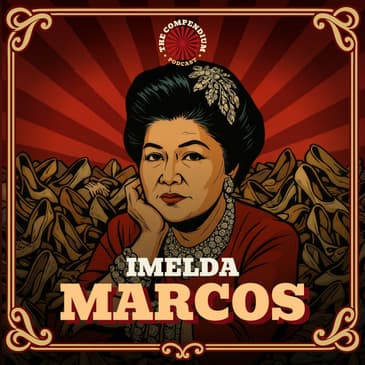
Imelda Marcos became famous for thousands of shoes, extravagant shopping and the glamour of the “Iron Butterfly”. Behind that image was the Marcos dictatorship: stolen public wealth, martial law, political repression and a family dynasty that returned to power decades after the People Power Revolution forced it into exile.
The shoes are irresistible. They are visual, excessive and almost too perfect as a symbol of political greed. Yet reducing Imelda Marcos to a collection of footwear can make the real story easier to ignore. The former First Lady of the Philippines was not merely a dictator’s glamorous wife with expensive taste. She was a political operator, diplomat, governor, minister and central figure in a regime associated with corruption and widespread human-rights abuses.
We look beyond the wardrobe to examine how Imelda and Ferdinand Marcos built power, presented themselves as national royalty and transformed public money into an international property, jewellery and art empire. We also follow the story beyond their flight from Manila, because exile was not the ending. The family returned, rebuilt its political influence and helped reshape public memory of the dictatorship.
What Happened During Imelda Marcos’s Rise to Power?
Imelda Romualdez was born in 1929 into a prominent family whose fortunes had declined. After her mother’s death, she grew up in Leyte before returning to Manila as a young woman. Her height, beauty and confidence helped her enter pageants, and the publicity surrounding the title of Miss Manila made her a recognisable figure in the capital’s social and political world.
In 1954, she met the ambitious congressman Ferdinand Marcos. Their courtship was extraordinarily brief, and they married within weeks. Imelda quickly became valuable to his career. She campaigned, hosted political gatherings, charmed voters and performed the emotional labour that made Ferdinand appear accessible. When he won the presidency in 1965, she became First Lady and gained a global platform of her own.
Imelda cultivated a style of diplomacy based on spectacle and personal charm. She met presidents, monarchs and authoritarian leaders, presenting herself as the elegant face of the Philippines. Her international travel also fed a taste for luxury. Stories of huge shopping trips, priceless art and impulsive property purchases became part of her legend, but the spending was inseparable from political power and access to state resources.
Ferdinand’s first presidential term was followed by growing debt, unrest and opposition. In September 1972, he placed the Philippines under martial law. The government closed or controlled media organisations, arrested political opponents and concentrated authority around the Marcos family and its allies. Ferdinand presented this as protection against disorder and communism; survivors and historical records describe detention, torture, disappearances and killings.
Imelda’s influence expanded during this authoritarian period. She served as governor of Metropolitan Manila and as minister of human settlements, controlled substantial budgets and promoted grand construction projects. Cultural centres, hospitals and venues were supposed to display a modern, sophisticated nation. Critics called the approach an “edifice complex”: monumental buildings erected while many Filipinos remained in poverty.
The couple’s wealth grew far beyond what their official income could explain. Investigators later traced property, companies, artworks, jewellery and money held through overseas accounts and foundations. Estimates of the fortune allegedly accumulated by the Marcos family run into billions of dollars. Recovering it has required decades of litigation, and a large portion remains disputed or missing.
Imelda’s private consumption became the regime’s most visible symbol. When the family fled Malacañang Palace in 1986, people found gowns, handbags, jewellery and rows upon rows of shoes. Accounts vary over the exact size of the collection. More than a thousand pairs were documented at the palace, while later retellings pushed the number towards 3,000 or even 6,000. The uncertainty hardly weakens the image: even the lowest credible figure represented astonishing abundance in a country carrying enormous debt.
There were stranger projects too. On Calauit Island, residents were displaced to create a wildlife reserve stocked with animals brought from Africa. The safari park projected wealth and international ambition while raising questions about land, conservation and the people forced to make way for Imelda’s vision. It is one of many details that makes her life sound satirical until the consequences come into focus.
The assassination of opposition leader Benigno “Ninoy” Aquino Jr in 1983 intensified resistance to the regime. His widow, Corazon Aquino, became the principal challenger to Ferdinand in the 1986 election. The vote was marred by allegations of fraud and intimidation. When senior military figures broke with Marcos, millions of Filipinos gathered along Epifanio de los Santos Avenue in the movement now known as the People Power Revolution.
Ferdinand and Imelda left the Philippines for Hawaii in February 1986. Crowds entered the palace, and the possessions they discovered gave ordinary people a physical measure of the family’s excess. Ferdinand died in exile in 1989. Imelda returned to the Philippines in 1991, faced numerous criminal and civil proceedings, and re-entered politics rather than disappearing from public life.
Her legal history is long and complicated. A US racketeering trial ended in acquittal. In the Philippines, some cases failed while others produced adverse rulings or asset recoveries. In 2018, the Sandiganbayan anti-graft court convicted her on seven counts involving Swiss foundations. In 2026, the Philippine Supreme Court reversed that conviction, illustrating how even decades later the legal story remains active and contested.
The political return was even more consequential. Imelda won a seat in Congress, while her children Imee and Ferdinand “Bongbong” Marcos Jr built careers of their own. In 2022, Bongbong became president of the Philippines. A family driven from the palace by a democratic uprising had returned to its highest office, assisted by nostalgia, campaigning and online narratives that softened or denied the record of martial law.
Why This Story Matters
Imelda Marcos matters because image can overpower memory. Shoes are easier to discuss than torture, kleptocracy or the slow capture of democratic institutions. Her extravagance can seem camp, funny and strangely charismatic, allowing the spectacle to obscure the people who paid for it. The most useful question is not how anyone could own so many pairs, but why the collection became more memorable than the system that made it possible.
The story also demonstrates that removing an authoritarian leader does not automatically dismantle a dynasty. Wealth, name recognition and control of historical narratives can survive exile. The Marcos family’s return shows how quickly documented abuses can be reframed as a lost golden age when later governments disappoint and social media rewards emotionally satisfying versions of the past.
We approach Imelda as both a remarkable personality and an active participant in political power. Listen to our full discussion for the beauty-pageant beginnings, diplomatic gatecrashing, infamous shopping trips, the palace discoveries and the extraordinary route from revolution and exile to a Marcos restoration.
Topics Include
Imelda Marcos’s beauty-pageant beginnings and marriage
Ferdinand Marcos, martial law and political repression
The Marcos family’s hidden wealth and international assets
The truth behind Imelda Marcos’s shoe collection
The 1986 People Power Revolution and exile
How the Marcos dynasty returned to political power
Resources and Further Reading
"Imelda Marcos: The Rise and Fall of One of the World's Most Powerful Women" by Carmen Navarro Pedrosa
"The Kingmaker" (2019) directed by Lauren Greenfield
“Ruby Wax Meets Imelda Macros” - Documentry by Ruby Wax